

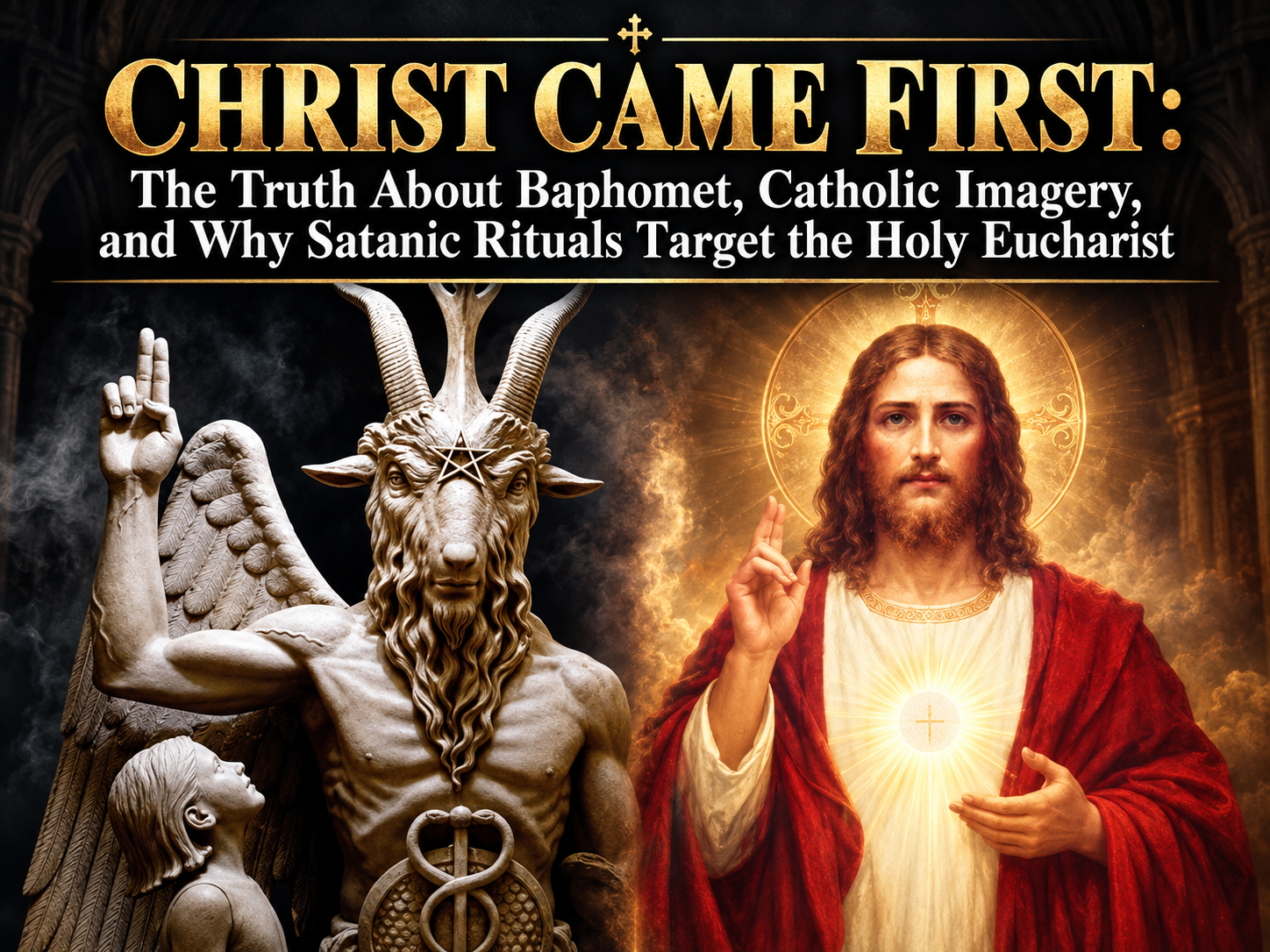
How a 19th-century occult symbol became ammunition against Catholicism—and why the Real Presence of Jesus Christ remains at the center of the spiritual battle.
By Catholicg33k
The Accusation: Is the Catholic Jesus Really Baphomet?
A disturbing image circulating across social media places traditional Catholic artwork of Jesus Christ beside a statue of Baphomet, the goat-headed figure associated with modern Satanic symbolism.
The accusation? That Catholics deliberately portray Jesus making the same hand gesture as Satan, supposedly proving that Catholicism worships a counterfeit Christ.
But there is one enormous problem with this argument.
History tells precisely the opposite story.
Christian iconography depicting Christ with His hand raised in blessing existed more than a thousand years before the famous occult illustration of Baphomet.
And when we investigate the history of Baphomet, the meaning of Christian gestures, and the deliberate mockery of the Catholic Mass in certain occult rituals, we discover something far more significant than a superficial resemblance between two images.
We discover the difference between authentic Christian worship and its deliberate distortion.
1. The Christian Blessing Predates Modern Baphomet by Over 1,000 Years
One of the oldest surviving Christian images of Jesus is the famous sixth-century icon of Christ Pantocrator, preserved at St. Catherine’s Monastery on Mount Sinai.
Dating to approximately AD 500–550, this ancient image depicts Christ holding the Gospels in His left hand while raising His right hand in a gesture associated with teaching and blessing.
This image existed long before modern Satanism.
In Christian iconographic traditions, raised fingers can symbolize Christ’s two natures—fully God and fully man. Other forms of the blessing gesture express the Holy Trinity or form the Greek Christogram IC XC, an abbreviation of the name Jesus Christ.
These are expressions of Christian theology, not occult worship.
The foundation is the Incarnation:
“And the Word was made flesh, and dwelt among us.” (John 1:14, Douay-Rheims)
Jesus is not an abstract spiritual force. He is God the Son made man.
The Christian blessing does not derive its meaning from Baphomet. Its meaning comes from Christ.
2. The Real History of Baphomet: From the Medieval Period to Modern Occultism
AD 1098–1307: The Medieval Name and the Knights Templar
Contrary to popular belief, the name Baphomet did not originate with modern Satanism.
Forms of the name appear in medieval European writings, including sources connected with the Crusades. Historians commonly associate the word with medieval variations of Mahomet, a European rendering of Muhammad.
By AD 1307, the name had become associated with accusations against the Knights Templar.
King Philip IV of France ordered the mass arrest of Templars, who faced charges including heresy, blasphemy, and the alleged worship of a mysterious idol.
Many confessions were obtained under torture. Descriptions of the supposed idol varied dramatically, and the accusations do not establish that the Templars worshipped the goat-headed figure familiar today.
The allegations were closely tied to royal political interests and the subsequent ecclesiastical proceedings that ended in the order’s suppression.
The medieval accusations must not be confused with proof that the modern image of Baphomet existed in the 14th century.
AD 1854–1856: Éliphas Lévi Creates the Famous Goat-Headed Image
The recognizable Baphomet of modern popular culture emerged through French occultist Éliphas Lévi.
In Dogme et Rituel de la Haute Magie, published in two volumes between 1854 and 1856, Lévi presented the famous figure known as the Sabbatic Goat.
His illustration depicts a winged, goat-headed figure with a pentagram on its forehead, one arm pointing upward and another downward.
Lévi explained the gestures through Hermetic and esoteric symbolism, involving the correspondence and balance of opposing forces.
The figure incorporated an assortment of occult, alchemical, and mythological motifs.
Importantly, Lévi did not originally present this figure simply as a portrait of Satan. Its later association with Satanism developed through subsequent occult movements.
There is also no compelling historical evidence that Lévi deliberately copied a specific Catholic icon of Jesus to create the hand gesture.
Nevertheless, the historical chronology is decisive:
The traditional Christian blessing predates Lévi’s Baphomet by approximately thirteen centuries.
A modern resemblance cannot establish that ancient Christian artwork was copied from a much later occult image.
AD 1966: Anton LaVey and the Church of Satan
In 1966, Anton Szandor LaVey established the Church of Satan.
The organization adopted and popularized the Sigil of Baphomet, featuring a goat’s head enclosed within an inverted pentagram.
This emblem developed through earlier occult artwork and was not identical to Lévi’s original full-bodied illustration.
It eventually became one of the most recognizable symbols associated with modern Satanism.
AD 2015: The Satanic Temple’s Baphomet Statue
In July 2015, The Satanic Temple unveiled a prominent Baphomet statue in Detroit.
The organization employs Satanic imagery largely as a symbol of rebellion against religious authority and as an expression of its secular political and philosophical commitments.
The Satanic Temple generally rejects belief in a literal Satan.
This distinction matters. Not every person or organization employing Baphomet imagery practices devil worship, and different Satanic movements hold substantially different beliefs.
From a Catholic theological perspective, however, the adoption of Satanic symbolism remains deeply objectionable when it glorifies rebellion against God or ridicules what Christians hold sacred.
3. Why Are Catholic Images Accused of Being Idols?
One of the most common accusations against Catholics is that displaying images of Jesus or Mary violates God’s commandments.
But Scripture itself distinguishes between idolatry and the legitimate use of religious images.
In Exodus 25:18–20, God commands Moses to construct two golden cherubim over the Ark of the Covenant.
In Numbers 21:8–9, God commands the making of a bronze serpent, through which the Israelites would receive healing when they obeyed His instruction.
The problem was never the mere existence of a religious image. The sin was treating a created object as a god.
When the bronze serpent later became an object of idolatrous worship, King Ezechias destroyed it (4 Kings 18:4).
The Catholic Church teaches precisely this distinction.
At the Second Council of Nicaea in AD 787, the Church defended the legitimate veneration of sacred images while maintaining that adoration belongs to God alone.
The Catechism of the Catholic Church, paragraphs 2131–2132, explains that the honor given to a sacred image is directed toward the person represented, not the wood, stone, paint, or metal itself.
A picture of Jesus is not another Jesus.
A statue of Mary is not another goddess.
And no Catholic doctrine permits the worship of Mary as God. She receives special honor because she is the Mother of God, while divine worship belongs to the Holy Trinity alone (CCC 971).
4. The More Serious Question: Why Do Some Occult Rituals Target the Catholic Eucharist?
Here we reach the heart of the matter.
Throughout the history of anti-Christian ritual practices, certain forms of the so-called black Mass have deliberately parodied the Catholic Mass.
Some have included attempted desecration of a consecrated Host.
That is especially significant because Catholicism does not teach that Holy Communion is merely a religious symbol.
The Catholic Church teaches that the Eucharist truly is the Body, Blood, Soul, and Divinity of Jesus Christ.
Jesus declared:
“For my flesh is meat indeed: and my blood is drink indeed.” (John 6:56, Douay-Rheims)
At the Last Supper, He proclaimed:
“This is my body, which is given for you.” (Luke 22:19)
The Church has never understood these words as empty symbolism.
Around AD 107, St. Ignatius of Antioch condemned those who refused to confess that the Eucharist is the flesh of Jesus Christ (Letter to the Smyrnaeans, 7).
Around AD 155, St. Justin Martyr likewise explained that Christians do not receive the Eucharist as ordinary bread and ordinary drink (First Apology, 66).
Centuries before Protestantism, the Church was proclaiming the extraordinary reality of Christ’s Eucharistic presence.
The Catechism expresses this ancient faith in paragraph 1374.
A documented example: Oklahoma City, 2014
This is not merely a theological abstraction.
In August 2014, Archbishop Paul Coakley of Oklahoma City pursued legal action over a consecrated Host that organizers of a planned Satanic black Mass had obtained.
The Host was subsequently returned to a Catholic priest, and the archbishop dismissed the lawsuit after receiving assurances that the organizers no longer possessed a consecrated Host and would not use one in their rituals.
The incident illustrates why Catholics take Eucharistic sacrilege seriously.
Why seek a consecrated Catholic Host for a ritual intended to profane the sacred? Why not simply use ordinary bread?
The very structure of such a ritual demonstrates that the Catholic Eucharist is the specific object being mocked.
To be historically and intellectually precise, this does not prove that every Satanist personally believes in the Real Presence. Some are non-theists whose purpose is symbolic protest or deliberate offense.
Nor is Catholicism the only Christian tradition that professes Christ’s real presence in the Eucharist. Eastern Orthodox Christians do as well, and Protestant Eucharistic beliefs vary.
Nevertheless, the intentional desecration of a Catholic Host is an attack upon something Catholics recognize as supremely holy.
The attacker may deny the truth of the Eucharist, but the attack is directed precisely at the Church’s claim that Christ Himself is present.
5. Even the Devils Believe—and Tremble
Sacred Scripture teaches us something extraordinary about the difference between recognizing divine truth and loving God.
“Thou believest that there is one God. Thou dost well: the devils also believe and tremble.” (James 2:19)
The demons recognize truths about God, but they do not respond with obedience or love.
In Mark 1:24, an unclean spirit recognizes Jesus as the Holy One of God.
This provides a profound theological insight.
Knowing who Christ is and submitting to Christ are two very different things.
Catholic theology understands Satan as the adversary of God, not as an equal divine power.
The devil cannot create another Incarnation, another Redemption, or another Christ.
He can only tempt, deceive, counterfeit, and seek to corrupt what God has made good.
This is why the deliberate parody of the Mass is so spiritually serious.
The Holy Sacrifice of the Mass makes sacramentally present the one sacrifice of Christ. A black Mass, by contrast, is constructed to ridicule or profane what Christians hold sacred.
One is ordered toward worship of God.
The other, when deliberately blasphemous, is ordered toward rejection or mockery of that worship.
The difference is not merely artistic or cultural.
It is spiritual.
6. Another Profound Inversion: “My Body, My Choice” Versus “My Body Given for You”
There is another contrast worth contemplating.
Modern abortion-rights rhetoric frequently employs the slogan:
“My body, my choice.”
At the Last Supper, Jesus declares:
“This is my body, which is given for you.” (Luke 22:19)
These expressions arise from different contexts, and their verbal contrast is not, by itself, a complete moral argument about abortion.
Nevertheless, the contrast illustrates something central to Catholic moral teaching.
Christ reveals the meaning of love through the free gift of Himself.
Rather than treating personal freedom as absolute independence from others, the Christian understanding of freedom reaches its perfection in truth, charity, and self-giving.
As Catholics, we recognize that human life is a sacred gift, including the life of the unborn (CCC 2270–2275).
Christ’s sacrifice reveals that the body is not meaningless matter. It is capable of expressing love, sacrifice, and communion.
The world often describes freedom primarily in terms of personal autonomy.
Christ reveals the higher freedom of self-giving love.
And the Eucharist is the supreme sacramental expression of that love.
7. Satan Does Not Get to Redefine Jesus Christ
When someone places a Catholic picture of Jesus beside Baphomet and declares that Christ is secretly Satan, the accusation collapses under historical examination.
The Christian blessing predates the modern occult illustration by centuries.
Christian artwork expresses theological beliefs about the Incarnation, Christ’s authority, and His blessing.
Baphomet’s modern symbolism emerged through a separate historical development involving medieval allegations, 19th-century occultism, and 20th-century Satanic organizations.
Superficial resemblance is not historical proof.
And there is a much greater Catholic truth at stake.
The Eucharist is not a stage prop.
It is not simply a symbol of belonging.
It is not ordinary bread after valid consecration.
It is Jesus Christ Himself, truly, really, and substantially present.
This is why Eucharistic desecration is gravely offensive, regardless of whether the perpetrator accepts the Church’s teaching (CCC 2120).
And it is why the Catholic response to sacrilege must ultimately be rooted not in fear or hatred, but in reverence, prayer, reparation, and unwavering fidelity to Christ.
When Anti-Catholic Ignorance Masquerades as Biblical Discernment
The following social media post illustrates just how far anti-Catholic misinformation can go.
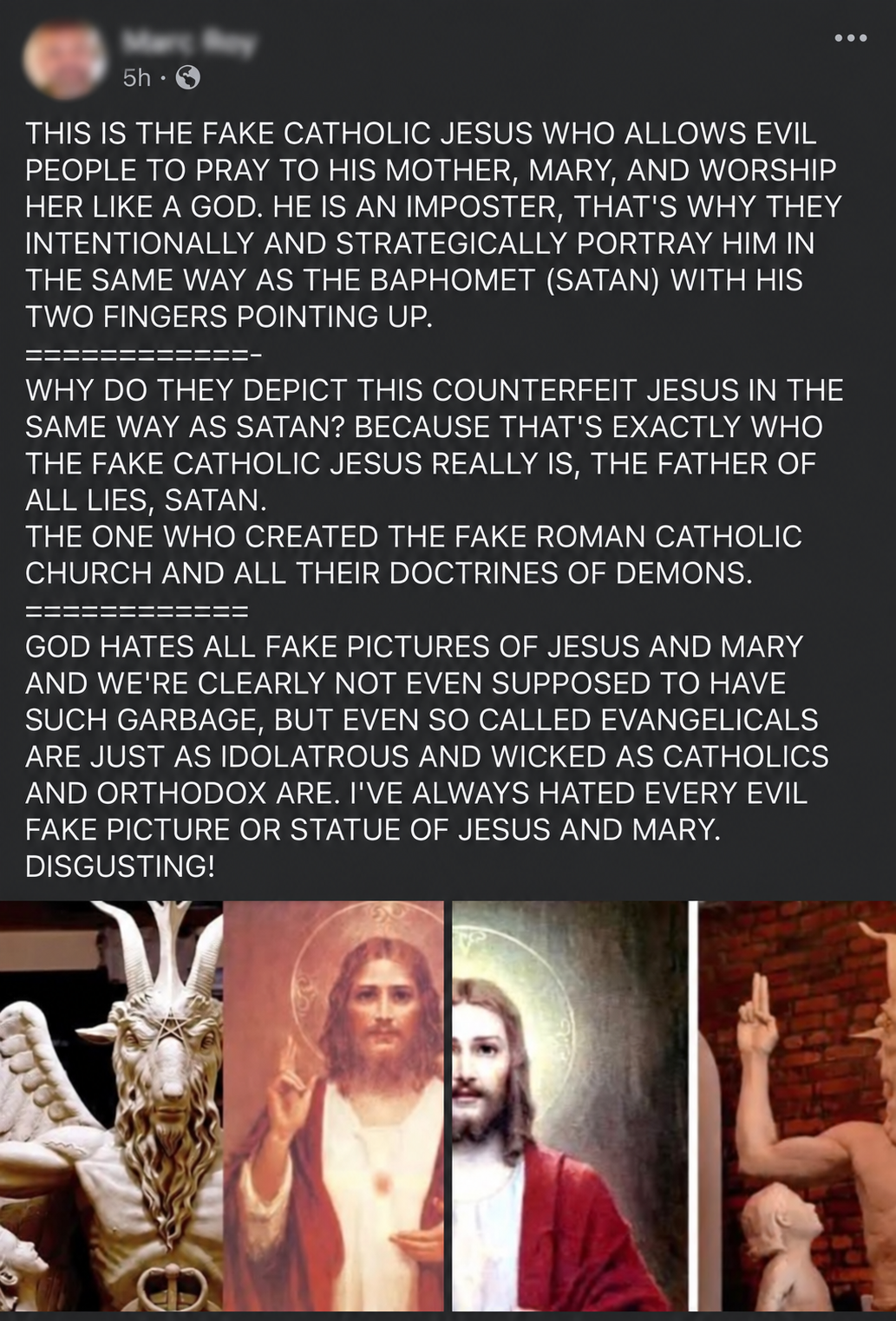
Above: An example of anti-Catholic misinformation circulating on social media, falsely equating traditional Christian images of Jesus Christ with Baphomet.
Look carefully at what is being claimed.
The author doesn’t simply question the Catholic use of religious images. He goes so far as to accuse Catholics of worshipping Satan, declares the Catholic Jesus to be an impostor, and describes traditional depictions of Christ as demonic.
And his evidence?
Two raised fingers.
Apparently, more than 1,300 years of Christian iconography can be dismissed because a 19th-century occult illustration contains a superficially similar hand gesture.
Never mind that ancient Christian depictions of Christ blessing the faithful predate Éliphas Lévi’s Baphomet.
Never mind that the Catholic Church explicitly condemns idolatry (CCC 2112–2114).
Never mind that Catholics worship Jesus Christ as true God and true man, while honoring His Blessed Mother without giving her the divine worship reserved for God alone (CCC 971).
And never mind that God Himself commanded the construction of sacred images in Exodus 25:18–20.
This is what happens when sensational accusations replace historical research, theological understanding, and intellectual honesty.
There is something profoundly tragic about Christians becoming so consumed with attacking Catholicism that they publicly describe the very Jesus Christ whom Catholics worship as Satan.
Disagreement over Catholic doctrine is one thing. Bearing false witness about what Catholics believe is another.
The Eighth Commandment still applies to religious controversy:
“Thou shalt not bear false witness against thy neighbour.” (Exodus 20:16)
Catholics should not respond with hatred, but neither should we allow false accusations against Christ, His Church, and His Blessed Mother to pass without correction.
You cannot defend Christianity by falsifying Christian history. And you cannot expose deception by spreading more of it.
The Catholic response is simple: examine the evidence, study the history, read the Church Fathers, and understand Catholic teaching before condemning it.
The Final Word
Satan did not invent Christ’s blessing.
Éliphas Lévi did not give the Church its understanding of Jesus.
And a modern occult illustration cannot rewrite nearly two thousand years of Christian history.
The Catholic Church worships Jesus Christ—true God and true man, crucified and risen, present in the Most Holy Eucharist.
Darkness may mock what is holy. It may imitate sacred signs or attempt to profane sacred things. But it cannot change the identity of Jesus Christ.
“And the light shineth in darkness, and the darkness did not comprehend it.” (John 1:5, Douay-Rheims)
The darkness does not define the Light.
Jesus Christ is the Light.
Sources and Historical References
- Holy Bible, Douay-Rheims: John 1:5, 1:14, 6:56; Luke 22:19; James 2:19; Mark 1:24; Exodus 25:18–20; Numbers 21:8–9
- Catechism of the Catholic Church, 971, 1374–1376, 2120, 2130–2132, 2270–2275
- St. Ignatius of Antioch, Letter to the Smyrnaeans, chapter 7, approximately AD 107
- St. Justin Martyr, First Apology, chapter 66, approximately AD 155
- Second Council of Nicaea, AD 787, decree concerning sacred images
- Malcolm Barber, The Trial of the Templars, second edition, 2006
- Éliphas Lévi, Dogme et Rituel de la Haute Magie, 1854–1856
- Robert S. Nelson and Kristen M. Collins, eds., Holy Image, Hallowed Ground: Icons from Sinai, 2006
- Anton Szandor LaVey, The Satanic Bible, 1969, for the modern Sigil of Baphomet
- Catholic News Service, August 22, 2014, reporting on the return of the consecrated Host in Oklahoma City
Catholicg33k — Defending the Faith. Exposing Error. Proclaiming Christ.