

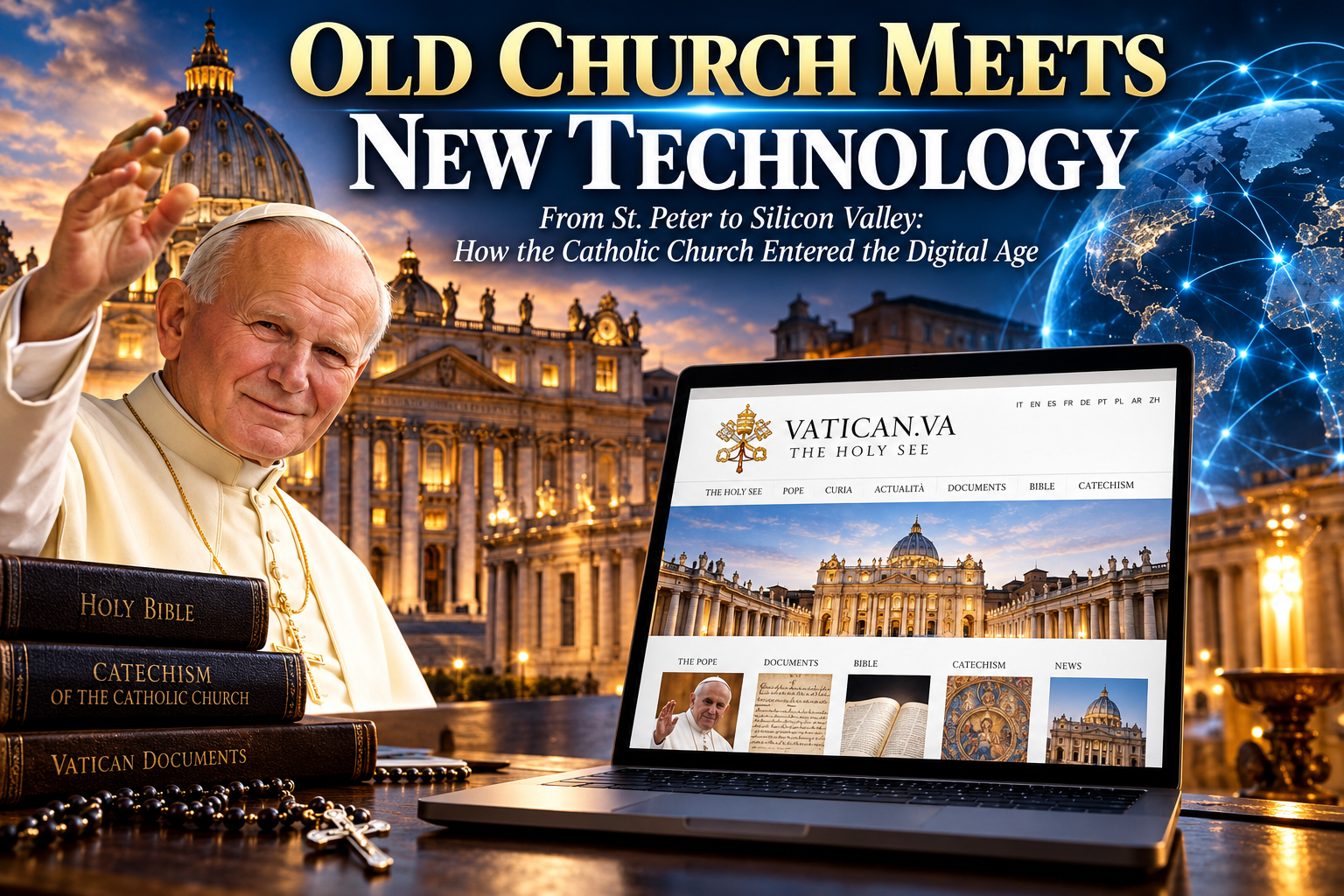
From St. Peter to Silicon Valley: How the Catholic Church Entered the Digital Age
By Catholicg33k | Faith • Technology • Evangelization
The Catholic Church is nearly 2,000 years old. The World Wide Web is only a few decades old. Yet when these two worlds came together, they opened an extraordinary new chapter in the history of Catholic evangelization.
On March 15, 1985, a computer manufacturer called Symbolics made Internet history by registering Symbolics.com, the world’s first registered .com domain name.
There were no smartphones, social media platforms, YouTube channels, or mobile applications as we know them today. The World Wide Web had not even become publicly available.
But the foundations of a technological revolution were being laid, and the Catholic Church would soon recognize the tremendous possibilities this new frontier offered for spreading the Gospel.
A Christmas Message That Made History
On Christmas Day, December 25, 1995, something remarkable happened.
Under the pontificate of Pope St. John Paul II, the Holy See began establishing its presence on the Internet, sharing the Pope’s Christmas message and Urbi et Orbi blessing with an emerging worldwide digital audience.
This historic initiative marked an important beginning for the Vatican’s online presence, which would develop around its now-familiar website, www.vatican.va.
Consider the significance of that moment.
An institution whose origins reach back to Jesus Christ commissioning St. Peter was embracing a revolutionary communications technology capable of transmitting information throughout the world almost instantaneously.
The Gospel, which had traveled along Roman roads, crossed oceans aboard missionary ships, and spread through monasteries and printing presses, could now reach people through computers and digital networks.
The message had not changed. The means of delivering it had.
That distinction remains essential to understanding the Church’s relationship with technology.
The Vatican’s Digital Mission
Today, the Holy See’s official website is an extraordinary resource for Catholics and anyone interested in understanding the teachings, history, and mission of the Church.
Through its digital resources, visitors can explore Sacred Scripture, papal encyclicals, apostolic exhortations, homilies, Church documents, historical archives, prayers, and important information about the Holy See.
Documents that previous generations might have needed access to specialized theological libraries to study are now available to readers around the world.
In 2011, the Holy See expanded its online communications with the launch of the News.va portal. This development eventually contributed to the establishment of Vatican News, which provides reporting and information about the Pope, the universal Church, and Catholic communities worldwide.
The possibilities for evangelization are profound.
A college student questioning the meaning of life can discover the Catechism of the Catholic Church. A Protestant exploring Catholic teaching can read papal documents and the writings of the early Church Fathers. A Catholic who has fallen away from the faith can rediscover the beauty of the sacraments and the teachings of Jesus Christ.
Someone who has never encountered Christianity might discover the Gospel through a single Internet search.
For the Church, the digital world represents an opportunity to reach people who might otherwise never enter a Catholic parish, attend a religious discussion, or open a theological book.
Pope St. John Paul II: A Visionary for Digital Evangelization
Pope St. John Paul II understood that the Internet represented much more than technological advancement.
He recognized that it was becoming a new cultural environment in which human beings would communicate, learn, form relationships, and search for truth.
In his message for the 36th World Communications Day in 2002, titled Internet: A New Forum for Proclaiming the Gospel, he encouraged Catholics to recognize the possibilities offered by the Internet while remaining aware of its limitations and dangers.
His message reflected an important missionary principle: the Church must proclaim the Gospel wherever people gather.
The Internet was becoming a new place of human encounter, and the Church needed to be present.
This understanding flows directly from the missionary command given by Jesus Christ to His Apostles:
“Going therefore, teach ye all nations; baptizing them in the name of the Father, and of the Son, and of the Holy Ghost.”
— Matthew 28:19, Douay-Rheims Bible
Our Lord’s command was never limited to a particular century, geographic region, language, or method of communication.
The Church’s missionary responsibility is universal.
And that responsibility extends into the digital world.
Evangelization in the Age of Artificial Intelligence
Three decades after the Vatican’s first steps onto the Internet, the digital environment has changed dramatically.
Websites have been joined by social media, podcasts, livestreaming, digital libraries, online communities, and increasingly sophisticated artificial intelligence systems.
Today, Catholics have access to technological tools that would have seemed unimaginable when the Vatican first entered cyberspace.
Artificial intelligence can assist with studying Sacred Scripture, examining Catholic theology, exploring Church history, locating magisterial documents, and answering questions about the Catholic faith.
These developments create extraordinary opportunities for education, apologetics, and evangelization.
However, they also introduce important moral and theological responsibilities.
Catholic digital evangelization must always remain rooted in truth, charity, fidelity to the Magisterium, and respect for the dignity of the human person.
Technology must serve the mission of the Church. It must never attempt to replace the Church herself.
Artificial intelligence cannot administer the sacraments. An online conversation cannot provide sacramental absolution. A livestream does not ordinarily fulfill the Sunday Mass obligation when a Catholic is able and obliged to attend Mass in person.
Most importantly, no technological system can replace the supernatural gift of God’s grace or the personal relationship with Jesus Christ to which every human being is called.
The Pontifical Council for Social Communications addressed similar concerns in its 2002 document The Church and Internet, emphasizing that digital communication can complement the Church’s life but cannot replace genuine Christian community or the sacramental encounter with Christ.
This distinction is particularly important as artificial intelligence becomes increasingly integrated into everyday life.
The Internet can help someone discover the Catholic faith. AI can help someone study the Catholic faith. But neither can substitute for living the Catholic faith.
Catholicg33k: Ancient Truth, Modern Tools
At Catholicg33k, we believe that authentic Catholic faith and responsible technological innovation can work together in the service of evangelization.
The Catholic Church possesses a remarkable intellectual tradition in which faith and reason complement one another.
From the philosophical and theological writings of St. Thomas Aquinas to the scientific contributions of Catholic scholars throughout history, the Church has consistently recognized the value of human reason when properly directed toward truth.
Technology offers another opportunity to place human creativity, intelligence, and innovation at the service of God and neighbor.
But genuine Catholic innovation does not mean changing the teachings of Christ to accommodate modern culture.
It means discovering effective ways to communicate the Church’s unchanging truths to people living in an increasingly technological society.
That is the heart of Catholic digital evangelization.
Our purpose should not simply be to accumulate followers, generate website traffic, collect likes, or build impressive digital platforms.
Those tools may help extend our reach, but they are not the ultimate measure of success.
The true mission is to help souls encounter Jesus Christ, discover the fullness of Catholic truth, and grow in holiness.
If technology helps accomplish that mission, then it can become a powerful instrument for good.
The Mission Hasn’t Changed. The Mission Field Has Expanded.
Throughout her history, the Catholic Church has encountered changing methods of communication.
The Apostles proclaimed the Gospel throughout the Roman Empire. Monastic communities preserved and copied Sacred Scripture. The printing press transformed the distribution of religious books. Radio and television allowed papal messages to reach enormous audiences.
Then came the Internet.
On Christmas Day in 1995, the Holy See’s entry into this new communications environment represented another important milestone in that continuing history.
Today, digital technology allows Catholic teaching to cross borders and reach people across the globe with extraordinary speed.
But despite these remarkable developments, the central proclamation of the Church remains unchanged.
Jesus Christ is Lord. He died for our sins, rose from the dead, and calls every human being to salvation through Him.
The platforms may change. Technologies may emerge and disappear. The ways people communicate will continue to evolve.
But the truth of the Gospel is eternal.
The question facing Catholic technologists, writers, educators, apologists, and digital missionaries is no longer whether the Church belongs in the digital world.
The question is how faithfully we will represent Jesus Christ within it.
For nearly two thousand years, the Catholic Church has proclaimed the same saving message.
Now that message can travel across the world at the speed of light.
Final Reflection: Ancient Faith, Eternal Truth, New Technology
The Catholic Church does not need to abandon her ancient faith to participate in the modern technological world.
Rather, she brings the light of eternal truth into every new generation and every new means of human communication.
Pope St. John Paul II recognized the missionary possibilities of the Internet at a pivotal moment in its development. Today, Catholic creators and innovators inherit the responsibility to use emerging technologies wisely, ethically, and faithfully.
The goal is not simply to make Catholicism more visible online.
It is to help people encounter Christ and find their way into the living communion of His Church.
As Sacred Scripture reminds us:
“Jesus Christ yesterday, and to day; and the same for ever.”
— Hebrews 13:8, Douay-Rheims Bible
Ancient Faith. Eternal Truth. New Technology.
And the mission continues.
Catholicg33k
Where Catholic Faith Meets Technology
References and Further Reading
- The Holy See: Events in the Pontificate of John Paul II, December 25, 1995.
- Pope St. John Paul II: Internet: A New Forum for Proclaiming the Gospel, Message for the 36th World Communications Day, 2002.
- Pontifical Council for Social Communications: The Church and Internet, February 22, 2002.
- Second Vatican Council: Inter Mirifica, Decree on the Means of Social Communication, December 4, 1963, especially paragraphs 1–3.
- Catechism of the Catholic Church: Paragraphs 849–856, concerning the Church’s missionary mandate.
- Sacred Scripture: Matthew 28:19; Hebrews 13:8 (Douay-Rheims Bible).
- Internet history: Historical registration of Symbolics.com, March 15, 1985.