

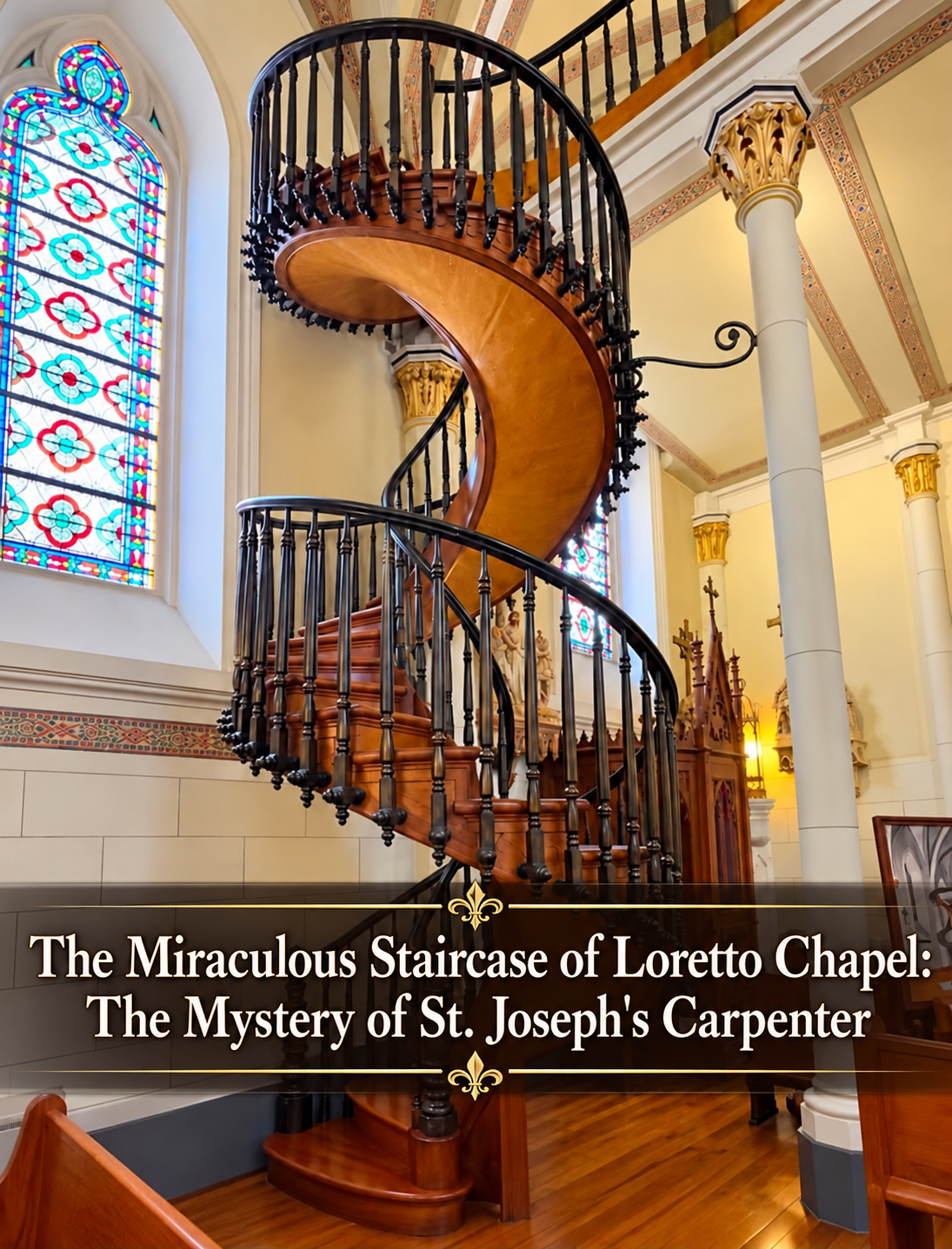
The extraordinary story of a mysterious carpenter, nine days of prayer, and a remarkable staircase that has inspired Catholic devotion for generations.
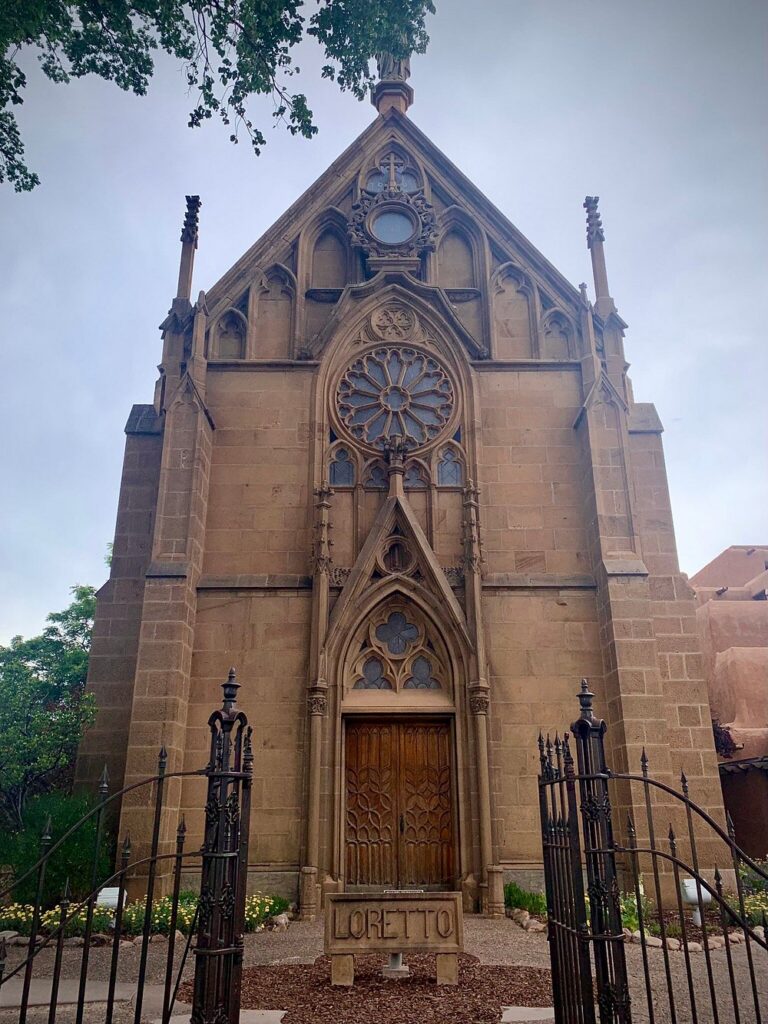
In the historic city of Santa Fe, New Mexico, stands a beautiful Gothic Revival chapel containing one of America’s most extraordinary examples of nineteenth-century woodworking. Known as the Loretto Chapel, this former Catholic chapel is home to a remarkable spiral staircase that has fascinated pilgrims, historians, architects, and engineers for more than a century.
Often called the Miraculous Staircase of St. Joseph, the wooden structure rises approximately twenty feet to the chapel’s choir loft, completing two full 360-degree turns without the central supporting pole ordinarily associated with spiral staircases.
Its unusual construction is impressive in itself. Yet the story surrounding its creation has given the staircase an even deeper significance.
According to a longstanding Catholic tradition, the Sisters of Loretto faced an architectural problem that appeared impossible to solve. After praying a nine-day novena to St. Joseph, the patron saint of carpenters, an unidentified craftsman reportedly arrived, constructed the extraordinary staircase, and departed without requesting payment.
For generations, some Catholics have believed that this mysterious carpenter was St. Joseph himself, appearing in answer to the sisters’ prayers.
Historical research, however, has offered another possible explanation: that the staircase was constructed by François-Jean Rochas, a highly skilled French-born carpenter who lived in New Mexico during the nineteenth century.
The resulting story brings together Catholic devotion, historical investigation, architectural ingenuity, and a mystery that continues to capture the imagination.
The Founding of the Loretto Chapel
The history of the staircase begins with the arrival of the Sisters of Loretto in Santa Fe in 1852.
The religious sisters traveled west to establish educational opportunities for children in the New Mexico Territory. Their mission developed into the Academy of Our Lady of Light, an institution dedicated to the Catholic education of young women.
Their work took place during a period of significant transformation for the Catholic Church in the American Southwest.
Bishop Jean-Baptiste Lamy, who later became the first Archbishop of Santa Fe, sought to strengthen Catholic institutions and introduce new forms of ecclesiastical architecture inspired by his native France.
Among the projects undertaken during this period was the construction of a chapel for the Sisters of Loretto.
Work began in the early 1870s, and the chapel was completed around 1878.
Designed in the Gothic Revival style, the building drew inspiration from the magnificent Sainte-Chapelle in Paris, famous for its soaring arches and beautiful stained-glass windows.
Its pointed arches, decorative stonework, and European architectural influences distinguished it from many of the traditional adobe structures surrounding it.
The completed chapel was dedicated to Our Lady of Light, a title honoring the Blessed Virgin Mary.
Despite its elegance, the building reportedly contained a serious practical problem.
There was no convenient staircase providing access to the elevated choir loft.
This omission would become the foundation of one of the best-known Catholic legends in the American Southwest.
An Architectural Problem That Seemed Impossible to Solve
The choir loft occupied an elevated position near the rear of the chapel, approximately twenty feet above the main floor.
It was intended to accommodate singers and musicians who contributed to the celebration of the sacred liturgy.
Without a proper staircase, however, reaching the loft presented considerable difficulty.
According to the chapel’s traditional account, local carpenters were consulted about constructing a suitable stairway.
They reportedly concluded that an ordinary staircase would occupy too much valuable floor space inside the relatively narrow chapel.
A conventional staircase would have required substantial horizontal distance, reducing the space available for seating and movement.
One proposed solution was to use a ladder.
For the sisters, however, a ladder was an undesirable arrangement, particularly when considering the practical needs of the religious community.
The situation seemed to demand an architectural solution that was both compact and structurally dependable.
Unable to find a satisfactory answer through the craftsmen they had consulted, the sisters turned to prayer.
The Nine-Day Novena to St. Joseph
Catholic tradition identifies St. Joseph, the husband of the Blessed Virgin Mary and foster father of Jesus Christ, as a carpenter or skilled craftsman.
In the Gospel according to St. Matthew, the people of Nazareth refer to Jesus as the carpenter’s son:
“Is not this the carpenter’s son? Is not his mother called Mary?” — Matthew 13:55, Douay-Rheims Bible.
Because of his association with honest labor, craftsmanship, and the care of the Holy Family, St. Joseph has long been venerated as the patron saint of workers and carpenters.
The Sisters of Loretto therefore turned to him in their difficulty.
According to the traditional account, they began a novena, a devotional practice involving nine consecutive days of prayer for a particular intention.
They asked St. Joseph to intercede before God and help them obtain a solution to their seemingly insurmountable architectural problem.
This devotion reflected the longstanding Catholic conviction that the saints, united with Christ in heaven, can intercede for those still living on earth.
The Catechism of the Catholic Church teaches:
“Their intercession is their most exalted service to God’s plan.” — Catechism of the Catholic Church, 2683.
The sisters’ prayers were therefore consistent with Catholic teaching on the communion of saints and the intercession of those who have gone before us in faith.
As the traditional story relates, something extraordinary occurred on the ninth and final day of their novena.
A mysterious carpenter appeared.
The Arrival of the Mysterious Carpenter
According to the legend preserved in accounts of the chapel’s history, an unfamiliar man arrived at the convent seeking work.
Some versions describe him as an elderly carpenter traveling with a donkey that carried his tools. Other retellings mention only a small collection of simple woodworking implements.
His identity was unknown to the sisters.
The stranger reportedly offered to construct a staircase that would reach the choir loft without consuming the limited floor space required by a conventional design.
Some versions of the story claim that he requested privacy while working.
He then began constructing what would become the chapel’s most famous architectural feature.
The work allegedly continued for several months.
When completed, the staircase rose in an elegant double spiral, joining the chapel floor to the choir loft.
Its unusual design appeared to solve the very problem that other carpenters had reportedly considered impracticable.
But the conclusion of the story was even more remarkable.
According to tradition, the carpenter departed without collecting payment or informing the sisters of his name.
The sisters reportedly attempted to discover his identity and determine where the wood had been obtained. The chapel’s traditional history also recounts attempts to locate him through local inquiries.
The mysterious circumstances surrounding his arrival and departure encouraged a remarkable interpretation.
Had St. Joseph himself appeared to help the sisters in answer to their novena?
For many devoted Catholics, the coincidence between the completion of their prayers and the stranger’s arrival seemed providential.
Others understood the event as evidence that St. Joseph had interceded by sending a gifted carpenter at precisely the moment he was needed.
Both interpretations became associated with the staircase’s enduring reputation.
The Extraordinary Construction of the Staircase
Even apart from its religious associations, the Loretto staircase represents an impressive achievement in woodworking.
Its most striking characteristic is the absence of an ordinary central newel post.
Most familiar spiral staircases employ a central pole or column around which the steps rotate.
The Loretto staircase instead uses a sophisticated arrangement of curved wooden structural members.
The staircase makes two complete revolutions while rising approximately twenty feet.
It is traditionally described as containing thirty-three steps, a number frequently connected in devotional interpretations with the traditional age of Jesus Christ at His Crucifixion.
Although this symbolic association has become part of the staircase’s popular religious history, there is no firm documentary evidence establishing that the number of steps was deliberately chosen for this purpose.
The Absence of a Central Support Pole
The staircase’s distinctive appearance comes principally from its lack of a conventional central supporting column.
However, this does not mean that the structure has no physical means of support.
The staircase contains inner and outer wooden stringers: long structural components that follow the spiral’s curvature and help carry the stair treads.
The tightly curved inner stringer contributes substantially to the structure’s rigidity and load-bearing capacity.
Its shape allows the staircase to distribute forces through the wooden assembly.
The structure is also connected to the choir loft, through which forces can be transferred to the surrounding building.
Thus, while the staircase may initially appear to defy gravity, its stability can be examined using established principles of structural engineering.
Its achievement lies not in a violation of natural laws but in the skillful application of geometry, material strength, and craftsmanship.
Wooden Pegs Instead of Nails
Another commonly cited feature is the staircase’s use of wooden pegs.
Descriptions of the original construction indicate that its components were joined through careful woodworking techniques rather than relying primarily on metal nails or screws.
Traditional joinery can produce strong, durable connections when performed by a highly skilled craftsman.
Such techniques were well established among European carpenters long before the nineteenth century.
Nevertheless, their application to an elaborate, tightly curved staircase demanded exceptional precision.
Historical descriptions identify multiple wooden segments in the curved stringers, demonstrating the complexity of shaping and assembling the structure.
The Mysterious Wood
The type of wood used in the staircase has also contributed to its reputation.
Some popular accounts claim that the timber came from an unknown species or could not be identified by modern specialists.
Those claims go beyond the available evidence.
Investigations have identified the wood as a type of spruce, although questions remain about its precise geographical origin.
Spruce was familiar to European craftsmen and could have been obtained through trade networks.
The possibility that the material came from outside the immediate Santa Fe area is interesting, but it does not establish a supernatural origin.
The staircase remains extraordinary without requiring such an explanation.
The Later Addition of Handrails and Supports
The staircase that visitors see today is not identical in every detail to its original nineteenth-century form.
Historical accounts indicate that the original staircase did not include the elaborate handrail and balustrade now associated with its appearance.
These were added later, generally dated to 1887 or the late 1880s.
Their addition made the staircase easier and safer to climb.
Supplementary metal brackets were also introduced at a later date to provide additional stabilization.
These modifications are important when evaluating claims about the staircase’s original structural design.
They also demonstrate that the staircase has a history of adaptation and preservation rather than remaining completely untouched since its construction.
The result is a remarkable piece of historic architecture whose beauty reflects both the original craftsmanship and subsequent efforts to preserve and improve it.
Who Was François-Jean Rochas?
For many decades, the mysterious carpenter’s identity remained a central feature of the Loretto tradition.
However, historical investigations during the late twentieth century uncovered evidence linking the staircase to a French immigrant named François-Jean Rochas, sometimes known as Frank or Frenchy Rochas.
Rochas was born in France in 1843 and later emigrated to the American Southwest.
He lived in New Mexico, where he became associated with ranching and skilled woodworking.
His name emerged prominently through the research of historian Mary Jean Straw Cook, whose book Loretto: The Sisters and Their Santa Fe Chapel was published by the Museum of New Mexico Press in 2002.
Cook examined historical documents, newspaper accounts, and financial records related to the chapel.
Her findings provided an important alternative to the traditional account of an otherwise unidentified craftsman.
The 1895 Newspaper Evidence
Among the most significant pieces of evidence was a notice published in the Santa Fe New Mexican on January 5, 1895, following Rochas’s death.
The newspaper described Rochas as a Frenchman recognized in Santa Fe for his woodworking expertise.
Significantly, the notice attributed the construction of the Loretto Chapel staircase to him.
This is an important historical detail.
The attribution appeared in a newspaper less than two decades after the staircase was completed, making it far closer to the events than many modern retellings.
Although a newspaper notice does not conclusively establish every circumstance of construction, it constitutes documentary evidence that Rochas was remembered as the staircase’s builder.
The Sisters’ Financial Records
Cook also identified a record from 1881 mentioning a payment of $150 associated with Rochas and wood.
This entry provides evidence of a financial connection between Rochas and the sisters.
However, historians and commentators have disagreed about precisely what the entry establishes.
Some interpret the record as corroborating his involvement with the staircase.
Others note that the wording may relate to materials for another building project rather than directly identifying payment for the staircase.
Consequently, the financial record is valuable but should not be treated as independently conclusive.
Taken together, the historical documents provide a substantial basis for associating Rochas with the staircase.
They do not, however, fully reconstruct the events surrounding its commissioning and construction.
Does the Historical Evidence Disprove the Miracle?
The identification of a possible carpenter raises an important question: If François-Jean Rochas built the staircase, does that necessarily invalidate the sisters’ belief that St. Joseph answered their prayers?
From the standpoint of Catholic theology, the answer requires a distinction between divine providence and an extraordinary supernatural intervention.
Catholic teaching does not hold that every answered prayer must involve a suspension of the ordinary laws of nature.
God can act providentially through human persons, circumstances, natural events, and ordinary means.
The Catechism teaches:
“God is the sovereign master of his plan. But to carry it out he also makes use of his creatures’ co-operation.” — Catechism of the Catholic Church, 306.
It also explains that God grants creatures the dignity of participating in His providential purposes (CCC 307).
Accordingly, a Catholic believer may regard the timely arrival of a skilled carpenter as an answer to prayer without concluding that the carpenter was personally St. Joseph.
That would be an interpretation of the event through the lens of faith, not an independently established historical fact.
The Catholic Church also distinguishes between the public Revelation entrusted to the Church and particular devotional traditions.
Public Revelation, fulfilled in Jesus Christ, is binding on Catholic faith. Private revelations and local traditions occupy a different place and are not additions to the deposit of faith (CCC 66–67).
There is no generally recognized formal judgment by the Catholic Church declaring that St. Joseph physically constructed the Loretto staircase.
Consequently, Catholics are not required to believe that the mysterious craftsman was St. Joseph.
They may appreciate the devotional story while acknowledging the historical evidence concerning Rochas.
St. Joseph and the Spiritual Meaning of the Staircase
The enduring appeal of the Loretto staircase is closely connected to the Catholic understanding of St. Joseph.
The Gospels describe him as a righteous man who faithfully carried out God’s will.
When Joseph learned that Mary was expecting a child, an angel appeared to him in a dream and instructed him not to fear taking her as his wife.
Scripture records Joseph’s obedient response:
“And Joseph rising up from sleep, did as the angel of the Lord had commanded him, and took unto him his wife.” — Matthew 1:24, Douay-Rheims Bible.
Throughout the Gospel narratives, Joseph is characterized less by recorded speech than by faithful action.
He protects Mary and Jesus, provides for the Holy Family, and responds to divine guidance.
His profession also gives particular significance to the Loretto account.
St. Joseph’s work reminds Catholics of the dignity of manual labor and the possibility of serving God through ordinary responsibilities.
Pope St. John Paul II emphasized Joseph’s role in the mystery of salvation in his 1989 apostolic exhortation Redemptoris Custos.
The document considers Joseph’s vocation, his fatherly care for Jesus, and the sanctifying significance of his daily work.
In this theological context, the staircase can serve as a fitting symbol of confidence in God’s providence, even when its construction is understood in entirely natural terms.
The sisters encountered a difficulty, persevered in prayer, and ultimately obtained a practical solution.
The spiritual lesson does not depend upon proving that St. Joseph personally appeared in nineteenth-century New Mexico.
Faith, History, and the Meaning of Miracles
The story of the Loretto Chapel illustrates why it is important to distinguish different kinds of claims.
The existence of the staircase is a historical and physical fact.
Its ingenious construction can be studied using woodworking history, geometry, and engineering.
The possibility that François-Jean Rochas built it is supported by historical evidence, especially the 1895 newspaper attribution.
The account of the sisters’ novena and the mysterious stranger belongs to the chapel’s longstanding devotional tradition.
The identification of that stranger as St. Joseph is an additional religious interpretation, not a demonstrated historical conclusion.
These distinctions need not diminish the staircase’s significance.
Catholic thought recognizes that faith and reason are not inherently opposed.
As the First Vatican Council taught in Dei Filius, chapter 4, there can never be a genuine disagreement between faith and reason, since both ultimately have their origin in God.
Historical research can therefore clarify the circumstances of the staircase’s construction without requiring believers to abandon the broader Catholic conviction that God hears prayer.
At the same time, devotion should not be used as a substitute for historical evidence.
Responsible examination of the Loretto story respects both the religious tradition and the documentary record.
The Loretto Chapel Today
The Loretto Chapel remains one of Santa Fe’s most recognizable historic landmarks.
Although it no longer functions as an ordinary active parish church, the historic building is preserved as a privately operated chapel and visitor attraction. It also serves as a venue for weddings and special events.
Its Gothic architectural design, stained-glass windows, and unusual staircase continue to attract attention from people of different religious backgrounds.
For students of architecture, the staircase presents an example of skilled nineteenth-century woodworking and structural ingenuity.
For historians, it offers an opportunity to explore the relationship between oral tradition, archival documents, and public memory.
For Catholics devoted to St. Joseph, it remains a powerful reminder of prayer, perseverance, humility, and trust in divine providence.
More than a century after its construction, the staircase continues to unite artistic craftsmanship and religious storytelling in a single remarkable structure.
Conclusion: A Staircase That Continues to Inspire
The Miraculous Staircase of Loretto Chapel occupies a distinctive place in American architectural and Catholic devotional history.
Constructed around the late 1870s or early 1880s, it rises approximately twenty feet, completes two graceful turns, and displays an exceptionally sophisticated understanding of wooden construction.
The traditional story recounts how the Sisters of Loretto prayed for the intercession of St. Joseph and received help from a mysterious carpenter who departed without payment.
For generations, that story has inspired the belief that St. Joseph may have appeared personally in response to their prayers.
Historical research has supplied a plausible identity for the craftsman: François-Jean Rochas, whose woodworking abilities and documented association with the chapel make him an important figure in understanding the staircase’s origins.
Whether the staircase was built by Rochas or another skilled craftsman, its existence demonstrates extraordinary craftsmanship.
Its religious significance, meanwhile, belongs to the enduring Catholic tradition of invoking St. Joseph as a protector, worker, and intercessor.
The most enduring lesson of the Loretto staircase may therefore be found not in claims that it defies the laws of physics, but in the relationship between prayer and human action.
For believers, the story recalls a fundamental principle of Christian life: divine providence can work through humble people, ordinary materials, and unexpected circumstances.
The staircase remains a monument to human skill and a symbol of the hope that sustained the Sisters of Loretto when they faced an apparently impossible problem.
And in that union of craftsmanship, history, and faith, the staircase continues to inspire wonder.
References and Further Reading
- Wikipedia contributors. “Loretto Chapel.” Wikipedia: The Free Encyclopedia. Sections addressing the chapel’s history, staircase construction, and proposed identity of its builder.
- United States National Park Service. “Loretto Chapel (Chapel of Our Lady of Light).” Historical overview of the chapel’s architecture, construction, and staircase.
- Loretto Chapel. “Our Story” and “Staircase.” Official historical and traditional accounts of the chapel and its celebrated spiral staircase.
- Cook, Mary Jean Straw. Loretto: The Sisters and Their Santa Fe Chapel. Museum of New Mexico Press, 2002.
- Santa Fe New Mexican. “Round About Town.” January 5, 1895. Historical newspaper notice attributing construction of the staircase to François-Jean Rochas.
- Catechism of the Catholic Church. Paragraphs 66–67, 306–308, 956, and 2683. Teachings on Revelation, divine providence, cooperation with grace, and the intercession of the saints.
- Pope St. John Paul II. Redemptoris Custos (1989). Apostolic exhortation on the person and mission of St. Joseph in the life of Christ and of the Church.
- First Vatican Council. Dei Filius (1870), chapter 4. Dogmatic constitution concerning faith and reason.
- The Holy Bible. Douay-Rheims translation. Matthew 1:18–25 and Matthew 13:55.
Historical note: The tradition that St. Joseph personally constructed the staircase should be distinguished from documented historical evidence. The Catholic Church has not established the supernatural identity of its builder as an article of faith. The account is best understood by presenting its devotional significance alongside the historical and architectural evidence.