

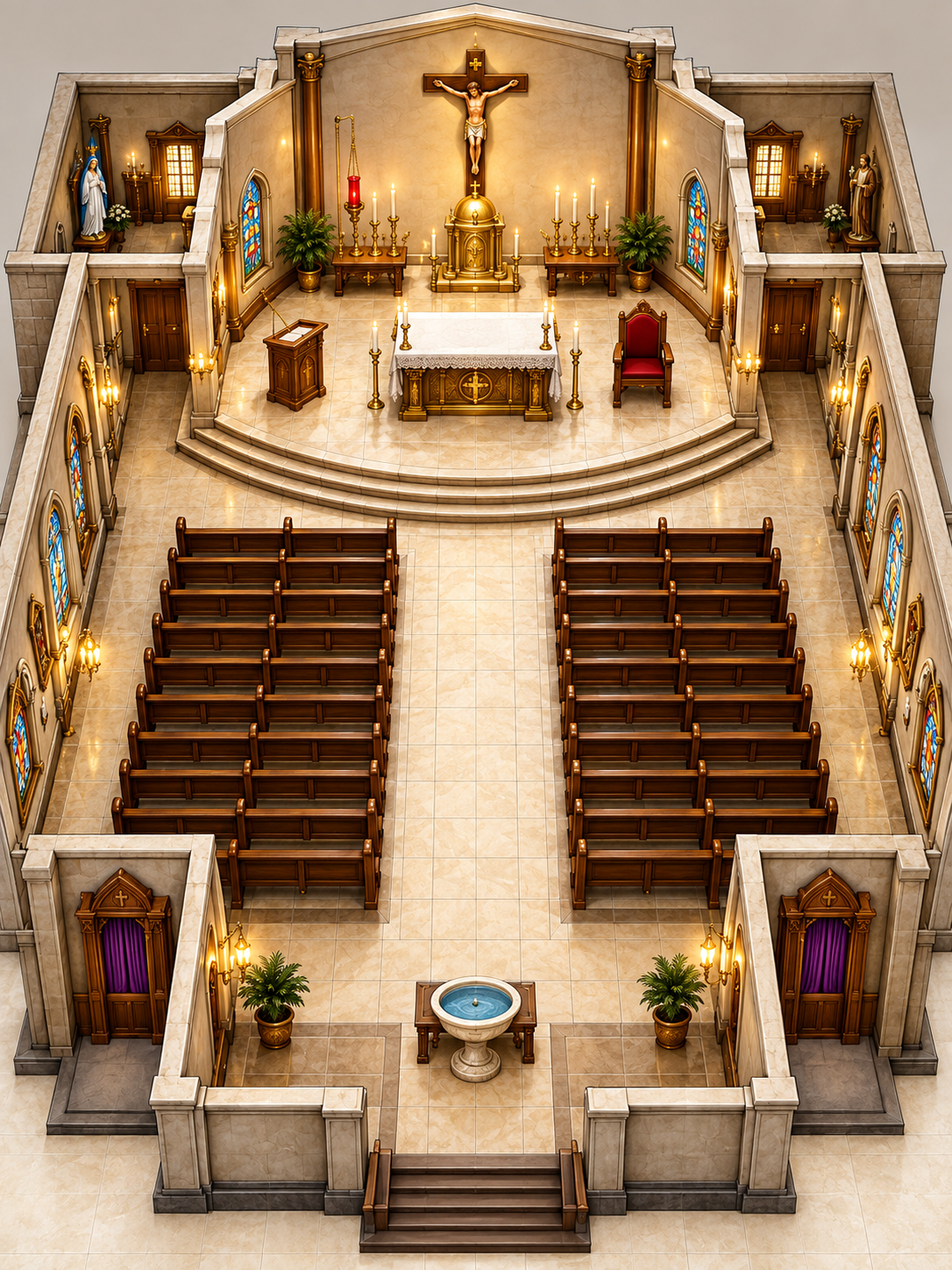
A Deep Guide to the Sacred Architecture, Theology, Liturgy, and Spiritual Meaning of God’s House
A Catholic church is not simply an auditorium in which Christians happen to gather. It is a sacred place set apart for divine worship, a visible expression of the mystery of the Church herself, and a building whose arrangement is meant to direct the mind and heart toward Jesus Christ.
Sacred architecture therefore teaches theology.
The doors speak of entrance into the household of God. The nave gathers the pilgrim people. The ambo announces the living Word. The altar makes present Christ’s Sacrifice sacramentally. The tabernacle safeguards the Eucharistic Lord. The baptismal font recalls our death and resurrection with Christ. The confessional points to the mercy by which sinners are restored. The crucifix places Calvary before our eyes.
Even the movement of a Catholic through the building can become a kind of catechesis:
we enter → we remember our Baptism → we hear God’s Word → we approach the altar → we receive Christ → we adore Him → we are sent back into the world.
The Catechism captures the principle beautifully:
“Visible churches are not simply gathering places but signify and make visible the Church living in this place.”
— Catechism of the Catholic Church, §1180
Let us therefore walk through the church piece by piece.
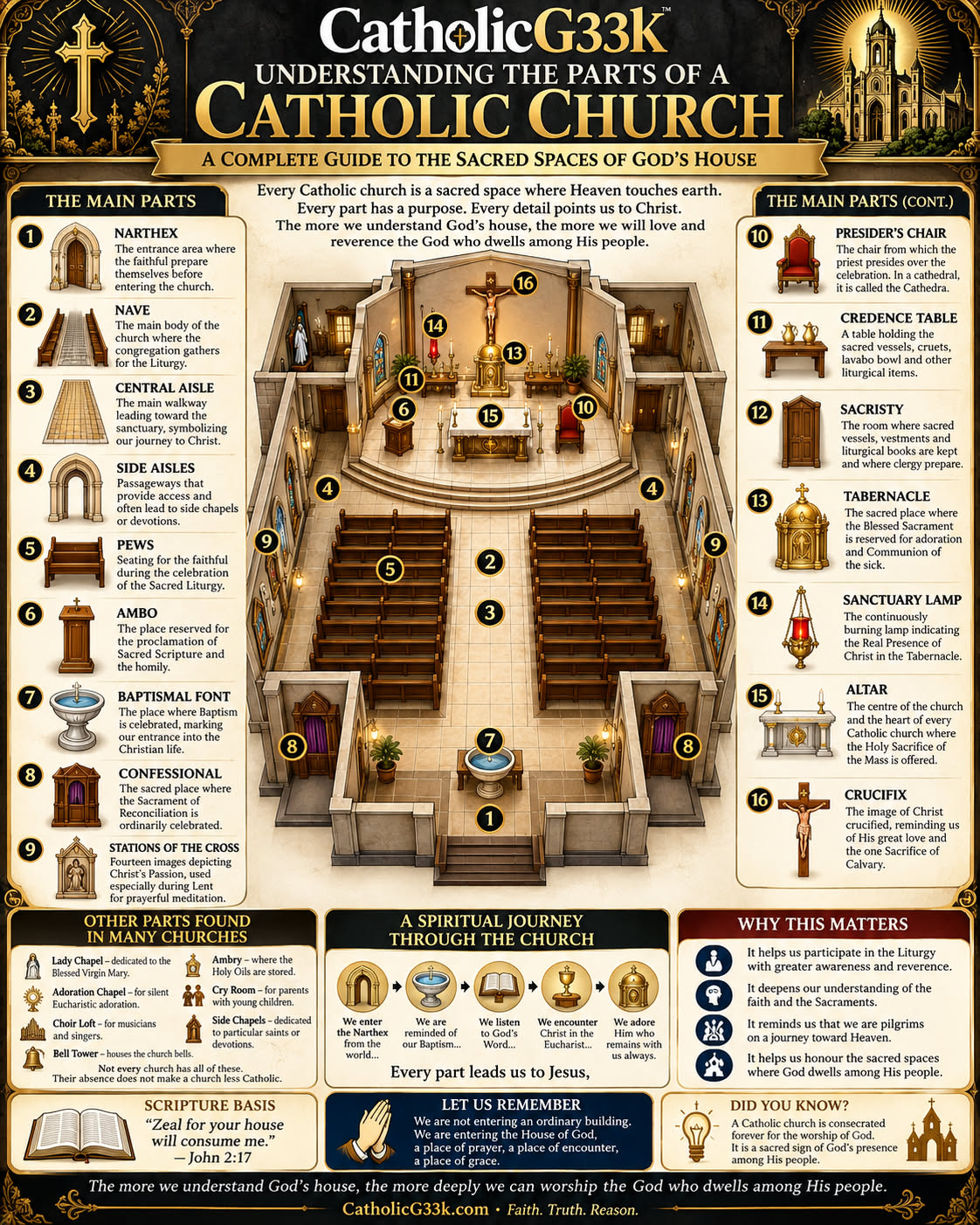
See Full Infographic below
I. WHY CATHOLICS HAVE SACRED CHURCH BUILDINGS
Christianity does not teach that God can be confined within a building.
Solomon himself prayed:
“Is it then to be thought that God should indeed dwell upon earth? for if heaven, and the heavens of heavens cannot contain thee, how much less this house which I have built?”
— 3 Kings 8:27, Douay-Rheims
Yet God continually chooses to meet His people through visible, material signs.
This principle reaches its summit in the Incarnation:
“And the Word was made flesh, and dwelt among us.”
— John 1:14
Christian worship therefore is not hostile to matter. Water becomes the sacramental sign of Baptism. Bread and wine become Christ’s Body and Blood. Oil is used in sacramental rites. Human voices proclaim Scripture. Hands bless. Incense rises. Bells ring. Sacred art teaches.
The church building belongs within this profoundly incarnational understanding of Christianity.
The Catechism explains:
“The worship ‘in Spirit and truth’ of the new covenant is not tied exclusively to any one place.”
— CCC §1179
But Christians nevertheless build churches precisely because the Church is a visible community worshipping sacramentally in history.
Canon law therefore defines sacred places as those designated for divine worship or burial by the Church through dedication or blessing.
— Code of Canon Law, can. 1205
A church is thus not holy because stone, wood, or marble possesses holiness naturally. It becomes a sacred place because it has been set apart for God.
II. THE CHURCH BUILDING AS AN IMAGE OF THE CHURCH
The word church has several interconnected meanings.
It can mean:
- the Christian people,
- the local Christian community,
- the universal Church,
- or the sacred building in which the Church gathers.
The building represents the people.
St. Peter writes:
“Be you also as living stones built up, a spiritual house, a holy priesthood, to offer up spiritual sacrifices, acceptable to God by Jesus Christ.”
— 1 Peter 2:5
The physical stones of the church therefore point toward the living stones of Christ’s Mystical Body.
This is why Catholic sacred architecture is fundamentally Christ-centered and ecclesial rather than merely decorative.
III. THE NARTHEX — CROSSING THE THRESHOLD
The narthex is the entrance or vestibule area of many churches.
Architecturally, it forms a transitional space between the ordinary world outside and the sacred space within.
Not every Catholic church possesses a distinct architectural narthex, and its precise form has varied greatly throughout history. Nevertheless, the symbolism is powerful.
Passing through the church doors can remind the Christian that worship involves leaving behind distraction and intentionally entering the presence of God.
The very imagery of a doorway has biblical significance.
Christ says:
“I am the door. By me, if any man enter in, he shall be saved.”
— John 10:9
The church doorway therefore easily evokes Christ Himself, through whom we enter communion with the Father.
Historically, vestibules and entrance areas also acquired practical functions: welcoming worshippers, forming processions, preparing catechumens, and separating the exterior environment from liturgical space.
Spiritually, the narthex asks:
Where am I going?
The answer is:
Into the assembly of Christ’s people to worship the living God.
IV. THE NAVE — THE PILGRIM CHURCH
The nave is the main body of the church where the congregation ordinarily gathers.
Its name is traditionally associated with the Latin navis, meaning ship.
That image has deep Christian resonance.
The Church has long been symbolized as a ship carrying the faithful through the storms of this world toward eternal life. The Gospel accounts of Christ calming the storm naturally encouraged this symbolism.
“And he said to them: Why are you fearful, O ye of little faith? Then rising up he commanded the winds, and the sea, and there came a great calm.”
— Matthew 8:26
The nave therefore can be seen as the earthly Church journeying toward the heavenly Jerusalem.
The people sitting there are not spectators.
They are the baptized faithful participating in the sacred liturgy.
The Second Vatican Council emphasizes that the Church desires the faithful to participate in the liturgy consciously and actively.
— Sacrosanctum Concilium, §§14, 48
Thus the nave is not an “audience section.”
It is the place occupied by the worshipping Body of Christ.
V. THE CENTRAL AISLE — PILGRIMAGE TOWARD CHRIST
The central aisle provides the principal path through the nave toward the sanctuary.
Its practical function is obvious: processions move through it.
Its symbolic meaning is even richer.
The Christian life itself is described as a journey.
Christ says:
“I am the way, and the truth, and the life.”
— John 14:6
At the beginning of Mass, the priest, deacon, and ministers process toward the sanctuary.
At weddings, bride and groom approach the altar.
At funerals, the body of the deceased is brought through the church in hope of resurrection.
At certain celebrations, processions move through the church solemnly.
The aisle therefore becomes a visual image of pilgrimage toward God.
And significantly, where does the principal axis ordinarily lead?
Toward the altar, and often visually toward the crucifix and tabernacle.
The architecture itself thus teaches:
Your life has a destination.
VI. THE SIDE AISLES
Side aisles permit movement through a church without disturbing the main central axis.
Historically, they have also given access to:
- side chapels,
- devotional shrines,
- confessionals,
- Stations of the Cross,
- statues,
- relics,
- and other sacred spaces.
They remind us that Catholic worship contains both communal and personal dimensions.
The Christian worships as a member of the Church, but he also kneels personally before God.
Sacred architecture makes room for both.
VII. THE PEWS — WHERE THE FAITHFUL PRAY
Pews are so familiar today that Catholics may assume they have always existed.
They have not.
Fixed seating became widespread relatively late in the history of Christian architecture. Many ancient Christians stood for substantial portions of worship, as Eastern Christians often continue to do.
Theologically, therefore, the pew itself is not essential to a church.
Its purpose is practical: it allows the faithful to sit, kneel, stand, listen, pray, and participate comfortably in the liturgy.
Catholic bodily postures themselves possess meaning.
We stand in reverence and resurrection dignity.
We sit attentively to receive instruction.
We kneel in worship, humility, supplication, and adoration.
The body participates because man is not merely a soul temporarily inhabiting a body. Human worship properly involves the whole person.
St. Paul writes:
“Glorify and bear God in your body.”
— 1 Corinthians 6:20
VIII. THE BAPTISMAL FONT — THE PLACE OF NEW BIRTH
Few objects in a Catholic church carry greater theological significance than the baptismal font.
Baptism is not merely a naming ceremony or public declaration.
Christ teaches:
“Unless a man be born again of water and the Holy Ghost, he cannot enter into the kingdom of God.”
— John 3:5
Through Baptism a person is freed from sin, reborn as a child of God, incorporated into Christ, incorporated into the Church, and made a participant in her mission.
— CCC §§1213, 1262-1270
St. Paul describes Baptism as participation in Christ’s death and resurrection:
“We are buried together with him by baptism into death; that as Christ is risen from the dead by the glory of the Father, so we also may walk in newness of life.”
— Romans 6:4
That explains why the font is sometimes near the entrance of the church.
Before ordinarily approaching the Eucharistic altar as a member of the Christian community, one first enters sacramental life through Baptism.
Symbolically:
the font is the doorway to the sacramental life.
IX. HOLY WATER
Although not numbered separately in the image, holy-water fonts are closely connected with Baptism.
Upon entering a Catholic church, the faithful commonly dip their fingers into holy water and make the Sign of the Cross.
That apparently small act contains an entire theology.
It recalls:
- the Trinity,
- Christ’s Cross,
- Baptism,
- purification,
- and our identity as Christians.
The Sign of the Cross accompanies us from the beginning of Christian life until death.
The Catechism observes that Christians begin their day, prayers, and activities with the Sign of the Cross.
— CCC §2157
Thus before Mass has even begun, the architecture and sacramentals are already preaching.
X. THE CONFESSIONAL — CHRIST’S TRIBUNAL OF MERCY
The confessional is the place ordinarily associated with the Sacrament of Penance.
After the Resurrection, Christ said to the Apostles:
“Receive ye the Holy Ghost. Whose sins you shall forgive, they are forgiven them; and whose sins you shall retain, they are retained.”
— John 20:22-23
Catholic confession rests upon this commission given by Christ.
In the sacrament, the priest does not replace Christ. Rather, Christ acts sacramentally through His ordained minister.
The Catechism teaches:
“Only priests who have received the faculty of absolving from the authority of the Church can forgive sins in the name of Christ.”
— CCC §1495
Canon law also requires provision for confessionals in churches and oratories, including fixed grilles where required by the law.
— Code of Canon Law, can. 964
The confessional therefore says something astonishing about Christianity:
sin need not have the final word.
Grace does.
The sinner enters burdened and, when properly disposed and absolved, departs reconciled.
XI. THE STATIONS OF THE CROSS
The traditional Stations of the Cross consist of fourteen stations meditating upon Christ’s Passion from His condemnation to His burial.
The devotion developed from Christian desire to prayerfully accompany Jesus along the road to Calvary, especially when actual pilgrimage to Jerusalem was impossible.
The traditional fourteen are:
- Jesus is condemned to death.
- Jesus receives the Cross.
- Jesus falls the first time.
- Jesus meets His Mother.
- Simon of Cyrene helps Jesus.
- Veronica wipes the face of Jesus.
- Jesus falls the second time.
- Jesus meets the women of Jerusalem.
- Jesus falls the third time.
- Jesus is stripped of His garments.
- Jesus is nailed to the Cross.
- Jesus dies on the Cross.
- Jesus is taken down from the Cross.
- Jesus is placed in the tomb.
Some modern devotional forms add a meditation upon the Resurrection, but the traditional Way of the Cross has fourteen stations.
The Holy See strongly commends meditation on the Passion of Christ.
— Directory on Popular Piety and the Liturgy, §§131-135
The Stations teach Catholics to contemplate not suffering in isolation, but suffering united with the love of Christ.
XII. THE AMBO — THE TABLE OF GOD’S WORD
The ambo is the place from which the Scriptures are proclaimed during the sacred liturgy.
This is much more than a convenient podium.
The General Instruction of the Roman Missal teaches that the dignity of the Word of God requires a suitable place from which it is proclaimed.
— General Instruction of the Roman Missal, §309
Ordinarily, the readings, Responsorial Psalm, and Easter Proclamation are proclaimed there, while its use should correspond to its liturgical dignity.
Why such emphasis?
Because when Sacred Scripture is proclaimed liturgically, Christ is truly present in His Word.
The Second Vatican Council teaches:
Christ “is present in his word, since it is he himself who speaks when the holy scriptures are read in the Church.”
— Sacrosanctum Concilium, §7
So the congregation does not merely hear information about God.
God addresses His people through His inspired Word.
This explains the close theological relationship between the ambo and altar.
One feeds us with God’s Word.
The other is associated with the Eucharistic Sacrifice and Banquet.
The Church speaks of the faithful being nourished from the table of God’s Word and the Body of Christ.
— Dei Verbum, §21; CCC §103
XIII. THE SANCTUARY
The sanctuary is the area in which the altar stands, where the Word of God is proclaimed, and where the priest, deacon, and other ministers exercise their liturgical roles.
The General Instruction states:
“The sanctuary is the place where the altar stands, where the Word of God is proclaimed, and where the Priest, the Deacon, and the other ministers exercise their functions.”
— GIRM §295
It should ordinarily be distinguished from the body of the church either by elevation or by particular structure and ornamentation.
This architectural distinction does not mean the clergy are spiritually more valuable than the laity.
Rather, the sanctuary manifests differences of liturgical function.
The Catholic liturgy is ordered because the Church herself is ordered.
Different members perform different roles while belonging to one Body.
Compare 1 Corinthians 12:12-27.
XIV. THE ALTAR — THE HEART OF THE CHURCH
At the theological and architectural center of Catholic worship stands the altar.
The altar possesses several related meanings.
It is:
- the place of Christ’s Sacrifice,
- the table of the Eucharistic banquet,
- a sign of Christ Himself,
- and the focal point of Eucharistic worship.
The Catechism states:
“The altar, around which the Church is gathered in the celebration of the Eucharist, represents the two aspects of the same mystery: the altar of the sacrifice and the table of the Lord.”
— CCC §1383
This distinction is crucial.
The Mass is not another crucifixion of Jesus.
Christ died once.
Scripture says:
“Christ was offered once to exhaust the sins of many.”
— Hebrews 9:28
The Sacrifice of the Mass makes sacramentally present the one Sacrifice of Calvary.
The Catechism explains:
“The sacrifice of Christ and the sacrifice of the Eucharist are one single sacrifice.”
— CCC §1367
The victim is the same Christ.
The Sacrifice is the same in its essential reality.
The manner of offering differs: Christ’s sacrifice on Calvary was bloody; His sacramental offering in the Eucharist is unbloody.
This is why the altar is treated with profound reverence.
At Mass the priest venerates it with a kiss.
It may be incensed.
Candles surround it.
The altar is not simply furniture.
It symbolizes Christ.
The GIRM describes the altar as the center toward which the attention of the whole congregation naturally turns during the Eucharistic liturgy.
— GIRM §299
XV. RELICS IN OR BENEATH ALTARS
An ancient Catholic tradition associates altars with the relics of martyrs and saints.
This practice has roots in the early Church, when Christians celebrated near the tombs of martyrs.
Revelation describes:
“Under the altar the souls of them that were slain for the word of God.”
— Apocalypse 6:9
Modern Church law maintains the ancient tradition of placing authentic relics of martyrs or other saints beneath an altar when appropriate.
— GIRM §302
The symbolism is magnificent.
Christ’s Sacrifice stands at the center.
The saints are those whose lives were united to His Sacrifice.
XVI. THE TABERNACLE — THE EUCHARISTIC PRESENCE OF CHRIST
The tabernacle is one of the most sacred features of a Catholic church because it contains the Most Blessed Sacrament reserved after Mass.
Catholics do not believe the Eucharist merely symbolizes Jesus.
The Church professes that after consecration, Christ is truly, really, and substantially present under the appearances of bread and wine.
— CCC §§1374-1377
Christ declared:
“This is my body.”
— Matthew 26:26
And:
“He that eateth my flesh, and drinketh my blood, hath everlasting life.”
— John 6:55
The reserved Eucharist allows Communion to be brought especially to the sick and dying and also makes Eucharistic adoration possible.
The tabernacle must be secure, worthy, and suited to safeguarding the Blessed Sacrament.
— Code of Canon Law, can. 938
The Catechism explains the development of Eucharistic reservation and adoration in §§1378-1381.
When the Eucharist is reserved in the tabernacle, Catholics genuflect toward Christ present there.
That genuflection is not directed to wood, gold, marble, or architecture.
It is directed to Jesus Christ.
XVII. THE SANCTUARY LAMP
Near the tabernacle one ordinarily finds a lamp burning continuously to indicate and honor Christ’s Eucharistic presence.
Canon law requires:
“A special lamp which indicates and honors the presence of Christ is to shine continuously before a tabernacle in which the Most Holy Eucharist is reserved.”
— Code of Canon Law, can. 940
The lamp silently proclaims:
He is here.
This makes the sanctuary lamp profoundly catechetical.
Before a person reads a sign or hears an explanation, that burning lamp directs attention toward the tabernacle.
It resembles, in a Christian fulfillment, biblical imagery of the perpetual lamp before God.
See Exodus 27:20-21.
XVIII. THE CRUCIFIX
A crucifix depicts Jesus Christ upon the Cross.
Catholic churches prominently display the crucified Lord because Christianity cannot be understood apart from Calvary.
St. Paul declares:
“We preach Christ crucified.”
— 1 Corinthians 1:23
And:
“I judged not myself to know anything among you, but Jesus Christ, and him crucified.”
— 1 Corinthians 2:2
Catholics do not display the crucifix because they deny the Resurrection.
Quite the opposite.
The Cross is victorious precisely because Christ rose.
The crucifix reveals the price of redemption and the depths of divine love.
“Greater love than this no man hath, that a man lay down his life for his friends.”
— John 15:13
During Mass, a cross bearing the figure of Christ crucified is to be present either on or near the altar and clearly visible to the assembled faithful.
— GIRM §308
Thus the crucifix visually interprets what happens sacramentally at the altar:
the Church is united to the one saving Sacrifice of Christ.
XIX. THE PRIEST’S OR CELEBRANT’S CHAIR
The chair used by the priest celebrant is not simply convenient seating.
It signifies his liturgical role of presiding over the assembled community and directing prayer.
The GIRM says:
“The chair of the Priest Celebrant must signify his function of presiding over the gathering and of directing the prayer.”
— GIRM §310
There is an important distinction, however.
Not every priest’s chair is a cathedra.
The cathedra is specifically the bishop’s chair in his cathedral church.
The word cathedral itself derives from cathedra.
The bishop’s chair symbolizes his teaching and governing office within the particular Church entrusted to him.
So:
every cathedral has a cathedra, but an ordinary parish priest’s chair is not properly called the cathedra.
XX. THE CREDENCE TABLE
The credence table is a small side table used to hold objects required during the celebration of Mass.
These may include:
- chalices,
- ciboria,
- cruets containing wine and water,
- lavabo bowl,
- towel,
- and other liturgical vessels.
Its significance is principally practical, but Catholic liturgy even gives practical objects an ordered place because sacred worship should be conducted with dignity and reverence.
See GIRM §§118, 139, 142.
The credence table keeps necessary liturgical items ready without cluttering the altar.
That distinction matters.
The altar is not intended as a general work surface.
It possesses a special liturgical dignity.
XXI. THE SACRISTY
The sacristy is the room in which sacred ministers ordinarily prepare for the liturgy and where vestments and various liturgical objects are kept.
Here one may find:
- chasubles,
- albs,
- stoles,
- chalices,
- ciboria,
- processional crosses,
- candles,
- incense,
- liturgical books,
- and other objects needed for worship.
The sacristy usually serves as the practical preparation point before the entrance procession.
But there is a spiritual lesson even here.
The priest does not simply “walk onstage.”
He vests for sacred service.
The vestments signify that in the liturgy the minister acts not merely as a private individual but according to the ministry entrusted to him by the Church.
XXII. THE AMBRY AND THE HOLY OILS
An ambry is a cabinet or secure repository in which the sacred oils may be kept.
The Church uses three principal oils.
Oil of Catechumens
Used in preparation for Baptism.
Sacred Chrism
A perfumed consecrated oil used especially in:
- Baptism in certain rites,
- Confirmation,
- Holy Orders,
- and the dedication of churches and altars.
Oil of the Sick
Used in the Sacrament of the Anointing of the Sick.
The use of oil is deeply biblical.
St. James commands:
“Is any man sick among you? Let him bring in the priests of the church, and let them pray over him, anointing him with oil in the name of the Lord.”
— James 5:14
The oils therefore remind us that grace touches the Christian throughout life — from initiation, through vocation, sickness, and preparation for eternity.
XXIII. THE LADY CHAPEL
Many Catholic churches contain a chapel or shrine dedicated particularly to the Blessed Virgin Mary.
Catholic devotion to Mary is always fundamentally Christological.
Mary’s dignity comes entirely from God’s grace and her unique relationship to Jesus Christ.
She is His Mother.
Elizabeth, filled with the Holy Ghost, calls her:
“the mother of my Lord.”
— Luke 1:43
Mary herself declares:
“Behold from henceforth all generations shall call me blessed.”
— Luke 1:48
A Lady Chapel therefore does not compete with Christ.
It points to the woman who said:
“Whatsoever he shall say to you, do ye.”
— John 2:5
Authentic Marian devotion always leads to Jesus.
XXIV. SIDE CHAPELS
Larger churches frequently have side chapels dedicated to particular saints, mysteries of Christ, or devotional purposes.
A chapel may contain:
- an altar,
- a tabernacle,
- relics,
- sacred images,
- or areas for private prayer.
These spaces express the profound Catholic understanding of the Communion of Saints.
The Church on earth does not worship God in isolation from heaven.
At every Mass, earthly worship joins the worship of angels and saints.
This is reflected especially in the Sanctus:
“Holy, holy, holy, Lord God of hosts.”
Compare Isaias 6:3 and Apocalypse 4:8.
XXV. EUCHARISTIC ADORATION CHAPEL
Some churches have a chapel specifically designated for Eucharistic adoration.
Here the Blessed Sacrament may be exposed in a monstrance for solemn adoration.
Eucharistic adoration flows directly from belief in the Real Presence.
The logic is simple:
If the Eucharist truly is Jesus Christ sacramentally present, then Eucharistic adoration is adoration of Christ Himself.
The Catechism therefore states:
“In the liturgy of the Mass we express our faith in the real presence of Christ under the species of bread and wine by, among other ways, genuflecting or bowing deeply as a sign of adoration of the Lord.”
— CCC §1378
Adoration continues this worship outside Mass.
XXVI. THE CHOIR LOFT
The choir has a ministerial role within the liturgy.
Sacred music is not simply background entertainment.
The Second Vatican Council says:
“The musical tradition of the universal Church is a treasure of inestimable value.”
— Sacrosanctum Concilium, §112
Sacred music serves prayer.
It helps unite the congregation.
It solemnizes worship.
It gives musical expression to the sacred texts themselves.
Gregorian chant receives a particular place within the Roman liturgical tradition.
— Sacrosanctum Concilium, §116
Whether a choir sings from a loft or another suitable location depends upon the church’s architecture, but its purpose remains service of the liturgy rather than performance for its own sake.
XXVII. THE BELL TOWER
Church bells have long called Christian communities to prayer and worship.
They mark sacred time.
A bell may announce:
- Mass,
- the Angelus,
- funerals,
- weddings,
- solemnities,
- or other important moments.
A church bell effectively tells the surrounding world:
God exists. Prayer matters. Eternity is real.
Its sound penetrates beyond church walls.
Historically, bells therefore became part of the Christian rhythm of towns and villages.
XXVIII. SACRED IMAGES AND STATUES
Catholic churches often contain images of Christ, Mary, angels, and saints.
Catholics do not believe statues are gods.
The distinction is fundamental.
God alone receives adoration.
Saints receive honor because God’s grace triumphed in them.
Sacred images are legitimate because the invisible God truly became visible through the Incarnation.
The Catechism explains:
“The Christian veneration of images is not contrary to the first commandment which proscribes idols.”
— CCC §2132
And the Seventh Ecumenical Council, Nicaea II in AD 787, defended the legitimate veneration of sacred images.
The honor shown to an image passes to the person represented; it does not terminate in the material object itself.
XXIX. CANDLES
Candles are among the simplest yet richest symbols found in a church.
They signify:
- Christ the Light,
- prayer,
- vigilance,
- sacrifice,
- and hope.
Jesus says:
“I am the light of the world: he that followeth me, walketh not in darkness, but shall have the light of life.”
— John 8:12
The Paschal Candle especially represents the risen Christ.
From it the faithful receive light during the Easter Vigil, dramatically expressing the triumph of Christ over darkness and death.
XXX. INCENSE
Incense has deep biblical roots.
Psalm 140 prays:
“Let my prayer be directed as incense in thy sight.”
— Psalm 140:2
The Book of Apocalypse similarly connects incense with the prayers of the saints.
“The smoke of the incense of the prayers of the saints ascended up before God.”
— Apocalypse 8:4
Incense may honor:
- the altar,
- the Gospel book,
- the Eucharistic gifts,
- the Blessed Sacrament,
- the celebrant,
- the ministers,
- the faithful,
- sacred images,
- and the body of the deceased at funerals.
Why incense people?
Because baptized human beings possess dignity as members of Christ.
Catholic ritual repeatedly teaches theology through matter.
XXXI. WHY THE CHURCH FACES TOWARD THE ALTAR
In a well-designed Catholic church, the architecture tends to establish visual hierarchy.
The altar is not merely one object among many.
The sanctuary should naturally attract attention.
The arrangement therefore teaches something about reality:
God is the center, not us.
Modern life constantly invites us to make ourselves the center.
The church building contradicts that temptation.
We enter.
We face Christ.
We listen.
We kneel.
We receive.
We adore.
We are sent.
Christian worship reorders the human person around God.
XXXII. THE CHURCH AS A SPIRITUAL JOURNEY
The infographic insightfully presents movement through the church as a spiritual journey.
We can deepen that idea.
At the entrance:
Conversion
We leave the world behind temporarily to encounter God.
At the baptismal font:
Identity
We remember whose children we became through Baptism.
In the nave:
Pilgrimage
We stand among God’s pilgrim people.
At the ambo:
Revelation
God speaks.
At the altar:
Sacrifice
Christ’s one Sacrifice is sacramentally made present.
At Holy Communion:
Union
Christ gives Himself as food.
At the tabernacle:
Presence
Christ remains sacramentally among His people.
Before the crucifix:
Redemption
We see the price of our salvation.
At the doors again:
Mission
We return to the world.
Mass therefore ends with sending.
The Latin missa is connected with this dismissal.
Christian worship is meant to transform Christian life.
XXXIII. WHY SILENCE MATTERS INSIDE A CHURCH
If Christ is truly present in the tabernacle, silence ceases to be mere etiquette.
It becomes theological.
Silence creates room for:
- recollection,
- prayer,
- examination of conscience,
- thanksgiving,
- and adoration.
The Catechism describes contemplative prayer as a form of silent love.
— CCC §§2715-2717
This is why unnecessary conversation in the presence of the Blessed Sacrament has traditionally been discouraged.
One is standing within a sacred place before the Eucharistic Lord.
XXXIV. GENUFLECTING, BOWING, AND KNEELING
Catholic worship uses the body because Christianity concerns the whole human person.
Genuflection
A genuflection toward the Blessed Sacrament expresses adoration of Christ truly present in the Eucharist.
Bowing
A bow expresses reverence and honor in various liturgical contexts.
Kneeling
Kneeling expresses worship, humility, repentance, and supplication.
St. Paul writes:
“In the name of Jesus every knee should bow.”
— Philippians 2:10
These actions are not empty ritual unless we make them empty.
Properly understood, they allow the body to say what the soul believes.
XXXV. WHY A CATHOLIC CHURCH SHOULD LOOK DIFFERENT FROM AN ORDINARY BUILDING
Sacred architecture communicates sacred purpose.
A courthouse looks different from a supermarket because architecture communicates function.
A church likewise ought to communicate:
This place is set apart for God.
Canon law describes a church as:
“a sacred building designated for divine worship.”
— Code of Canon Law, can. 1214
Beauty therefore has theological importance.
Beauty can draw the heart toward God.
This does not mean every Catholic church must be enormous, expensive, Gothic, Romanesque, Byzantine, or Baroque.
A humble mission chapel may be genuinely sacred.
But whatever the architectural style, the building should serve worship and express the sacred mysteries celebrated there.
XXXVI. “ZEAL FOR THY HOUSE”
The infographic concludes with a scriptural theme taken from John 2.
After Christ cleanses the Temple, His disciples remember:
“The zeal of thy house hath eaten me up.”
— John 2:17
Christ was referring ultimately to the words of Psalm 68:
“Because the zeal of thy house hath eaten me up.”
— Psalm 68:10
The Catholic church building cannot simply be identified with the Jerusalem Temple of the Old Covenant.
Christ Himself fulfills and surpasses the Temple.
Indeed, He says:
“Destroy this temple, and in three days I will raise it up.”
St. John immediately explains:
“But he spoke of the temple of his body.”
— John 2:19, 21
Christ Himself is therefore the ultimate meeting place between God and humanity.
The physical Catholic church derives its meaning from Christ and His Mystical Body.
XXXVII. AN IMPORTANT CLARIFICATION ABOUT CONSECRATION
The infographic says that a Catholic church is “consecrated forever.”
There is an important canonical nuance.
A church may be solemnly dedicated or blessed for divine worship and therefore acquires a sacred character.
But extraordinary circumstances can lead ecclesiastical authority to relegate a church to profane but not sordid use.
See:
- Code of Canon Law, can. 1212
- Code of Canon Law, can. 1222
Therefore Catholic sacred spaces should indeed be treated with lasting reverence, but canonically their status can change under circumstances determined by Church law.
XXXVIII. THE DEEPEST MEANING OF THE WHOLE BUILDING
Now step back and look at the church as a whole.
The entire building can be read as a proclamation of salvation history.
The door says:
Come to Christ.
The holy water says:
Remember your Baptism.
The confessional says:
Be reconciled.
The Stations say:
Take up your cross.
The saints say:
Holiness is possible.
The ambo says:
Listen to God.
The crucifix says:
You were bought at a price.
The altar says:
Christ’s Sacrifice saves you.
The Eucharist says:
Take and eat.
The tabernacle says:
Christ remains with His Church.
The sanctuary lamp says:
He is here.
The pews say:
Remain with His people.
The central aisle says:
Keep journeying.
The church doors at the end of Mass say:
Go into the world and live what you have received.
That is why understanding Catholic sacred architecture can transform the way someone attends Mass.
What once looked like furniture becomes theology.
What once seemed ornamental becomes catechetical.
What once seemed like ritual becomes an embodied proclamation of the Gospel.
The Church Is Ultimately About Jesus Christ
Every legitimate Catholic devotion, image, sacramental, architectural feature, and liturgical action ultimately points beyond itself.
Toward Christ.
The font points to Christ who gives new birth.
The confessional points to Christ who forgives.
The ambo points to Christ who speaks.
The altar points to Christ who sacrifices Himself.
The crucifix points to Christ who dies for us.
The tabernacle contains Christ sacramentally present.
The sanctuary lamp announces Christ’s presence.
Mary points toward her Son.
The saints witness to what Christ’s grace can accomplish.
And the congregation itself is being formed into Christ’s Mystical Body.
So perhaps the deepest lesson of a Catholic church is this:
nothing is supposed to terminate in itself.
Everything directs us toward God.
The church building is therefore a school of prayer constructed from stone, wood, glass, light, movement, silence, art, Scripture, and sacrament.
It quietly teaches the Catholic faith before the homily begins and continues teaching after the Mass has ended.
And at the center of everything stands not an idea, philosophy, or architectural style, but a Person:
“Jesus Christ, yesterday, and today; and the same for ever.”
— Hebrews 13:8
Principal Catholic Sources
For deeper study, the major sources behind this explanation are the Douay-Rheims Bible; Catechism of the Catholic Church, especially §§1179-1199, 1213-1284, 1322-1419, 1422-1498, 2129-2132, and 2691-2719; Code of Canon Law, especially cann. 1205-1239, 938-940, and 964; the General Instruction of the Roman Missal, especially §§288-318; Vatican II’s Sacrosanctum Concilium, especially §§7, 14, 48, 112-121; Vatican II’s Dei Verbum §21; and the Directory on Popular Piety and the Liturgy, particularly §§131-135.
The most important principle is beautifully summarized by the Catechism: sacred churches are places of prayer and Eucharistic celebration, but they also “signify and make visible the Church living in this place.” — CCC §1180.