

A CatholicG33k Investigation Into Egypt, Pagan Rome, St. Peter, and the Triumph of the Cross
Walk into St. Peter’s Square and it is impossible to miss.
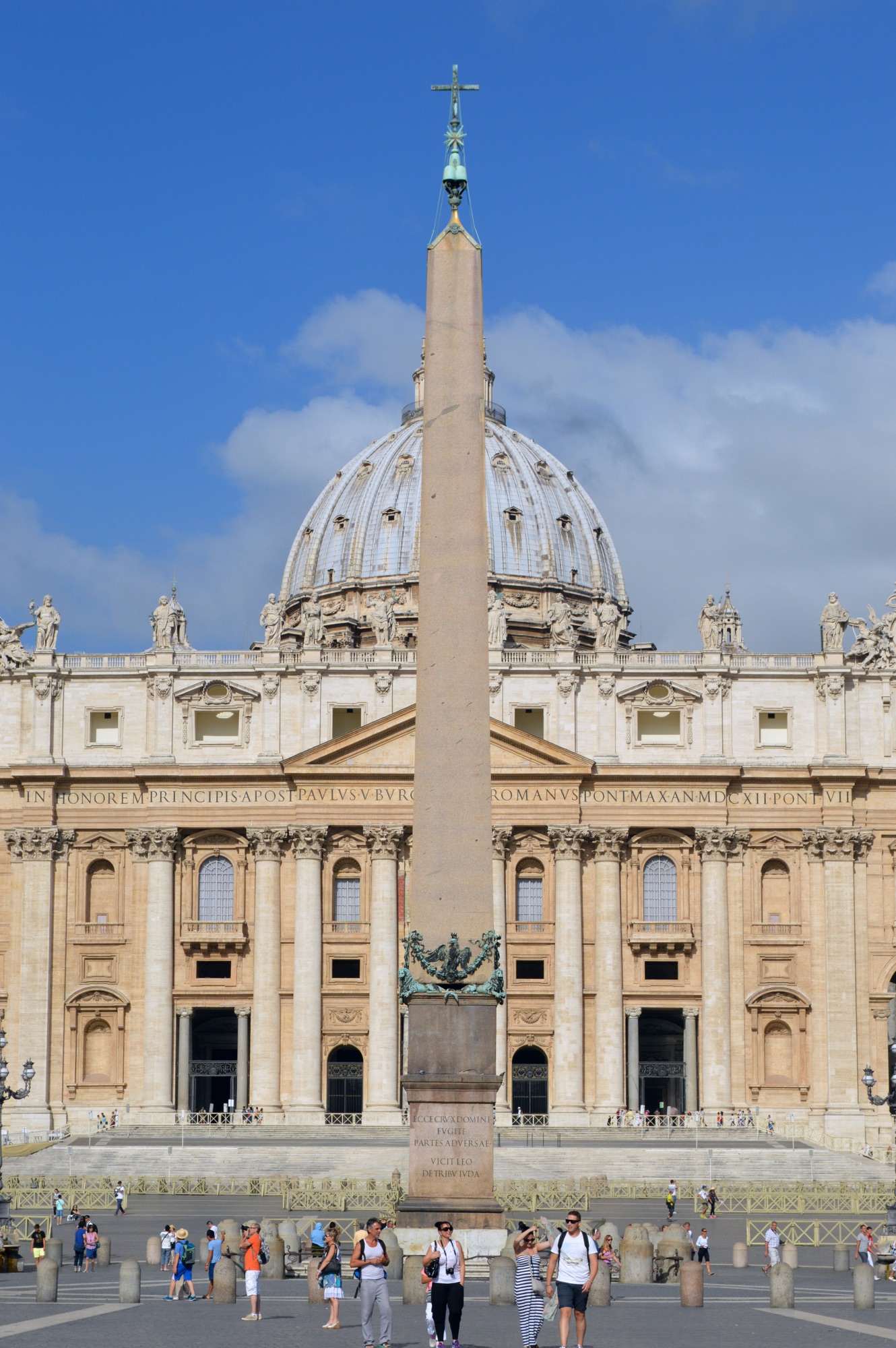
Standing directly in the center of one of the most recognizably Catholic places on earth is an enormous ancient stone obelisk.
And sooner or later, someone online will point at it and say:
“See? The Vatican has a pagan Egyptian obelisk. Catholicism is pagan.”
It sounds devastating—until you actually investigate the history.
Because the history of the Vatican Obelisk does not tell the story of Christianity surrendering to paganism.
It tells almost the opposite story.
This stone passed through the world of ancient Egypt, came into the possession of pagan Rome, stood in the circus associated with the persecution of Christians, witnessed the age in which St. Peter was martyred, and was eventually deliberately stripped of its pagan associations and crowned with the Cross of Jesus Christ.
The Church did not hide that history.
She carved it into the monument itself.
First: What Exactly Is an Obelisk?
The classical Egyptian obelisk is a tall, four-sided stone monument that narrows toward a pyramid-shaped point.
In ancient Egypt, obelisks commonly had religious significance and were associated particularly with solar worship. They frequently stood at temple complexes and could bear inscriptions honoring Egyptian gods and pharaohs.
So there is nothing unreasonable about saying that obelisk architecture has pagan Egyptian origins.
The mistake comes in the next step:
“If something originated in pagan culture, Christians can never use it for another purpose.”
Christianity has never operated according to that principle.
A material object does not possess an eternal religious allegiance simply because somebody once used it within paganism.
Stone is stone.
Gold is gold.
Architecture is architecture.
The decisive question is:
What does the object signify, and to what is it presently ordered?
That distinction becomes crucial when we get to the Vatican.
Pagan Obelisks Really Are All Over the World
Ancient Egyptian obelisks and ancient Roman-Egyptian examples did not remain confined to Egypt.
Roman emperors transported enormous monuments from Egypt to Rome as symbols of imperial prestige. Centuries later, additional Egyptian obelisks were transported to major Western cities.
That is why genuine ancient examples can now be found far from Egypt.
Among the most famous are:
Egypt
Egypt remains the homeland of the obelisk.
Important ancient examples survive around Luxor, Karnak, Heliopolis and other archaeological sites.
Rome
Rome became extraordinary in this respect.
Roman emperors transported multiple Egyptian obelisks to the imperial capital, while additional Egyptian-style obelisks were also produced during the Roman period.
That is why ancient obelisks appear throughout Rome today.
Paris
The Luxor Obelisk stands in the Place de la Concorde.
It originated at Luxor Temple and dates from the reign of Ramesses II.
London
An ancient Egyptian obelisk known as Cleopatra’s Needle stands beside the Thames.
Despite its later nickname, it actually dates back to the age of Pharaoh Thutmose III.
New York City
Another ancient Egyptian monument called Cleopatra’s Needle stands in Central Park.
Istanbul
The Obelisk of Theodosius was originally erected in Egypt under Thutmose III and was later transported to Constantinople.
And then there is one particularly famous example:
The Vatican Obelisk
This one deserves much closer examination.
Where Did the Vatican Obelisk Come From?
The Vatican itself acknowledges that the obelisk has an ancient pre-Christian history.

It is made of red granite, stands approximately 25.36 meters—about 83 feet—high without its base, and weighs approximately 330 tons. (Vatican)
But there is an important historical detail that is often omitted from viral anti-Catholic posts:
The exact Egyptian origin of this particular obelisk is uncertain.
Unlike many Egyptian obelisks, the Vatican Obelisk contains no hieroglyphic inscriptions.

The Vatican describes it as the only ancient obelisk in Rome without hieroglyphs and notes that its exact origin remains uncertain. (Vatican)
Ancient testimony associates its history with Heliopolis and later Alexandria.
Eventually it entered the Roman world.
And that is where things become extremely interesting.
Caligula Brought It to Rome
The Roman emperor Caligula, who ruled from AD 37–41, brought the obelisk to Rome.
It was erected in the emperor’s circus in the Vatican area. (Vatican)
This area later became associated particularly with Nero.
And Nero’s name should immediately ring a bell for Christians.
Because under Nero came one of the earliest horrific Roman persecutions of Christians.
The Obelisk and the Martyrdom of St. Peter
Here the story dramatically changes.
The Vatican circus became associated with the persecution and execution of Christians.
The ancient tradition of the Church of Rome holds that St. Peter was martyred in Nero’s circus and buried in the neighboring Vatican necropolis.
Pope Francis summarized that ancient Roman tradition when he wrote:
“the Apostle Peter, after his martyrdom in the Circus of Nero, was buried in the adjoining necropolis of the Vatican Hill.”
(Vatican)
That means the Vatican Obelisk belongs geographically to the very landscape in which pagan Rome attempted to destroy Christianity.
Think about that.
Rome once proclaimed:
Caesar is lord.
Christians proclaimed:
Jesus Christ is Lord.
Rome executed them.
Peter died.
The martyrs bled.
The Empire appeared victorious.
And yet the Empire that persecuted them eventually disappeared.
The Gospel remained.
Today the Basilica built over the traditional burial place of Peter dominates that landscape.
And the ancient monument that once stood within the imperial world of Caligula and Nero now stands underneath—
the Cross.
The official Basilica of St. Peter describes the obelisk today as originating from the Circus of Caligula and Nero and says that, crowned by Christ’s saving Cross, it recalls Peter’s crucifixion and the suffering of Rome’s early Christian martyrs. (Basilica di San Pietro)
That completely changes the apologetics discussion.
Pope Sixtus V Did Not Pretend It Was Christian
This is perhaps the strongest part of the entire story.
In 1586, Pope Sixtus V ordered the enormous obelisk moved to its present location.
The engineering operation was staggering.
According to the Vatican, it required:
907 men. 75 horses. 44 winches.
Architect Domenico Fontana directed the project. (Vatican)
But Sixtus did more than relocate it.
He deliberately transformed its meaning.
The bronze sphere that had previously stood on top was removed.
In its place:
A Cross was erected.
(Vatican)
And if anyone thinks the Pope secretly intended to preserve pagan worship, the inscriptions he placed on the monument destroy that theory.
Read What the Vatican Actually Carved Into It
One side of the base explicitly acknowledges the monument’s pagan past.
It states that Sixtus V moved the obelisk which had once been:
“dedicated to the impious cult of pagan gods”
to the threshold of the Apostles. (Vatican)
That is hardly an endorsement of paganism.
Another inscription says that Sixtus V consecrated the obelisk to the “invincible Cross” after it had been purified from superstition. (Vatican)
In other words:
The Church did not say,
“Let us worship what the Egyptians worshipped.”
She effectively said,
“Whatever pagan meaning this monument once possessed is finished. Christ has conquered.”
And the remaining inscriptions make that unmistakable.
CHRISTUS VINCIT
Facing toward St. Peter’s Basilica are the words:
CHRISTUS VINCIT CHRISTUS REGNAT CHRISTUS IMPERAT
Meaning:
Christ conquers. Christ reigns. Christ commands.
The inscription continues by asking Christ to defend His people from evil. (Vatican)
On another side appears:
ECCE CRUX DOMINI
“Behold the Cross of the Lord.”
And then:
VICIT LEO DE TRIBU IUDA
“The Lion of the tribe of Judah has conquered.”
(Vatican)
That last expression comes directly from the imagery of Revelation 5:5.
So imagine accusing Catholics of secretly venerating Egyptian gods while standing underneath a monument declaring:
CHRIST CONQUERS.
CHRIST REIGNS.
CHRIST COMMANDS.
That interpretation simply does not survive contact with the monument itself.
The Pagan Roman Inscription Was Not Even Hidden
Another fascinating detail is that ancient Roman inscriptions connected to Augustus and Tiberius remain visible.
They include language honoring the Roman emperors in the imperial religious context. (Vatican)
Why didn’t Catholics erase every trace of that history?
Because Christianity does not need to falsify history.
The monument can testify simultaneously to two realities:
what Rome once believed
and
what eventually conquered Rome.
The contrast is precisely what makes the monument powerful.
Caesar’s inscription remains on the stone.
But Caesar’s empire is gone.
Above Caesar’s words stands the Cross.
And beneath the Cross:
CHRISTUS VINCIT.
That is not pagan triumphalism.
It is Christian triumphalism.
Can Christians Reuse Something Pagans Once Used?
This is the theological question underneath the entire controversy.
And Scripture itself gives us categories for answering it.
St. Paul taught something extraordinarily important regarding objects associated with pagan worship.
We know that an idol is nothing in the world, and that there is no God but one.
Paul certainly condemned idolatry.
Christians could never participate in the worship of false gods.
But Paul also understood that material creation itself does not become metaphysically contaminated because pagans misuse it.
That distinction matters.
Christianity Does Not Believe Evil Owns Matter
This point goes even deeper.
Christianity is radically opposed to the idea that the material world belongs to evil.
God created matter.
God created stone.
God created gold.
God created wood.
God created human artistic ability.
Sin can misuse these things.
Idolatry can misuse them.
But evil cannot become their ultimate owner.
The Christian response is not always destruction.
Sometimes it is redemption and reorientation.
That pattern appears throughout Christian history.
Places once dedicated to pagan culture became places where Christ was proclaimed.
People who formerly worshipped pagan gods became saints.
Cultures were evangelized.
Artistic forms were transformed.
Languages once used to praise false gods were used to preach the Gospel.
The Roman Empire itself went from persecuting Christians to containing churches proclaiming Christ.
Christ does not retreat from creation because Satan once touched it.
Christ reclaims what belongs to God.
But Didn’t God Command Pagan Altars to Be Destroyed?
Yes.
And that must not be ignored.
In the Old Testament God repeatedly commanded Israel to destroy idolatrous shrines because Israel was being tempted into actual participation in pagan worship.
The Church likewise condemns idolatry absolutely.
The Catechism teaches that idolatry occurs when man honors and reveres a creature in place of God.
That is completely different from retaining an ancient piece of stone whose religious function has been abolished and whose present symbolism explicitly proclaims Christ.
The Vatican Obelisk is not functioning as an altar to Ra.
Nobody sacrifices to an Egyptian god beneath it.
Catholics do not pray toward it.
It contains no tabernacle.
It has no sacramental function.
It possesses no place in Catholic worship.
Instead, it stands beneath a Cross surrounded by inscriptions proclaiming Christ’s victory.
Those distinctions matter.
“But the Shape Itself Is Pagan!”
That argument creates enormous problems.
If originating within pagan civilization permanently contaminates an architectural form, Christians would have to abandon huge portions of Western civilization.
Columns?
Used extensively in pagan Greek and Roman temples.
Domes?
Used by pre-Christian civilizations.
Basilicas?
The architectural concept existed in Roman civic life before Christian churches adopted it.
Latin?
The language of pagan Rome.
Certain philosophical terminology?
Developed by pagan Greek thinkers.
Calendar terminology?
Filled with pre-Christian cultural history.
Even the names of several English days of the week contain references to pre-Christian gods.
Yet almost nobody believes saying “Thursday” constitutes worship of Thor.
Why?
Because historical origin and present meaning are not identical things.
That same basic distinction applies here.
The Washington Monument Does Not Prove America Worships Ra
This is another useful comparison.
Washington, D.C. contains an enormous obelisk-shaped monument:
the Washington Monument.
Does that establish that the United States government officially worships the Egyptian sun god?
Obviously not.
It means an architectural form developed in one civilization was later adopted for another purpose.
Likewise, an obelisk-shaped tombstone in a nineteenth-century Christian cemetery does not automatically prove Egyptian religion.
Form alone does not determine worship.
Intent, use, context and meaning matter.
Why Keep the Vatican Obelisk at All?
Because its history became intertwined with the history of Christian Rome.
The Basilica of St. Peter itself emphasizes its relationship to the Circus of Caligula and Nero, Peter’s martyrdom, and the Roman protomartyrs. (Basilica di San Pietro)
Seen from that perspective, the obelisk becomes almost a silent witness.
It survived the empire.
It survived emperors.
It survived persecutions.
It stood while Christians were being killed.
And Christianity survived.
Today, instead of towering over Christians being persecuted by pagan Rome, it stands before the greatest church associated with the Apostle whom Rome executed.
Above it stands the Cross.
That reversal is extraordinary.
Pagan Rome Thought It Had Defeated Peter
Consider the irony.
Peter was a Galilean fisherman.
Rome was the greatest imperial power in the Mediterranean world.
Rome possessed armies.
Peter possessed no army.
Rome possessed palaces.
Peter had nowhere approaching imperial wealth.
Rome possessed emperors who called themselves divine.
Peter proclaimed a crucified Jewish Messiah.
Rome killed Peter.
From the purely worldly perspective, Rome won.
Except history did not end there.
Centuries passed.
Nero became remembered primarily as a persecutor and tyrant.
The imperial religious order disappeared.
Pilgrims came from throughout the world to Peter’s tomb.
And over that location rose St. Peter’s Basilica.
Today the successor of Peter stands in that same city proclaiming Jesus Christ.
The ancient Roman world did not convert Christianity into paganism.
Christianity converted Rome.
The Cross Above the Obelisk Is the Entire Point
If someone photographs only the lower portion of the monument and says:
“Look! Pagan obelisk at the Vatican!”
tell them to tilt the camera upward.
There is a Cross sitting on top.
And not accidentally.
Sixtus V deliberately placed it there.
The inscriptions deliberately proclaim its meaning.
According to the Vatican’s own historical account, the previous bronze sphere was replaced by the Cross during the monument’s Christian transformation in 1586. (Vatican)
The message is visible in stone:
Paganism does not stand over Christ.
Christ stands over paganism.
A Remarkable Detail: The Obelisk Became a Sundial
The story gained another layer in 1817.
The Vatican astronomer Filippo Luigi Gilj designed a meridian or sundial using the obelisk itself as a gnomon.
The shadow cast from the monument—specifically from the Cross above it—helps indicate local noon and seasonal solar positions. (Vatican)
So something once associated with the ancient pagan world now quite literally casts the shadow of the Cross across St. Peter’s Square.
There is symbolism there even if the astronomical installation was primarily practical.
So Is the Vatican Obelisk Pagan?
The answer depends entirely upon what somebody means.
Was its ancient history connected to the pagan world?
Yes.
The Vatican itself acknowledges this openly.
Did the obelisk pass through pagan Roman imperial culture?
Absolutely.
Was it once associated with non-Christian religious ideas?
According to the monument’s own Renaissance inscription, yes.
Does the Catholic Church currently use it for pagan worship?
Absolutely not.
Did Pope Sixtus V attempt to preserve its pagan religious meaning?
Quite the opposite.
He explicitly repudiated that meaning, removed its former summit, crowned it with the Cross and surrounded it with inscriptions proclaiming Christ’s victory.
Common Misconception
“The Vatican has an Egyptian obelisk, therefore Catholicism is secretly Egyptian paganism.”
That conclusion simply does not follow.
An object’s previous use does not necessarily determine its later use.
The obelisk’s Christian context is explicit.
Its inscriptions describe the former pagan cult negatively.
Its summit bears the Cross.
Its base proclaims Christ.
Its location recalls the martyrdom of Peter and early Roman Christians.
Nothing about its present function resembles Egyptian worship.
Calling that “pagan worship” requires ignoring nearly every piece of contextual evidence surrounding the monument.
A Better Way to Understand It
Imagine a king defeating an enemy army and displaying the defeated army’s banner beneath his own standard.
Would anyone reasonably conclude:
“The king must secretly worship the defeated army because he possesses its banner”?
No.
The meaning is precisely the reverse.
The conquered standard displays the victor’s triumph.
Something similar is happening symbolically in St. Peter’s Square.
The ancient world that once persecuted the Church has been placed beneath the sign of the One whom the martyrs refused to deny.
Christ Does Not Fear Paganism
Christians sometimes respond to pagan history as though merely touching something once associated with paganism gives paganism supernatural ownership over it forever.
That gives paganism far too much power.
The Christian proclamation is much bigger.
The earth is the Lord’s and the fulness thereof: the world, and all they that dwell therein.
Creation belongs to God.
History belongs to God.
Nations belong to God.
Stone belongs to God.
Even civilizations that rebel against Him remain within His providence.
Christianity does not need to pretend paganism never existed.
It can point directly toward the ruins of pagan civilization and proclaim:
Christ conquered here too.
Final Reflection: The Stone That Watched an Empire Fall
Perhaps the most remarkable thing about the Vatican Obelisk is simply that it survived.
Imagine everything that ancient stone has witnessed.
Pharaohs.
Egypt.
Alexandria.
Roman emperors.
Caligula.
Nero.
Imperial triumph.
Christian persecution.
The blood of martyrs.
The collapse of pagan Rome.
The growth of Christianity.
The construction of the great basilica.
Popes.
Kings.
Revolutions.
Wars.
Pilgrims from every continent.
Through all of it, the stone remained.
But the gods once associated with the civilization from which it emerged are no longer worshipped there.
The emperor who transported it is dead.
The emperor who persecuted Christians is dead.
The empire that demanded allegiance from Peter is gone.
Yet Peter’s confession remains:
Thou art Christ, the Son of the living God.
And today an ancient monument from that vanished world stands in the Square bearing a Cross and proclaiming:
CHRISTUS VINCIT.
CHRISTUS REGNAT.
CHRISTUS IMPERAT.
Christ conquers. Christ reigns. Christ commands.
Maybe the Vatican Obelisk is not evidence that paganism conquered Christianity.
Maybe it is one of the most enormous pieces of stone in the world proclaiming that it didn’t.
CatholicG33k Quick Answer
Claim: “The Vatican has a pagan obelisk, therefore Catholicism is pagan.”
Answer: The Vatican makes no attempt to conceal the monument’s pagan history. Pope Sixtus V explicitly had inscriptions placed upon it describing its former association with pagan worship, had it symbolically purified, replaced the object formerly crowning it with the Cross, and surrounded it with declarations including “Christ conquers, Christ reigns, Christ commands.” (Vatican)
The obelisk also came from the circus associated with Caligula and Nero, near the traditional location of St. Peter’s martyrdom. Today the Basilica of St. Peter interprets the monument beneath the Cross as a remembrance of Peter and Rome’s early Christian martyrs. (Basilica di San Pietro)
That is not the preservation of pagan worship.
It is the deliberate transformation of a monument from the pagan imperial world into a proclamation of the victory of Christ.