

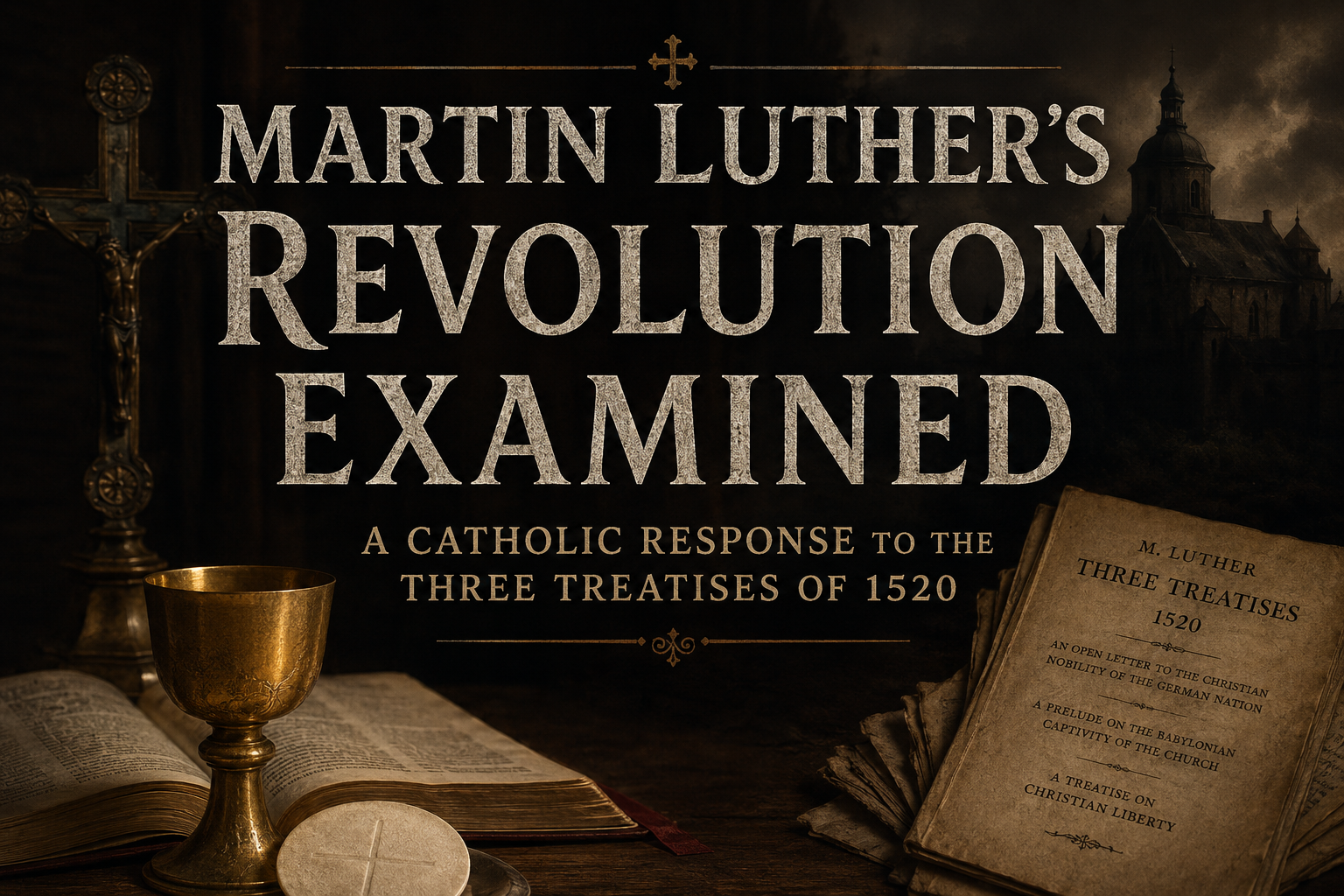
In 1520, Martin Luther published three works that helped transform a dispute about indulgences into a direct attack upon the sacramental, hierarchical, and doctrinal constitution of the Catholic Church:
- An Open Letter to the Christian Nobility of the German Nation
- A Prelude on the Babylonian Captivity of the Church
- A Treatise on Christian Liberty
Taken together, these works reveal the structure of Luther’s revolution.
The Open Letter attacks the authority and visible constitution of the Church. The Babylonian Captivity attacks the sacramental system. Christian Liberty supplies the theory of justification that supports both attacks.
Luther’s argument may therefore be summarized in three steps:
- The ordained hierarchy possesses no essential spiritual authority distinguishing it from the baptized faithful.
- The Church has allegedly imprisoned Christians through sacramental doctrines and laws not clearly established by Luther’s reading of Scripture.
- The sinner is justified by faith alone, apart from any interior renewal or cooperation with grace, while good works merely follow an already complete justification.
Luther identified real moral corruption and genuine administrative abuses. Catholics are not required to defend every practice of every cleric in the sixteenth century. But the existence of corruption does not prove that Christ failed to establish a visible Church, a ministerial priesthood, authoritative teaching offices, or seven sacraments.
Luther’s fundamental mistake was to move from a legitimate criticism of sinful churchmen to a rejection of the divine constitution of the Church herself.
I. The Three Walls Luther Tried to Tear Down
In the Open Letter, Luther describes three supposed “walls” by which, he claims, the Roman Church protected herself from reform.
The first is the distinction between the spiritual and temporal estates. Luther argues that all baptized Christians belong to the spiritual estate and that clergy differ from laypeople only by the office they temporarily perform.
The second is the Church’s claim to possess authoritative judgment concerning the interpretation of Scripture.
The third is the claim that only ecclesiastical authority may summon a general council.
Luther’s immediate purpose was political as well as theological. He appealed to German princes and nobles to intervene in the government and reform of the Church. He believed the hierarchy had failed, so temporal rulers should take action.
This appeal was revolutionary. Luther was not merely asking rulers to stop financial corruption. He was inviting secular authorities to assume responsibilities previously recognized as belonging to the Church’s pastors.
What Luther Got Right
Luther was correct that every baptized Christian possesses a real spiritual dignity.
St. Peter calls Christians “a chosen generation, a kingly priesthood, a holy nation”:
“But you are a chosen generation, a kingly priesthood, a holy nation, a purchased people.”
— 1 Peter 2:9, Douay-Rheims
The Church has never denied the common priesthood of the baptized. Through baptism, the faithful are joined to Christ and called to offer spiritual sacrifices.
The Second Vatican Council teaches:
“The baptized, by regeneration and the anointing of the Holy Spirit, are consecrated as a spiritual house and a holy priesthood.”
— Lumen Gentium, §10
Clergy are not a superior biological class. They are not necessarily holier, wiser, or morally better than laypeople. Every member of the Church is subject to Christ, and every office exists for service.
Luther was also correct that popes, bishops, and priests can sin. Individual churchmen can be greedy, cowardly, negligent, or corrupt. The Catholic doctrine of the Church does not require us to pretend otherwise.
Where Luther Went Wrong
Luther turned the common priesthood of the baptized into an argument against the essential distinction between that common priesthood and the ministerial priesthood.
Scripture, however, teaches both.
Christ chose twelve Apostles from among the larger body of disciples:
“And when day was come, he called unto him his disciples; and he chose twelve of them, whom also he named apostles.”
— Luke 6:13
He gave them particular authority:
“As the Father hath sent me, I also send you.”
— John 20:21
He commissioned them to forgive sins:
“Whose sins you shall forgive, they are forgiven them; and whose sins you shall retain, they are retained.”
— John 20:23
The Apostles then appointed ministers through the laying on of hands:
“Then they, fasting and praying, and imposing their hands upon them, sent them away.”
— Acts 13:3
St. Paul reminded St. Timothy of a spiritual gift communicated through ordination:
“Neglect not the grace that is in thee, which was given thee by prophecy, with imposition of the hands of the priesthood.”
— 1 Timothy 4:14
He later told him:
“Stir up the grace of God which is in thee, by the imposition of my hands.”
— 2 Timothy 1:6
The ministerial priesthood is therefore not merely a job assigned by the congregation. It is a sacramental participation in Christ’s ministry, conferred through the laying on of hands.
The Church explains that the common and ministerial priesthoods are related but differ “essentially and not only in degree.” The ordained priest acts sacramentally in the person of Christ the Head, especially when offering the Eucharistic sacrifice and absolving sins. See Lumen Gentium, §10; Catechism of the Catholic Church, §§1546–1553.
Luther saw that all Christians belong to Christ. He wrongly concluded that this eliminated the special authority Christ entrusted to the Apostles and their successors.
II. Did Luther Refute the Church’s Authority to Interpret Scripture?
Luther rejected the claim that the pope or ecclesiastical hierarchy possessed an exclusive right to interpret Scripture. He maintained that Christians must judge teaching by Scripture and resist a pope who acts contrary to it.
There is an important truth here: no pope stands above the Word of God. The pope is not free to contradict divine revelation. Catholicism does not teach that every papal opinion, sermon, administrative decision, interview, or private interpretation is infallible.
The pope is a servant of revelation, not its creator.
But Luther’s alternative raises a serious question: when sincere Christians interpret Scripture differently, who possesses authority to judge the dispute?
Luther’s theory appears simple while there is only one reformer confronting one institution. It becomes unstable as soon as multiple reformers disagree with one another.
And they did.
Reformation leaders disagreed about baptism, predestination, free will, the Eucharist, church government, the permanence of salvation, the relationship between the Old and New Testaments, and the meaning of justification itself. Appeals to “Scripture alone” did not produce doctrinal unity because Scripture does not interpret itself apart from the believing Church.
Scripture Points to an Authoritative Church
Christ did not leave behind a book with instructions that every believer should independently reconstruct Christianity. He established a Church and gave her pastors authority to teach.
He said to St. Peter:
“Thou art Peter; and upon this rock I will build my church, and the gates of hell shall not prevail against it.”
— Matthew 16:18
He gave Peter the keys:
“And I will give to thee the keys of the kingdom of heaven.”
— Matthew 16:19
Christ prayed especially for Peter’s faith and commanded him to strengthen the others:
“But I have prayed for thee, that thy faith fail not: and thou, being once converted, confirm thy brethren.”
— Luke 22:32
After the Resurrection, Christ entrusted His flock to Peter:
“Feed my lambs.”
“Feed my sheep.”
— John 21:15–17
The early Church did not resolve its first major doctrinal controversy by distributing copies of Scripture and permitting every congregation to reach its own conclusion. The Apostles and presbyters assembled in Jerusalem, deliberated, and issued a binding judgment:
“It hath seemed good to the Holy Ghost and to us.”
— Acts 15:28
This is the biblical pattern of a teaching Church exercising authority under the guidance of the Holy Ghost.
St. Paul calls the Church—not the private interpreter—“the pillar and ground of the truth”:
“The church of the living God, the pillar and ground of the truth.”
— 1 Timothy 3:15
The Catholic position is not that Scripture is unimportant. It is that Scripture belongs within the Apostolic Tradition and must be authentically interpreted by the teaching office entrusted to the Church.
As the Second Vatican Council teaches, the Magisterium “is not above the word of God, but serves it.” Scripture, Tradition, and the teaching office of the Church are so connected that one cannot stand without the others. See Dei Verbum, §10.
Luther correctly denied that a pope could legitimately oppose Scripture. He did not establish that every Christian possesses equal authority to determine Scripture’s binding meaning.
III. Luther’s Attack on the Sacraments
In the Babylonian Captivity of the Church, Luther applies his new theological principles to the sacramental life.
He begins with the traditional seven sacraments but gradually reduces their number. At different points, he speaks of three—Baptism, Penance, and the Eucharist—and eventually suggests that strictly speaking there are only two, Baptism and the Eucharist, because he does not think Penance contains a divinely instituted visible sign in the same manner.
His method is significant. A sacrament is accepted only when Luther believes he can identify both a divine promise and an external sign instituted by Christ according to his chosen criteria.
This places Luther himself in the position of judging which rites universally received by the Church truly came from Christ.
The Catholic Church did not invent seven sacraments as an arbitrary medieval list. The sacramental rites developed in their external forms, but their substance was received from Christ and the Apostles.
The Council of Trent solemnly taught:
“If anyone saith that the sacraments of the New Law were not all instituted by Jesus Christ, our Lord; or that they are more or less than seven … let him be anathema.”
— Council of Trent, Session VII, Canon 1 on the Sacraments
Biblical Foundations of the Seven Sacraments
The seven sacraments are not seven identical ceremonies. Each has its own institution, matter, form, minister, and purpose.
Baptism: Christ commanded the Apostles to baptize all nations in the name of the Father, Son, and Holy Ghost. See Matthew 28:19. Baptism brings regeneration and the remission of sins. See John 3:5; Acts 2:38; Titus 3:5; 1 Peter 3:21.
Confirmation: The baptized received a further imparting of the Holy Ghost through the Apostles’ laying on of hands. See Acts 8:14–17; 19:5–6; Hebrews 6:2.
The Eucharist: Christ took bread and wine, declared them to be His Body and Blood, and commanded the Apostles to do this in remembrance of Him. See Matthew 26:26–28; Luke 22:19–20; 1 Corinthians 10:16; 11:23–29.
Penance: Christ gave the Apostles authority to forgive and retain sins. See John 20:21–23; Matthew 16:19; 18:18; James 5:16.
Anointing of the Sick: St. James commanded the sick to summon the priests of the Church, who would anoint them with oil and pray over them. See James 5:14–15.
Holy Orders: Ministerial authority and spiritual grace were transmitted through the laying on of hands. See Acts 6:6; 13:3; 1 Timothy 4:14; 2 Timothy 1:6; Titus 1:5.
Matrimony: Christ restored marriage to its original permanence, and St. Paul called the union of husband and wife a “great sacrament” in relation to Christ and the Church. See Matthew 19:4–6; Ephesians 5:31–32.
Luther did not discover that five sacraments lacked all biblical support. He imposed a restrictive definition and rejected sacramental realities that did not fit it.
IV. Luther and the Eucharist
Luther did not deny the Real Presence of Christ in the Eucharist. In this respect, he remained much closer to the Catholic faith than many later Protestants.
He strongly defended Christ’s words, “This is my body,” against merely symbolic interpretations.
Yet he rejected transubstantiation, opposed the sacrificial understanding of the Mass, and attacked the withholding of the chalice from the laity.
These questions must be distinguished.
Reception Under One Species
The Catholic Church teaches that Christ is wholly present—Body, Blood, Soul, and Divinity—under either Eucharistic species. Receiving only the consecrated Host does not mean receiving only Christ’s Body while being deprived of His Blood.
The risen Christ is indivisible.
The discipline of receiving under one species developed for pastoral reasons and did not deny Christ’s institution. The Church has also permitted Communion under both species in many circumstances. This is a disciplinary question, not a denial of the completeness of the sacrament.
Transubstantiation
Luther thought the Church had unnecessarily imposed a philosophical explanation upon the Eucharistic mystery.
But transubstantiation does not explain away the mystery. It protects what Christ said.
At the consecration, the underlying reality—or substance—of bread and wine becomes the Body and Blood of Christ, while the sensible appearances remain.
The doctrine preserves three truths simultaneously:
- Christ is truly and substantially present.
- After consecration, the underlying reality is no longer ordinary bread and wine.
- The appearances of bread and wine remain perceptible.
Christ did not say, “This bread represents my body.” He said:
“This is my body.”
— Matthew 26:26
He also declared:
“My flesh is meat indeed: and my blood is drink indeed.”
— John 6:56
St. Paul warned that one who receives unworthily is “guilty of the body and of the blood of the Lord.” See 1 Corinthians 11:27. A person cannot become guilty of profaning Christ’s Body merely by mishandling a symbol.
The Council of Trent taught that the Church fittingly calls this conversion transubstantiation. See Session XIII, Chapter 4 and Canon 2. The term serves the revealed reality; it does not replace it.
Is the Mass a Sacrifice?
Luther’s deeper objection was directed against the Mass as a propitiatory sacrifice.
Catholic teaching does not claim that Christ is crucified repeatedly or that each Mass adds another sacrifice to Calvary.
Christ offered Himself once upon the Cross:
“For by one oblation he hath perfected for ever them that are sanctified.”
— Hebrews 10:14
The Mass is the sacramental re-presentation of that one sacrifice. The same Christ who offered Himself once in a bloody manner upon Calvary makes that offering sacramentally present under the appearances of bread and wine.
At the Last Supper, Christ did not merely give the Apostles food. He spoke sacrificially:
“This is my body, which is given for you.”
— Luke 22:19
“This is the chalice, the new testament in my blood, which shall be shed for you.”
— Luke 22:20
He then commanded:
“Do this for a commemoration of me.”
— Luke 22:19
The Eucharist is both sacrament and sacrifice because it contains and makes present the sacrificed Christ.
The Council of Trent states that the victim is the same and the offering priest is the same Christ; only the manner of offering differs. See Session XXII, Chapter 2.
Luther was right to condemn superstitious attitudes toward the Mass, including the idea that merely paying for Masses could purchase salvation. He was wrong to identify abuses surrounding the Mass with the sacrificial nature of the Mass itself.
V. Luther’s Doctrine of Faith Alone
Christian Liberty contains some of Luther’s most attractive and spiritually powerful writing.
He presents two apparently contrary propositions:
- The Christian is free and subject to no one.
- The Christian is a servant and subject to everyone.
The inner man, Luther argues, is justified and liberated through faith. The outward man then performs works of love, not to earn justification, but to discipline the body and serve the neighbor.
There is much here that Catholics can affirm.
Grace cannot be purchased. External observances without faith cannot save. Good works performed for pride or human praise are spiritually barren. Christian obedience must arise from love, not from a commercial attempt to place God in our debt.
The Catholic Church condemns Pelagianism—the belief that human beings can initiate or achieve salvation by their natural powers.
The Council of Trent teaches that adults are moved and assisted by God’s prevenient grace before they can turn toward Him. No one can be justified through works performed without grace. See Session VI, Chapters 5 and 8.
The disagreement is therefore not between Luther, who believed in grace, and Catholics, who supposedly believed in self-salvation.
The real disagreement concerns what justifying grace does within the sinner.
Luther’s Account
Luther repeatedly states that faith alone justifies without works. Good works follow from a person already made righteous through faith, but they do not contribute to justification.
His favored image is that a good tree produces good fruit. Fruit does not make the tree good; the tree must first be good before it produces good fruit.
There is truth in this analogy. A person must first receive grace before he can perform works meriting eternal life. Grace precedes merit.
But Luther pushes the distinction too far when he separates justification from the interior transformation of the person and excludes grace-enabled obedience from the believer’s growth in righteousness.
The Catholic Account
Justification is not merely God’s declaration that an unchanged sinner is righteous. It includes the remission of sins and the sanctification and renewal of the inner man.
God does not merely cover corruption. He begins to heal it.
St. Paul writes:
“The charity of God is poured forth in our hearts, by the Holy Ghost, who is given to us.”
— Romans 5:5
He describes Christians as genuinely transformed:
“And such some of you were; but you are washed, but you are sanctified, but you are justified.”
— 1 Corinthians 6:11
Grace makes us adopted children of God and enables us to love Him. This love is not a merely human achievement. It is itself God’s gift.
Faith is essential, but the faith that unites us to Christ is living faith—faith working through charity:
“For in Christ Jesus neither circumcision availeth any thing, nor uncircumcision: but faith that worketh by charity.”
— Galatians 5:6
St. James explicitly rejects the formula that a person is justified by faith alone:
“Do you see that by works a man is justified; and not by faith only?”
— James 2:24
James is not teaching self-salvation. He is distinguishing living faith from dead faith:
“Faith also, if it have not works, is dead in itself.”
— James 2:17
Luther attempted to resolve this by insisting that genuine faith necessarily produces good works. But that admission undermines any radical separation between saving faith and grace-enabled obedience.
Christ Himself connects eternal life with concrete acts of charity. In Matthew 25:31–46, the final judgment concerns whether people fed the hungry, clothed the naked, welcomed the stranger, and visited the sick and imprisoned.
St. Paul says that God:
“Will render to every man according to his works.”
— Romans 2:6
He promises eternal life to those who persevere in good works:
“To them indeed, who according to patience in good work, seek glory and honour and incorruption, eternal life.”
— Romans 2:7
These works do not place God in man’s debt. They are the fruits of grace and the free cooperation of a person whom grace has healed and elevated.
The Catholic position preserves both sides of the biblical teaching:
- We cannot be saved without grace.
- Grace does not save us without transforming us.
- Faith is necessary.
- Faith without charity is dead.
- Good works have supernatural value only because God produces them in us and graciously rewards His own gifts.
As St. Augustine taught:
“When God crowns our merits, He crowns nothing else but His own gifts.”
— St. Augustine, Letters, 194
VI. Luther’s Internal Tension Concerning Works
Luther wants to make two claims simultaneously.
First, faith alone is sufficient for righteousness and salvation, and works are unnecessary for justification.
Second, authentic faith necessarily produces obedience, self-discipline, charity, and service.
This creates a tension.
If a person claims to possess faith but lives in grave and unrepentant sin, does he still possess saving faith?
If the answer is yes, Luther’s doctrine risks separating salvation from conversion.
If the answer is no, then obedience and charity are not merely optional evidence added after salvation. Their absence reveals that the person does not possess the living faith that saves.
Catholic theology resolves this by distinguishing unformed faith from faith formed by charity. A person may intellectually believe revealed truths while refusing to love God. Such faith is real as intellectual assent, but it is not spiritually alive.
St. Paul confirms this:
“And if I should have all faith, so that I could remove mountains, and have not charity, I am nothing.”
— 1 Corinthians 13:2
Not even “all faith,” considered without charity, is sufficient.
Luther rightly insisted that works performed without faith cannot justify. He wrongly concluded that charity, obedience, and interior renewal must therefore be excluded from justification.
VII. Christian Freedom Is Not Freedom from the Church
Luther’s teaching on Christian liberty contains a beautiful call to serve one’s neighbor. Yet his principle of liberty also weakened the believer’s sacramental and ecclesial obligations.
Christian freedom does not mean freedom from Christ’s commandments, His Church, or the moral law. It is freedom from slavery to sin so that we may become servants of righteousness.
St. Paul writes:
“Being made free from sin, you became the servants of justice.”
— Romans 6:18
Freedom is therefore ordered toward holiness.
Christ gave real authority to His Church:
“He that heareth you, heareth me; and he that despiseth you, despiseth me.”
— Luke 10:16
Obedience to legitimate ecclesiastical authority is not inherently opposed to Christian liberty. It can be an exercise of freedom when authority commands what is consistent with the Gospel.
Certainly, churchmen can abuse authority. Catholics may resist commands that are sinful, and they may legitimately criticize imprudent governance. But abuse does not erase office.
David refused to treat Saul as though Saul’s personal wickedness had automatically destroyed the sacred character of his office. Likewise, the sins of a pope or bishop do not permit every individual Christian to become his own final doctrinal authority.
VIII. Luther’s Rhetoric and the Problem of Reform Through Destruction
The Open Letter employs harsh rhetoric against the papacy, the Roman Curia, bishops, canon lawyers, monks, and other ecclesiastical institutions. Luther frequently describes his opponents not merely as mistaken but as tyrants, deceivers, servants of Antichrist, or instruments of the devil.
Some of his anger arose from genuine scandals. Yet polemical intensity is not evidence.
Luther often combines three different things:
- Authentic Catholic doctrine
- Corrupt practices that violated Catholic doctrine
- Local disciplines that could legitimately be changed
He then attacks all three together.
For example, clerical greed does not disprove the ministerial priesthood. The sale or abuse of indulgences does not disprove the Church’s authority to remit temporal punishment. Superstitious practices surrounding the Mass do not disprove the Eucharistic sacrifice. Ignorant preaching does not disprove the Magisterium. Bad popes do not disprove the office Christ gave to Peter.
A physician distinguishes the disease from the patient. Luther increasingly treated the patient herself as the disease.
The Catholic Reformation demonstrated that genuine reform did not require the destruction of Catholic doctrine. The Council of Trent corrected abuses, strengthened seminary formation, regulated preaching, reformed episcopal residence, clarified the doctrine of justification, defended the sacraments, and renewed clerical discipline.
Saints such as Charles Borromeo, Philip Neri, Ignatius of Loyola, Teresa of Ávila, John of the Cross, and Francis de Sales pursued reform through fidelity rather than separation.
IX. The Political Consequences of Luther’s Appeal
By calling upon German nobles to reform the Church, Luther weakened the distinction between spiritual and temporal authority.
His program did not simply liberate Christians from Roman control. In many territories, it transferred extensive control over religion to secular princes.
Once the authority of bishops and the papacy was rejected, someone still had to determine public doctrine, appoint ministers, regulate worship, and administer church property. Territorial rulers frequently assumed these roles.
Thus, an attack made in the name of Christian freedom contributed to state-controlled churches.
This does not prove every Catholic political arrangement was just. It shows that abolishing ecclesiastical authority does not abolish authority itself. It often transfers authority to another institution that may be less qualified to exercise it.
X. The Central Error Behind the Three Treatises
The deepest problem in Luther’s three treatises is not merely his rejection of one pope, one indulgence practice, or one scholastic theory.
It is his understanding of the relationship between Christ and the Church.
Luther increasingly treated Christ’s saving work as something delivered to the individual primarily through personal faith in the divine promise. The visible Church became secondary and was judged according to the individual’s interpretation of Scripture.
Catholicism begins from a different premise.
Christ’s Incarnation is sacramental and ecclesial. The eternal Son entered history through a visible human nature. He formed a visible community, selected Apostles, gave them authority, instituted sacramental signs, and promised to remain with His Church.
“Behold I am with you all days, even to the consummation of the world.”
— Matthew 28:20
The Church is not an obstacle placed between Christ and the believer. She is Christ’s Body:
“And he is the head of the body, the church.”
— Colossians 1:18
To oppose the Church is to oppose Christ:
“Saul, Saul, why persecutest thou me?”
— Acts 9:4
Saul was persecuting Christians, yet Christ said Saul was persecuting Him. Christ identifies Himself with His Church.
This does not mean every action of every churchman is an action of Christ. It means the Church cannot be reduced to a voluntary association whose authority exists only when each believer agrees with it.
Conclusion: Reform Without Rebellion
Martin Luther saw real evils. Some churchmen were greedy. Some pastors were negligent. Some religious practices had become mechanical or superstitious. Some ecclesiastical offices were treated as sources of wealth and political power.
Catholics should not minimize these scandals.
But Luther’s diagnosis exceeded the evidence, and his cure attacked organs essential to the life of the Church.
He confused sinful officeholders with the offices Christ established. He confused disciplinary abuses with sacramental doctrine. He confused the priority of grace with the exclusion of human cooperation. He confused the common priesthood with the denial of the ministerial priesthood. He confused the authority of Scripture with private interpretive supremacy. He confused freedom from sin with freedom from divinely established ecclesial authority.
The answer to corruption is holiness.
The answer to bad priests is not the abolition of the priesthood, but holy priests.
The answer to bad bishops is not the destruction of apostolic succession, but bishops who imitate the Apostles.
The answer to superstition is not the rejection of the sacraments, but their worthy celebration.
The answer to works performed without faith is not faith separated from charity, but living faith working through charity.
The answer to ecclesiastical abuse is not rebellion against the Church Christ founded, but reform within her.
Luther called Christians away from Rome because he believed the visible Church had imprisoned the Gospel. The Catholic answer is that the Gospel itself gave us the visible Church, the Apostles, the priesthood, the sacraments, and the authority to teach in Christ’s name.
Christ did not promise that every pastor would be virtuous. He promised that the gates of hell would not prevail against His Church.
A Catholic may condemn the sins of Renaissance churchmen without surrendering the faith of the Apostles. We may admit the need for reform without accepting Luther’s revolution.
The saints reformed the Church by becoming holy within her. Luther attempted to reform her by placing himself in judgment over her constitution.
That is the decisive difference.
Principal Sources
Martin Luther, Three Treatises (Philadelphia: Muhlenberg Press, 1943):
- An Open Letter to the Christian Nobility of the German Nation Concerning the Reform of the Christian Estate, especially the treatment of the “three walls.”
- A Prelude on the Babylonian Captivity of the Church, especially the discussions of the Eucharist, Baptism, Penance, Confirmation, Matrimony, Holy Orders, and Extreme Unction.
- A Treatise on Christian Liberty, especially Luther’s treatment of faith alone, Christian freedom, the priesthood of believers, and the relationship between faith and works.
Holy Scripture, Douay-Rheims:
- Matthew 16:18–19; 19:4–6; 25:31–46; 26:26–28; 28:19–20
- Luke 6:13; 10:16; 22:19–20, 31–32
- John 3:5; 6:54–57; 20:21–23; 21:15–17
- Acts 2:38; 6:6; 8:14–17; 9:4; 13:3; 15:1–29; 19:5–6
- Romans 2:6–7; 5:5; 6:18
- 1 Corinthians 6:11; 10:16; 11:23–29; 13:2
- Galatians 5:6
- Ephesians 5:31–32
- Colossians 1:18
- 1 Timothy 3:15; 4:14
- 2 Timothy 1:6
- Titus 1:5; 3:5
- Hebrews 6:2; 10:14
- James 2:14–26; 5:14–16
- 1 Peter 2:5, 9; 3:21
Magisterial and Patristic Sources:
- Council of Trent, Session VI, Decree on Justification
- Council of Trent, Session VII, Decree on the Sacraments
- Council of Trent, Session XIII, Decree on the Most Holy Eucharist
- Council of Trent, Session XXII, Doctrine on the Sacrifice of the Mass
- Council of Trent, Session XXIII, Doctrine on the Sacrament of Order
- First Vatican Council, Pastor Aeternus
- Second Vatican Council, Dei Verbum, §10
- Second Vatican Council, Lumen Gentium, §§10, 18–29
- Catechism of the Catholic Church, §§74–100, 811–870, 1113–1134, 1210–1666, 1987–2029
- St. Augustine, Letters, 194