
Church History · Early Church (AD 30-600) · 17 of 67
Apostolic Missions & Maps
Where the Apostles Preached—and How Historical Evidence Should Be Read
Early Church Library
Apostolic Age (AD 30-100) Track
Essential Catholic Synthesis
Jesus Christ sent the Apostles to make disciples of all nations. The Acts of the Apostles records part of that mission in detail, especially the ministries of Peter and Paul, while early Christian writers and the ancient memories of local Churches preserve additional traditions concerning Andrew, John, Thomas, Bartholomew, Jude, and the other Apostles.
The evidence is not equally strong for every route. Paul’s journeys can be traced from Acts and his letters. Peter’s path from Jerusalem through Antioch to Rome is supported by the New Testament and early patristic testimony. The Indian Christian tradition concerning Thomas is ancient and substantial, although the precise itinerary remains uncertain. Routes assigned to Simon, James son of Alphaeus, and Matthias are far more fragmentary and conflicting.
These CatholicG33k maps therefore do not pretend that every colored line is a documented road. They distinguish Sacred Scripture, early patristic witness, ancient ecclesial tradition, and later or disputed claims. This protects the honor of the Apostles by refusing both skeptical dismissal and devotional exaggeration.
Key Truths
- The apostolic mission began with Christ’s command and the outpouring of the Holy Spirit at Pentecost.
- Acts provides detailed geographical evidence for Peter, Paul, and the expansion from Jerusalem into the Gentile world.
- Early patristic writers preserve important information not narrated in the New Testament, especially concerning Rome, Ephesus, Scythia, Parthia, and other mission fields.
- Ancient local Churches may preserve authentic apostolic memory even when a complete itinerary cannot be demonstrated.
- Later hagiography, pilgrimage traditions, and national legends must not be treated as equal to first-century or early patristic evidence.
- A route line indicates a remembered relationship between locations; it does not prove an exact road, date, or sailing course.
- The spread of the Gospel was accomplished by networks of Apostles, bishops, presbyters, deacons, women, households, catechists, prophets, and other coworkers.
- Apostolic succession concerns the continuing mission and authority entrusted by Christ, not merely the recovery of ancient travel routes.
How to Read These Maps
Grade A marks Sacred Scripture or secure first-century evidence. Grade B marks early patristic testimony. Grade C marks ancient ecclesial or regional tradition. Grade D marks later, disputed, or conflicting claims.
The grades do not measure holiness. A Grade D tradition may have enormous devotional or cultural importance, while a Grade A location may tell us only that an Apostle was present there once. The scale measures the historical basis for the geographical claim.
The maps are original CatholicG33k reconstructions. They use the locations gathered from Scripture, early Christian literature, regional ecclesial traditions, and the research site that inspired this project, but they do not copy or trace that site’s images.
In This Article
Introduction
The risen Christ did not commission the Apostles to remain in one city. He sent them outward from Jerusalem to Judea, Samaria, and the ends of the earth. Pentecost gave this mission its divine power, and the Church’s earliest history became a history of movement: preaching in synagogues and marketplaces, baptizing households, forming Eucharistic communities, appointing ministers, correcting error, enduring persecution, and carrying the Name of Jesus across cultural and political boundaries.
“Going therefore, teach ye all nations; baptizing them in the name of the Father, and of the Son, and of the Holy Ghost. Teaching them to observe all things whatsoever I have commanded you: and behold I am with you all days, even to the consummation of the world.”
Mapping that mission is valuable, but maps can create false confidence. A line on a modern image may suggest that historians know a precise itinerary, even when the surviving source names only a broad region. The Apostles did not leave synchronized travel logs, and later Christians naturally wished to connect their own Churches with apostolic founders. Some of those memories are early and credible; others are late, symbolic, or contradictory.
This page gathers the strongest available information while making uncertainty visible. It honors Scripture as the inspired written witness, takes early Christian testimony seriously, respects the ancient memories of Eastern and Western Churches, and refuses to present pious possibility as documented fact.
The Four-Level Evidence Scale
Grade A — Sacred Scripture or secure first-century evidence. These locations and movements are explicitly recorded in the New Testament or established by evidence of comparable proximity. Examples include Peter in Jerusalem, Joppa, and Caesarea; John on Patmos; James the Greater’s martyrdom in Jerusalem; Matthias’s election there; and Paul’s routes in Acts.
Grade B — Early patristic witness. These claims appear in writers close enough to the apostolic period to carry significant weight, especially First Clement, Ignatius of Antioch, Irenaeus, Polycrates, Origen as preserved by Eusebius, and other early testimonies. Peter and Paul at Rome, John at Ephesus, Andrew’s association with Scythia, and Thomas’s association with Parthia belong here.
Grade C — Ancient ecclesial or regional tradition. These traditions may be deeply rooted in the worship, memory, and identity of historic Christian communities. Thomas in India, Bartholomew in Armenia, Jude in Mesopotamia and Persia, and Andrew at Patras are important examples. Their antiquity deserves respect even when an exact route cannot be reconstructed.
Grade D — Later, disputed, or conflicting tradition. These claims may emerge in later hagiography, national legends, pilgrimage traditions, or sources that cannot be reconciled. Peter in Britain, Andrew in Novgorod, Simon’s many incompatible routes, and some Spanish, African, and Caucasian claims belong here.
This system avoids two opposite errors. It rejects the skeptical assumption that nothing outside the New Testament can preserve authentic memory, and it rejects the credulous assumption that every medieval itinerary is equally historical.
Master Apostolic Mission Map
The master map presents one representative mission field for each Apostle and for St. Paul. It is intentionally conservative. It does not reproduce every route line found in later hagiographical maps. Instead, it shows the geographical reach remembered across Scripture, early Christian literature, and ancient ecclesial tradition while making the evidence grade visible.
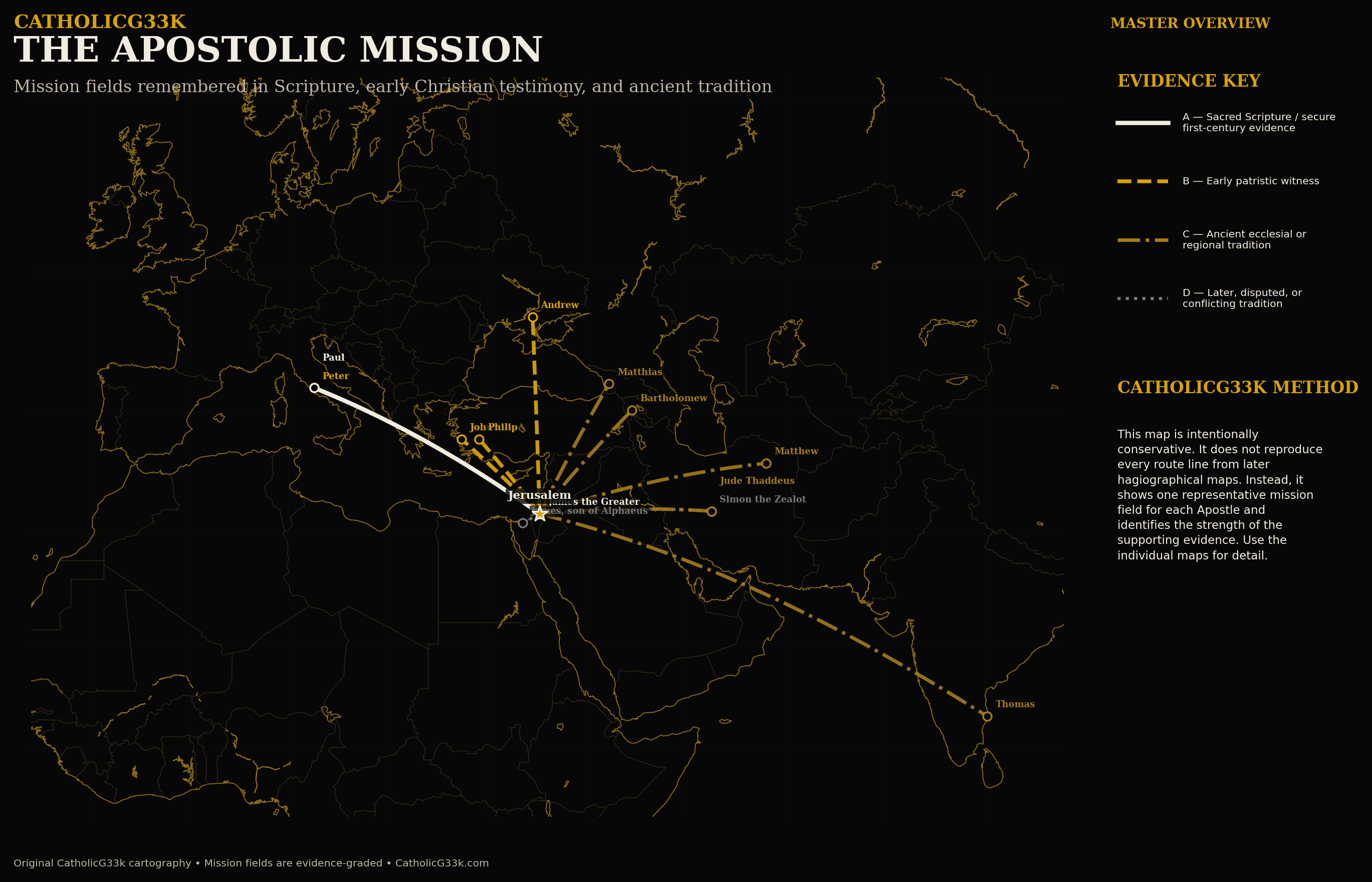
The visual center remains Jerusalem because the apostolic mission proceeds from the death and Resurrection of Christ, the gathering of the Apostles, and the gift of the Holy Spirit. The geographical expansion never means independence from the apostolic faith or from ecclesial communion.
St. Peter: Jerusalem, Antioch, and Rome
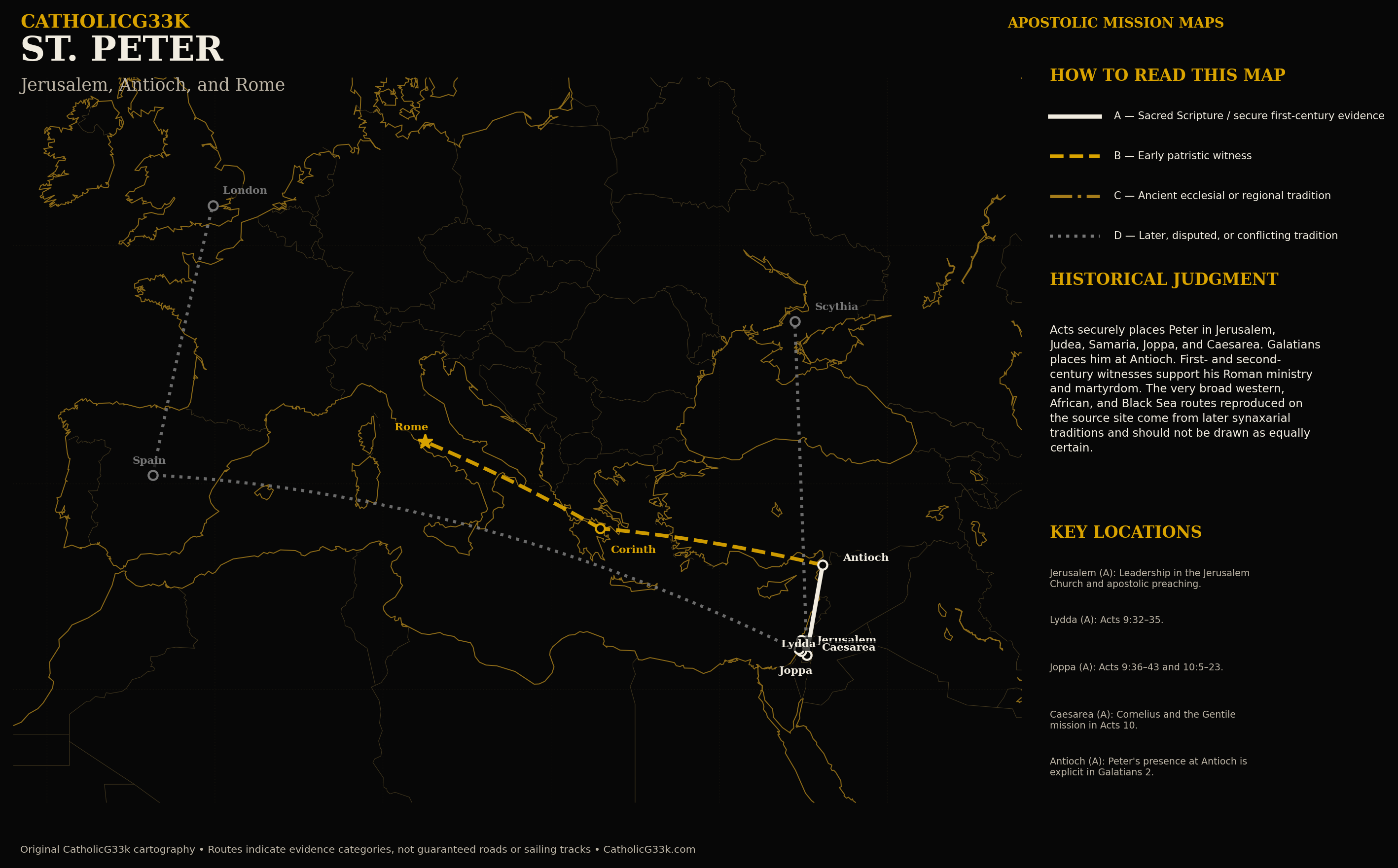
Acts securely places Peter in Jerusalem, Judea, Samaria, Joppa, and Caesarea. Galatians places him at Antioch. First- and second-century witnesses support his Roman ministry and martyrdom. The very broad western, African, and Black Sea routes reproduced on the source site come from later synaxarial traditions and should not be drawn as equally certain.
Peter is the clearest example of how different types of evidence can be joined without being confused. Acts records his ministry in Jerusalem, Lydda, Joppa, and Caesarea; Galatians places him in Antioch; and early Roman witnesses connect his final ministry and martyrdom with Rome. Those sources are not identical in genre, but together they form a strong historical trajectory.
Later traditions greatly enlarge Peter’s route, sometimes sending him to Spain, Britain, or the Black Sea. Such traditions may preserve devotional memory, but they cannot be displayed with the same confidence as Acts, Galatians, First Clement, Ignatius, Irenaeus, and the Roman archaeological memory of Peter.
Grade A: Jerusalem: Leadership in the Jerusalem Church and apostolic preaching. Lydda: Acts 9:32–35. Joppa: Acts 9:36–43 and 10:5–23. Caesarea: Cornelius and the Gentile mission in Acts 10. Antioch: Peter’s presence at Antioch is explicit in Galatians 2.
Grade B: Rome: Early Roman and patristic witness to Peter’s ministry and martyrdom. Corinth: Dionysius of Corinth, preserved by Eusebius, links Peter and Paul with Corinth.
Grade D: Spain: Later western tradition; not securely documented as Peter’s route. London: Later British tradition; not early historical evidence. Scythia: The source site’s Black Sea route is synaxarial and highly uncertain.
St. Andrew and the Greek World
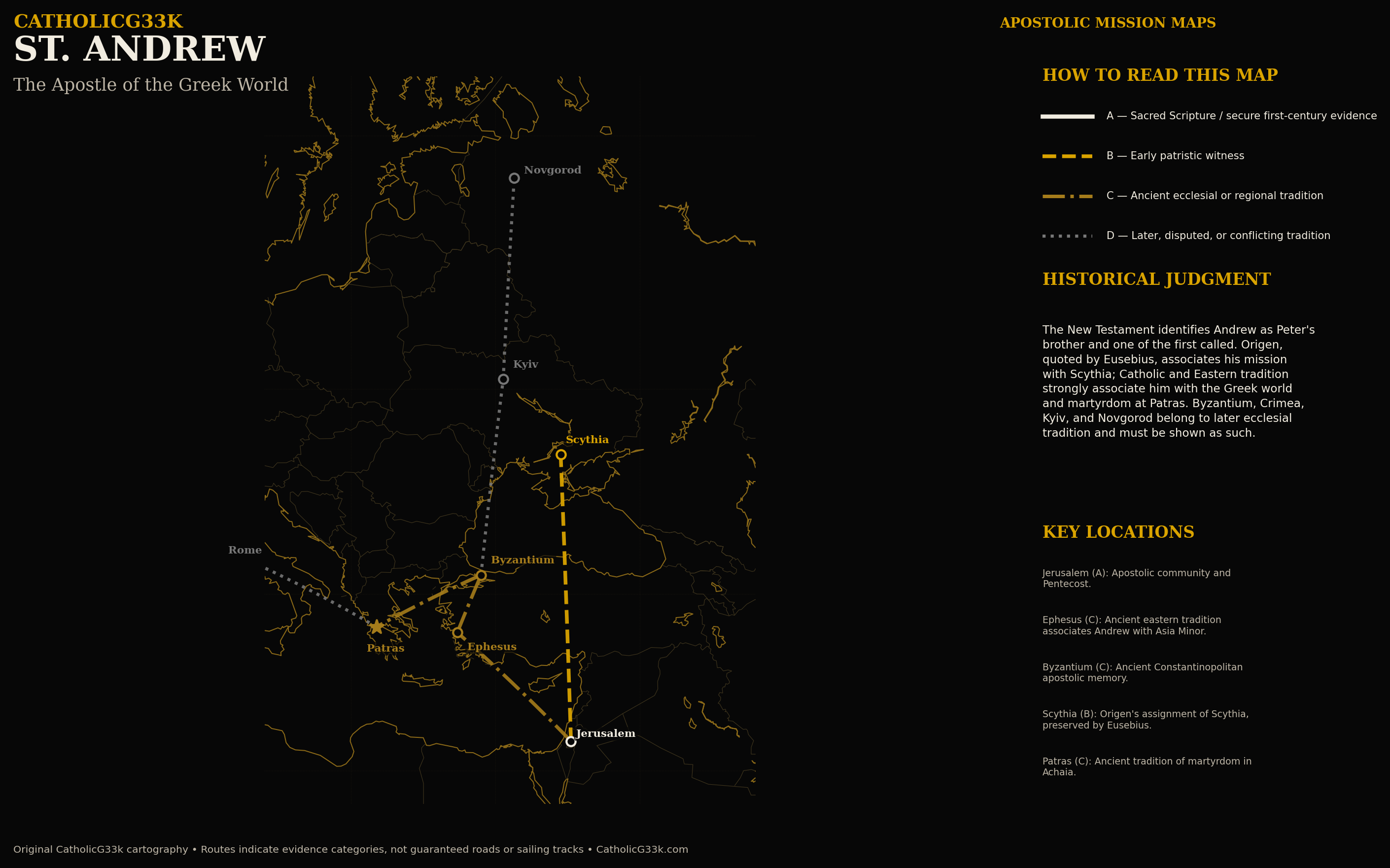
The New Testament identifies Andrew as Peter’s brother and one of the first called. Origen, quoted by Eusebius, associates his mission with Scythia; Catholic and Eastern tradition strongly associate him with the Greek world and martyrdom at Patras. Byzantium, Crimea, Kyiv, and Novgorod belong to later ecclesial tradition and must be shown as such.
Andrew appears in the Gospels as Peter’s brother and one of the first disciples called by Christ. The New Testament does not preserve a post-Pentecost travel diary for him. Origen, quoted by Eusebius, associates his mission with Scythia, while ancient Greek tradition connects him with Achaia and martyrdom at Patras.
The later prestige of Andrew in Byzantium, the Black Sea world, Kyiv, and Novgorod should be respected as ecclesial memory while remaining historically graded. The map therefore distinguishes an early mission-field notice from the much later routes attached to the Christianization of the Rus.’
Grade A: Jerusalem: Apostolic community and Pentecost.
Grade B: Scythia: Origen’s assignment of Scythia, preserved by Eusebius.
Grade C: Ephesus: Ancient eastern tradition associates Andrew with Asia Minor. Byzantium: Ancient Constantinopolitan apostolic memory. Patras: Ancient tradition of martyrdom in Achaia.
Grade D: Kyiv: Later Rus’ tradition. Novgorod: Later northern extension of the Rus’ tradition. Rome: Included on the source map but not securely evidenced as a mission stop.
St. James the Greater and the Spanish Tradition
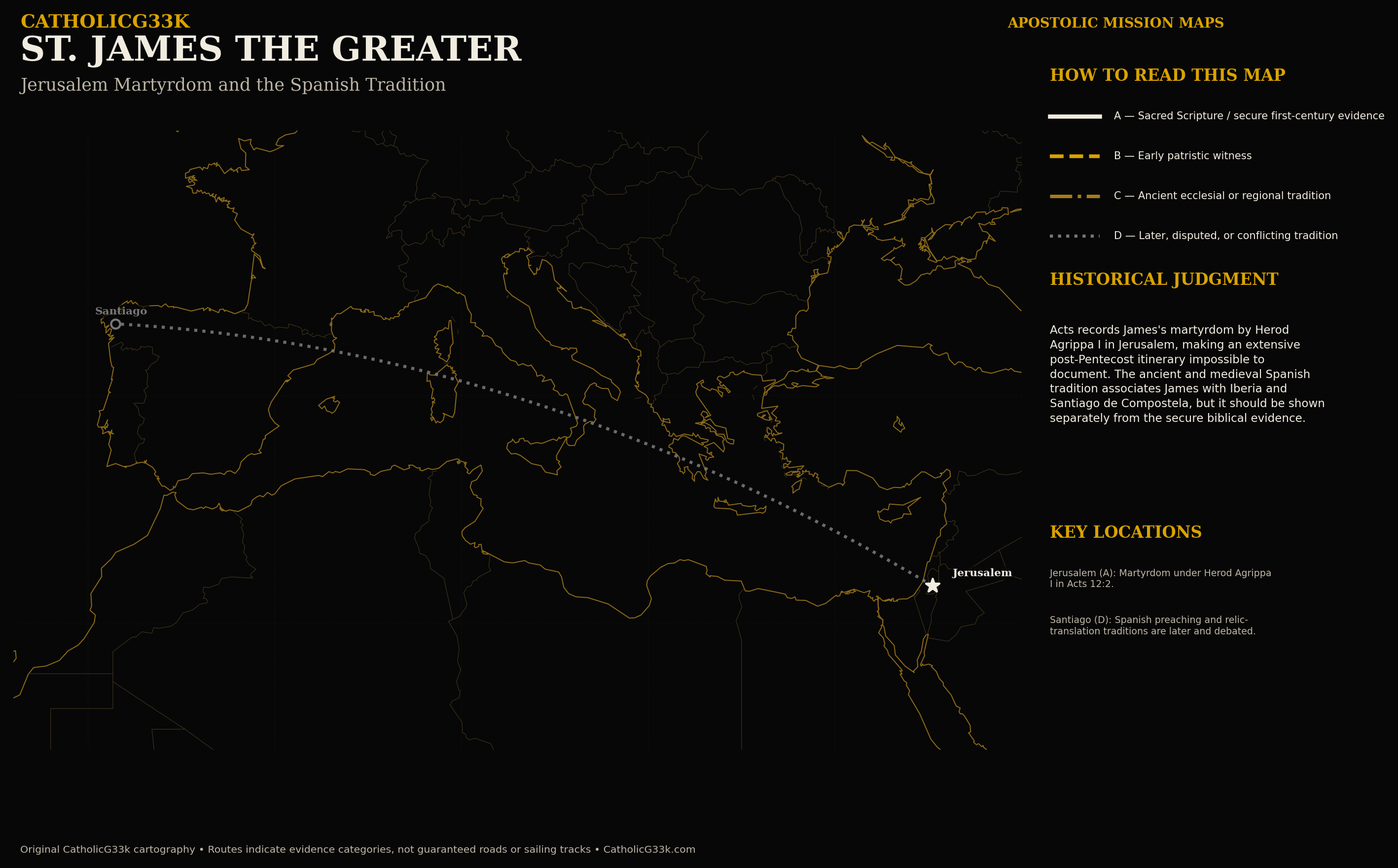
Acts records James’s martyrdom by Herod Agrippa I in Jerusalem, making an extensive post-Pentecost itinerary impossible to document. The ancient and medieval Spanish tradition associates James with Iberia and Santiago de Compostela, but it should be shown separately from the secure biblical evidence.
James the Greater presents a necessary chronological limit. Acts 12 records his execution under Herod Agrippa I, probably around AD 44. Because his martyrdom occurred early, any proposed mission to Spain must fit within a short period and cannot be verified from the New Testament or the earliest surviving Christian writers.
The Spanish and Compostela traditions became enormously important for medieval pilgrimage and Catholic devotion. They belong to the history of Christian memory, but a responsible page must distinguish their spiritual and cultural importance from the historical certainty of James’s Jerusalem martyrdom.
Grade A: Jerusalem: Martyrdom under Herod Agrippa I in Acts 12:2.
Grade D: Santiago: Spanish preaching and relic-translation traditions are later and debated.
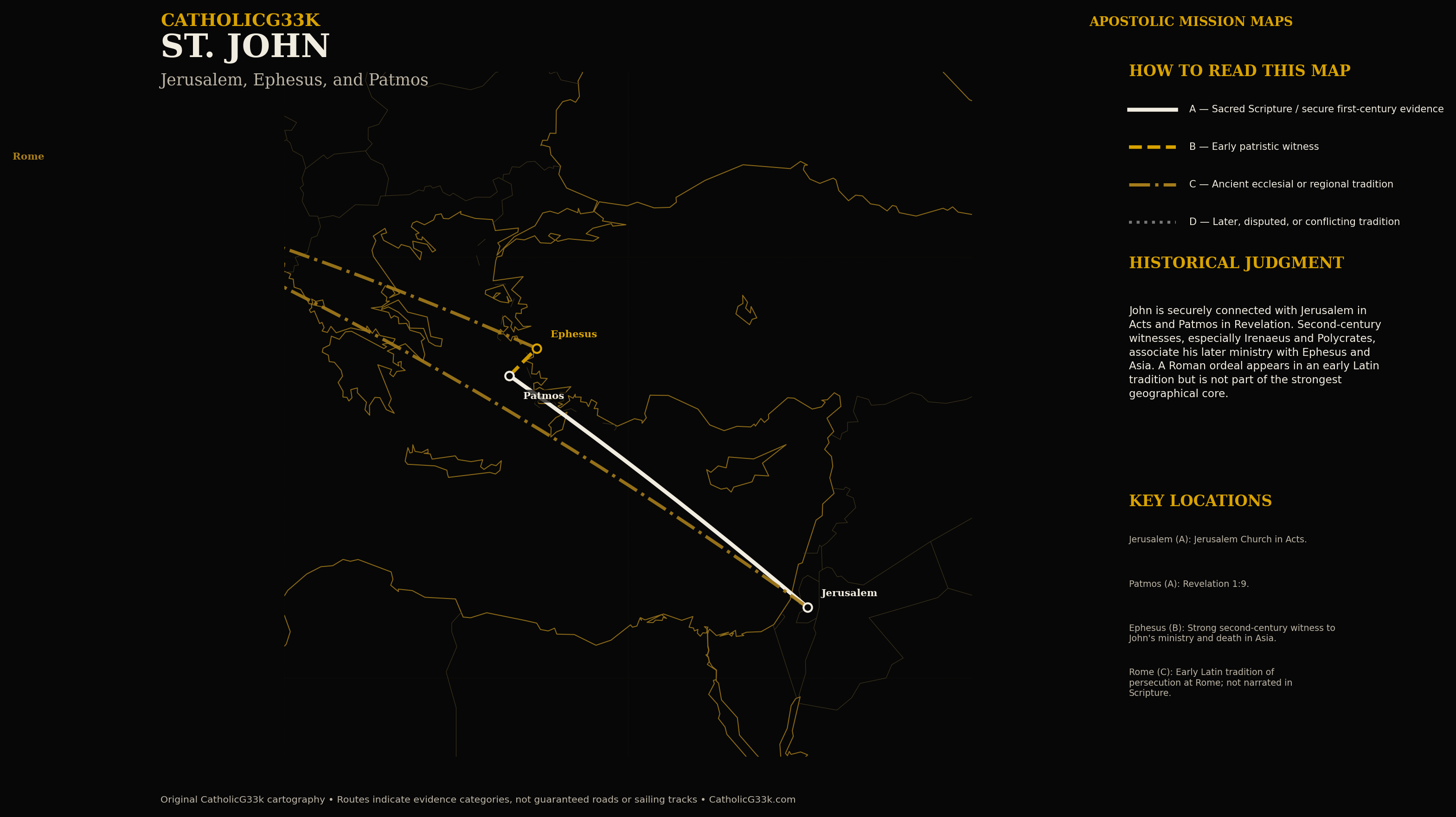
St. John: Jerusalem, Ephesus, and Patmos
John is securely connected with Jerusalem in Acts and Patmos in Revelation. Second-century witnesses, especially Irenaeus and Polycrates, associate his later ministry with Ephesus and Asia. A Roman ordeal appears in an early Latin tradition but is not part of the strongest geographical core.
John is securely connected with the Jerusalem Church and with Patmos through the Book of Revelation. Strong second-century witnesses, especially Irenaeus and Polycrates, associate his later life with Ephesus and the churches of Asia. This combination makes the Jerusalem–Patmos–Ephesus pattern historically substantial even though every intermediate movement is unknown.
Traditions of a Roman ordeal may be ancient, but they are not as secure as the Asian evidence. The map emphasizes the durable Johannine memory of Ephesus without pretending that all questions concerning authorship, chronology, and the identity of every figure named John are simple.
Grade A: Jerusalem: Jerusalem Church in Acts. Patmos: Revelation 1:9.
Grade B: Ephesus: Strong second-century witness to John’s ministry and death in Asia.
Grade C: Rome: Early Latin tradition of persecution at Rome; not narrated in Scripture.
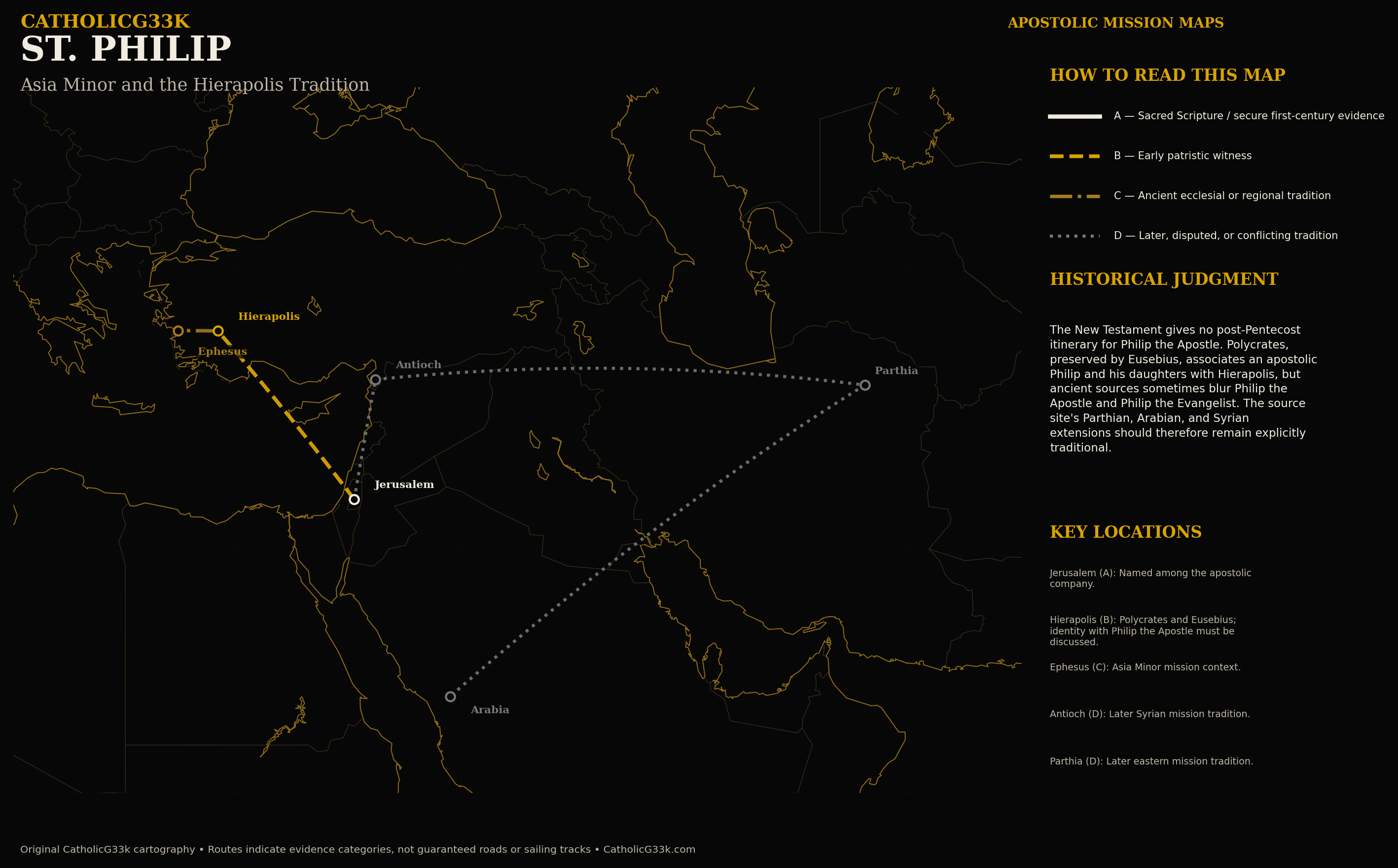
St. Philip and the Hierapolis Tradition
The New Testament gives no post-Pentecost itinerary for Philip the Apostle. Polycrates, preserved by Eusebius, associates an apostolic Philip and his daughters with Hierapolis, but ancient sources sometimes blur Philip the Apostle and Philip the Evangelist. The source site’s Parthian, Arabian, and Syrian extensions should therefore remain explicitly traditional.
Philip requires an identity warning. The New Testament distinguishes Philip the Apostle from Philip the Evangelist, yet later sources sometimes combine details associated with them. Polycrates, preserved by Eusebius, remembers a Philip and prophetic daughters at Hierapolis, but scholars debate which Philip is meant.
The map therefore gives Hierapolis real weight while labeling broader Syrian, Parthian, and Arabian routes as later tradition. Catholic historical honesty does not require discarding ancient memory; it requires refusing to solve an identity problem by assertion.
Grade A: Jerusalem: Named among the apostolic company.
Grade B: Hierapolis: Polycrates and Eusebius; identity with Philip the Apostle must be discussed.
Grade C: Ephesus: Asia Minor mission context.
Grade D: Antioch: Later Syrian mission tradition. Parthia: Later eastern mission tradition. Arabia: Later route tradition.
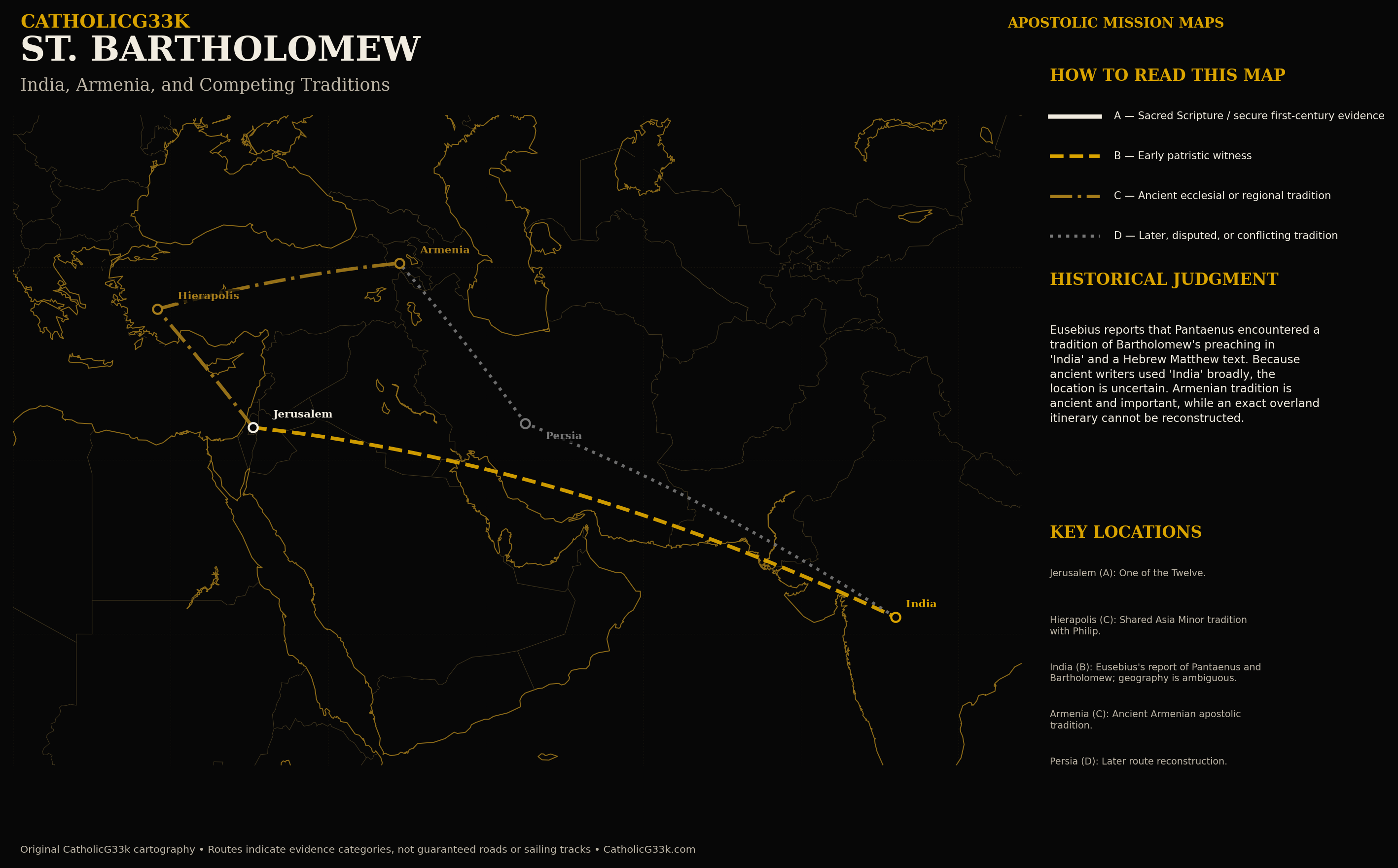
St. Bartholomew: India and Armenia
Eusebius reports that Pantaenus encountered a tradition of Bartholomew’s preaching in ‘India’ and a Hebrew Matthew text. Because ancient writers used ‘India’ broadly, the location is uncertain. Armenian tradition is ancient and important, while an exact overland itinerary cannot be reconstructed.
Bartholomew’s name appears in the apostolic lists, while the Gospel of John names Nathanael. The traditional identification of the two is possible and longstanding, but not explicitly made in Scripture. Eusebius reports that Pantaenus encountered a tradition in “India” that Bartholomew had preached there and left a Hebrew form of Matthew.
Ancient geographical language is the central difficulty. “India” could indicate lands east or south of the Roman world more broadly than the modern nation. Armenian tradition is also ancient and important. The CatholicG33k map presents India and Armenia as mission traditions rather than joining them into a fabricated exact itinerary.
Grade A: Jerusalem: One of the Twelve.
Grade B: India: Eusebius’s report of Pantaenus and Bartholomew; geography is ambiguous.
Grade C: Hierapolis: Shared Asia Minor tradition with Philip. Armenia: Ancient Armenian apostolic tradition.
Grade D: Persia: Later route reconstruction.
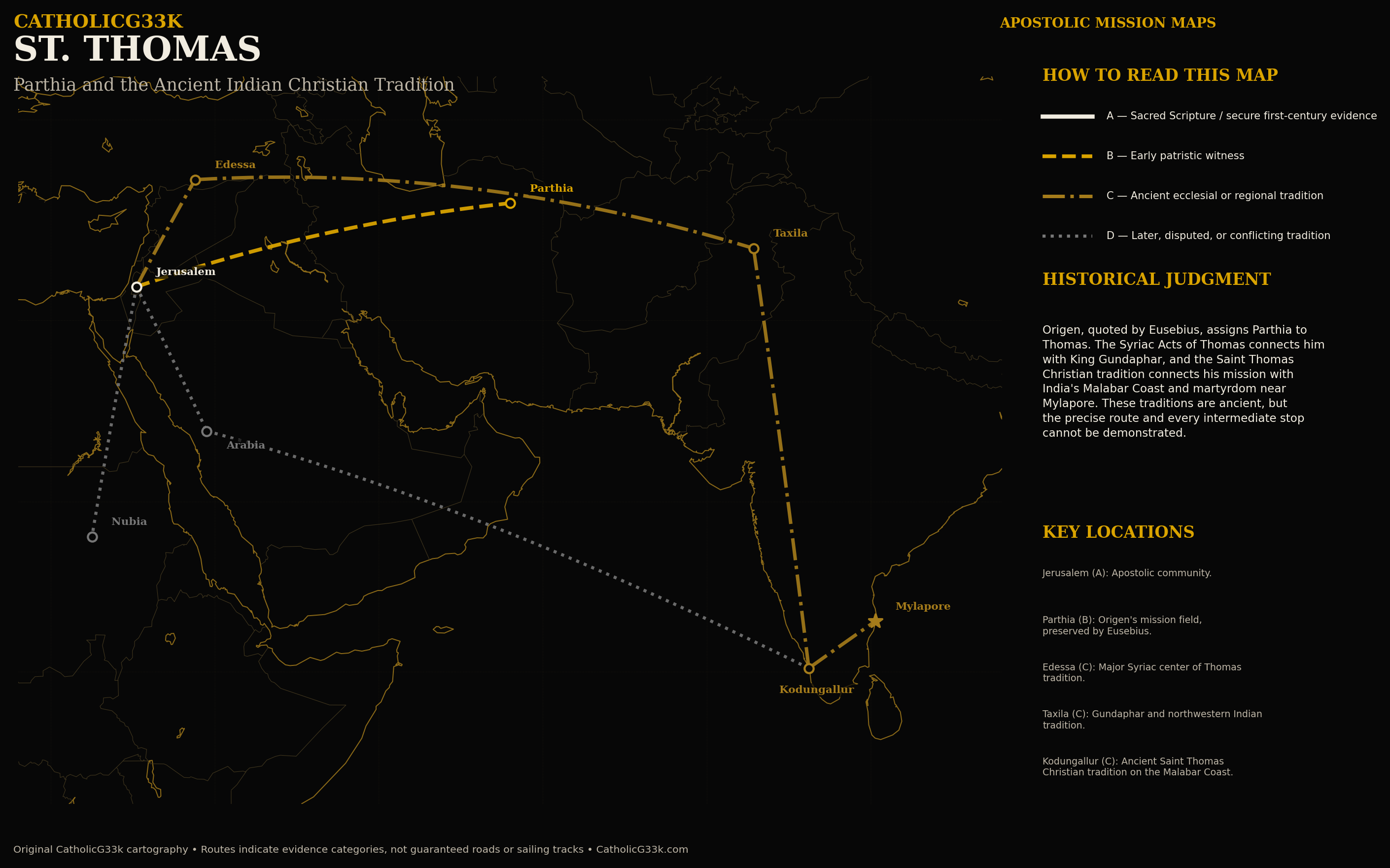
St. Thomas: Parthia and India
Origen, quoted by Eusebius, assigns Parthia to Thomas. The Syriac Acts of Thomas connects him with King Gundaphar, and the Saint Thomas Christian tradition connects his mission with India’s Malabar Coast and martyrdom near Mylapore. These traditions are ancient, but the precise route and every intermediate stop cannot be demonstrated.
Thomas possesses one of the strongest non-biblical apostolic mission traditions. Origen, through Eusebius, associates him with Parthia. Syriac Christianity developed a rich Thomas tradition centered on Edessa, while the Acts of Thomas connects him with King Gundaphar. The Saint Thomas Christians of India preserve an ancient ecclesial memory of his arrival and martyrdom.
The exact road from Jerusalem to India cannot be reconstructed. North Indian, Persian, Arabian, and maritime possibilities remain debated. The map honors the deep antiquity of the Syriac and Indian traditions while declining to convert a sacred memory into an unsupported turn-by-turn route.
Grade A: Jerusalem: Apostolic community.
Grade B: Parthia: Origen’s mission field, preserved by Eusebius.
Grade C: Edessa: Major Syriac center of Thomas tradition. Taxila: Gundaphar and northwestern Indian tradition. Kodungallur: Ancient Saint Thomas Christian tradition on the Malabar Coast. Mylapore: Ancient martyrdom and tomb tradition.
Grade D: Arabia: Possible maritime or overland route; not securely recoverable. Nubia: Included in later expansive maps but weakly connected to Thomas.
St. Matthew and the Eastern Mission Traditions
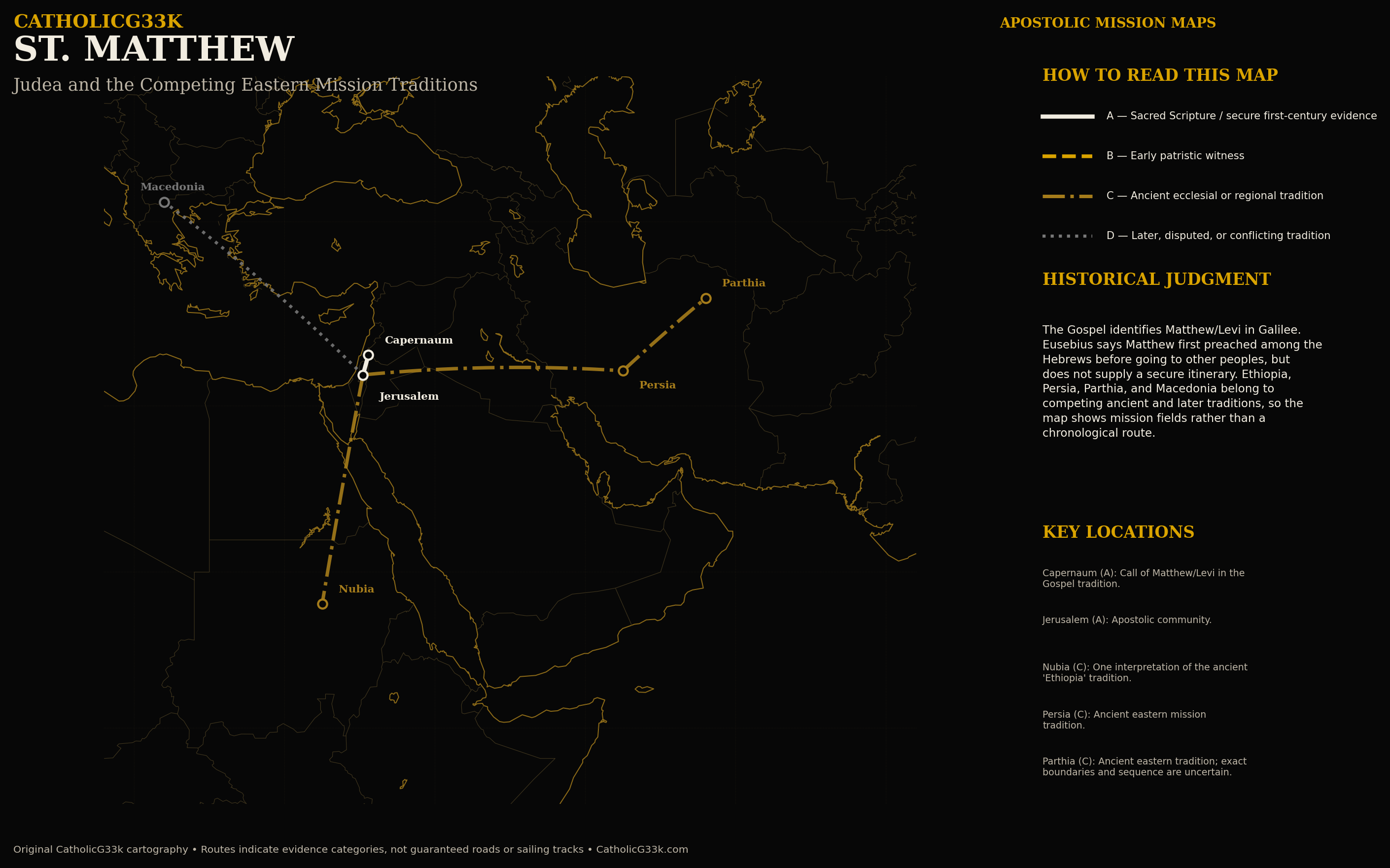
The Gospel identifies Matthew/Levi in Galilee. Eusebius says Matthew first preached among the Hebrews before going to other peoples, but does not supply a secure itinerary. Ethiopia, Persia, Parthia, and Macedonia belong to competing ancient and later traditions, so the map shows mission fields rather than a chronological route.
Matthew is known securely as the tax collector called by Christ and as one of the Twelve. Eusebius reports that he first preached among the Hebrews before going to other peoples, but the surviving notice does not identify one certain destination. Later traditions place him in Ethiopia, Arabia, Persia, Parthia, or Macedonia.
Because the ancient word “Ethiopia” could refer to regions south of Egypt rather than the modern country alone, and because eastern traditions conflict, the map displays alternative mission fields. It does not claim that Matthew traveled through every region in the order shown by later compilations.
Grade A: Capernaum: Call of Matthew/Levi in the Gospel tradition. Jerusalem: Apostolic community.
Grade C: Nubia: One interpretation of the ancient ‘Ethiopia’ tradition. Persia: Ancient eastern mission tradition. Parthia: Ancient eastern tradition; exact boundaries and sequence are uncertain.
Grade D: Macedonia: Later route tradition.
St. James, Son of Alphaeus
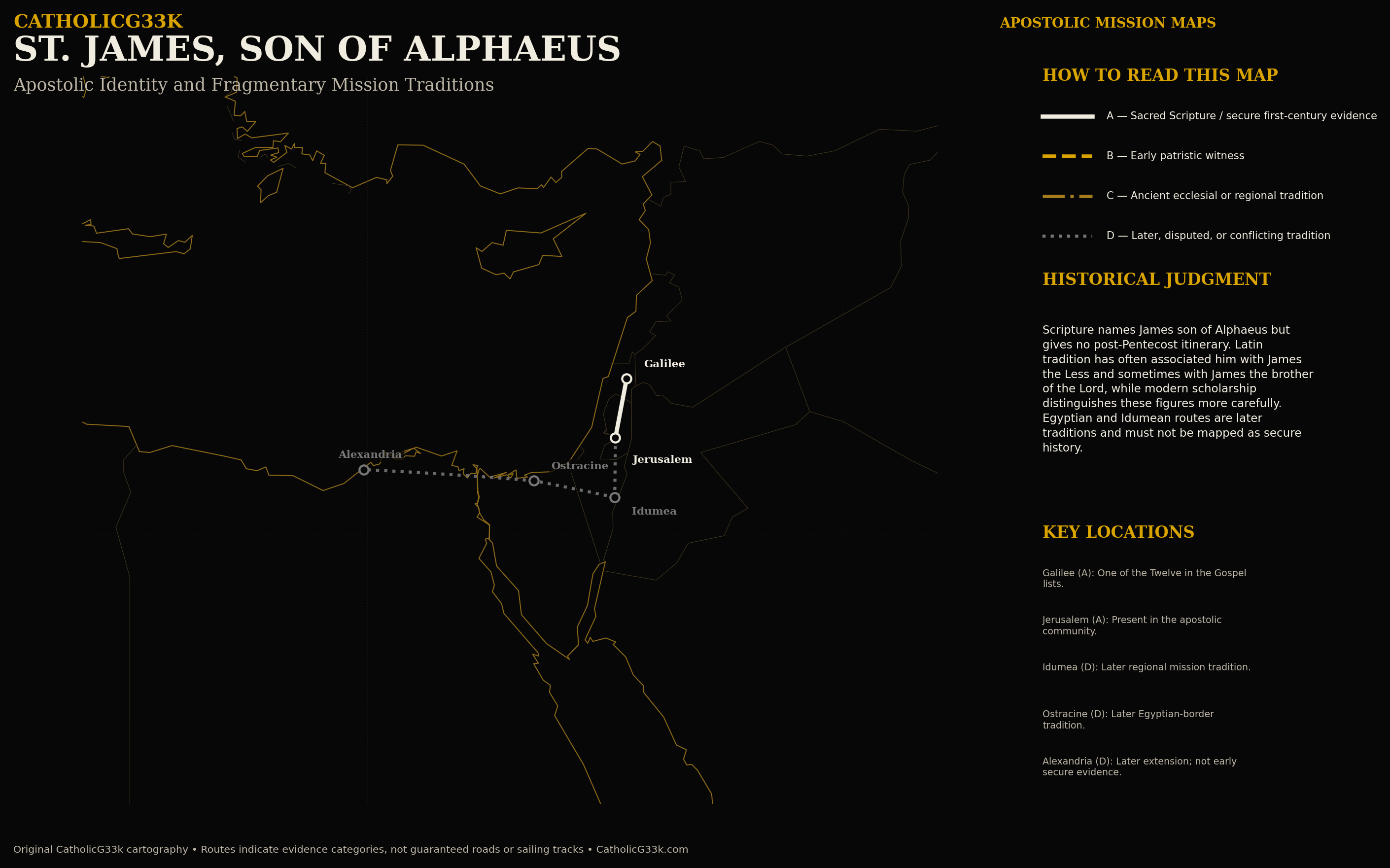
Scripture names James son of Alphaeus but gives no post-Pentecost itinerary. Latin tradition has often associated him with James the Less and sometimes with James the brother of the Lord, while modern scholarship distinguishes these figures more carefully. Egyptian and Idumean routes are later traditions and must not be mapped as secure history.
James son of Alphaeus is named among the Twelve, but Scripture supplies no later itinerary. Historical confusion arises because Christian tradition has sometimes identified him with James the Less and with James the brother of the Lord. Those identifications have been defended in Catholic tradition but are not accepted uniformly by modern scholars.
Egyptian and Idumean mission claims are therefore highly uncertain. The map’s restraint is part of its value: it shows that an Apostle can be honored fully even when the evidence does not permit a confident biography.
Grade A: Galilee: One of the Twelve in the Gospel lists. Jerusalem: Present in the apostolic community.
Grade D: Idumea: Later regional mission tradition. Ostracine: Later Egyptian-border tradition. Alexandria: Later extension; not early secure evidence.
St. Simon the Zealot
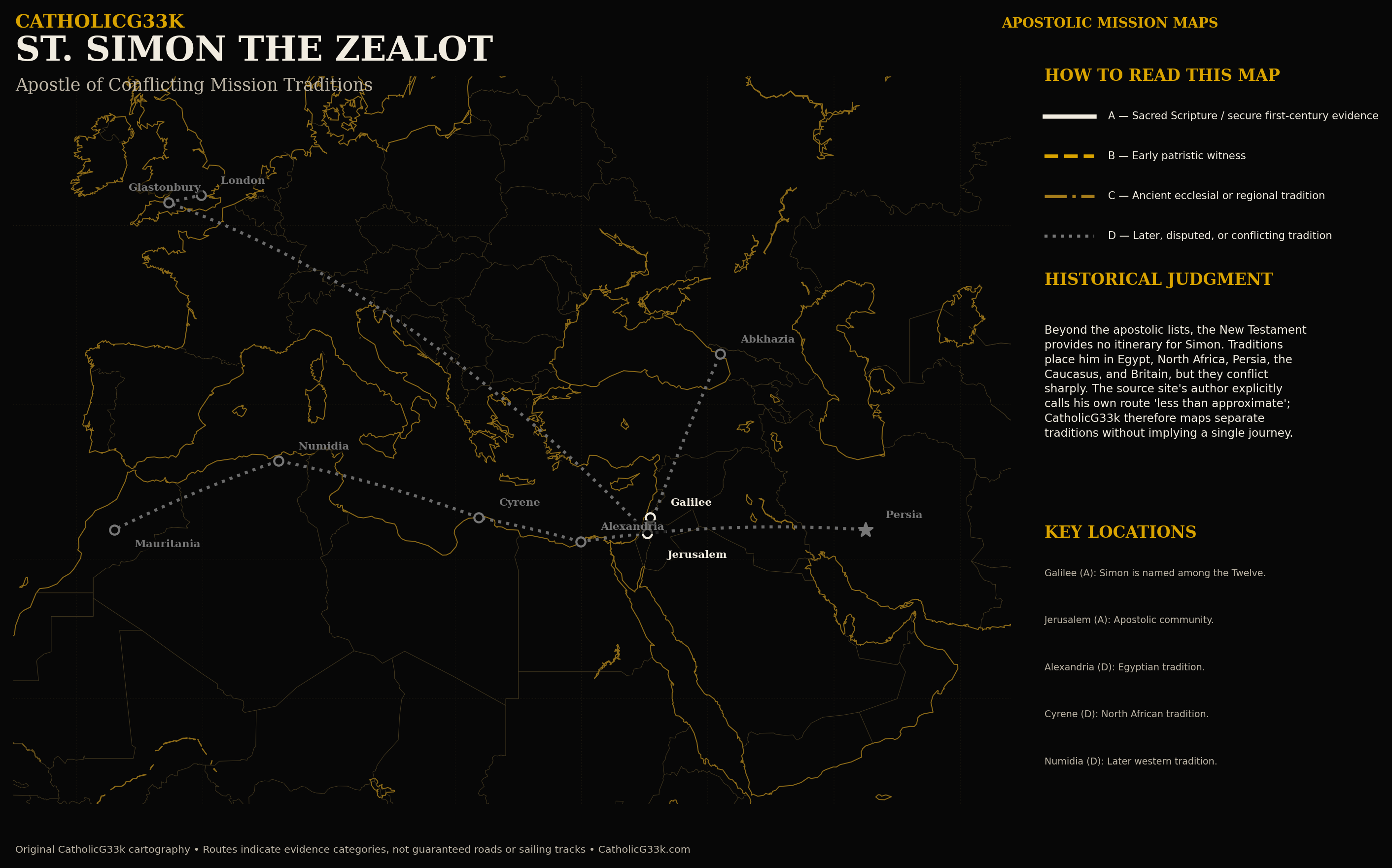
Beyond the apostolic lists, the New Testament provides no itinerary for Simon. Traditions place him in Egypt, North Africa, Persia, the Caucasus, and Britain, but they conflict sharply. The source site’s author explicitly calls his own route ‘less than approximate’; CatholicG33k therefore maps separate traditions without implying a single journey.
Simon is identified by the Gospel lists as the Zealot or Cananaean. Beyond that, the New Testament does not describe his mission. Traditions send him to Egypt, North Africa, Persia, the Caucasus, and Britain, sometimes pairing his martyrdom with Jude. These accounts cannot be combined into one coherent journey without speculation.
The source map used for research admitted that its Simon route was less than approximate. CatholicG33k retains the traditions as separate evidence-graded possibilities. The resulting map is deliberately less dramatic but more truthful.
Grade A: Galilee: Simon is named among the Twelve. Jerusalem: Apostolic community.
Grade D: Alexandria: Egyptian tradition. Cyrene: North African tradition. Numidia: Later western tradition. Mauritania: Later western tradition. Glastonbury: Late British tradition. London: Late British tradition. Persia: Ancient/later eastern martyrdom tradition, often paired with Jude. Abkhazia: Caucasian tradition.
St. Jude Thaddeus: Syria, Mesopotamia, and Persia
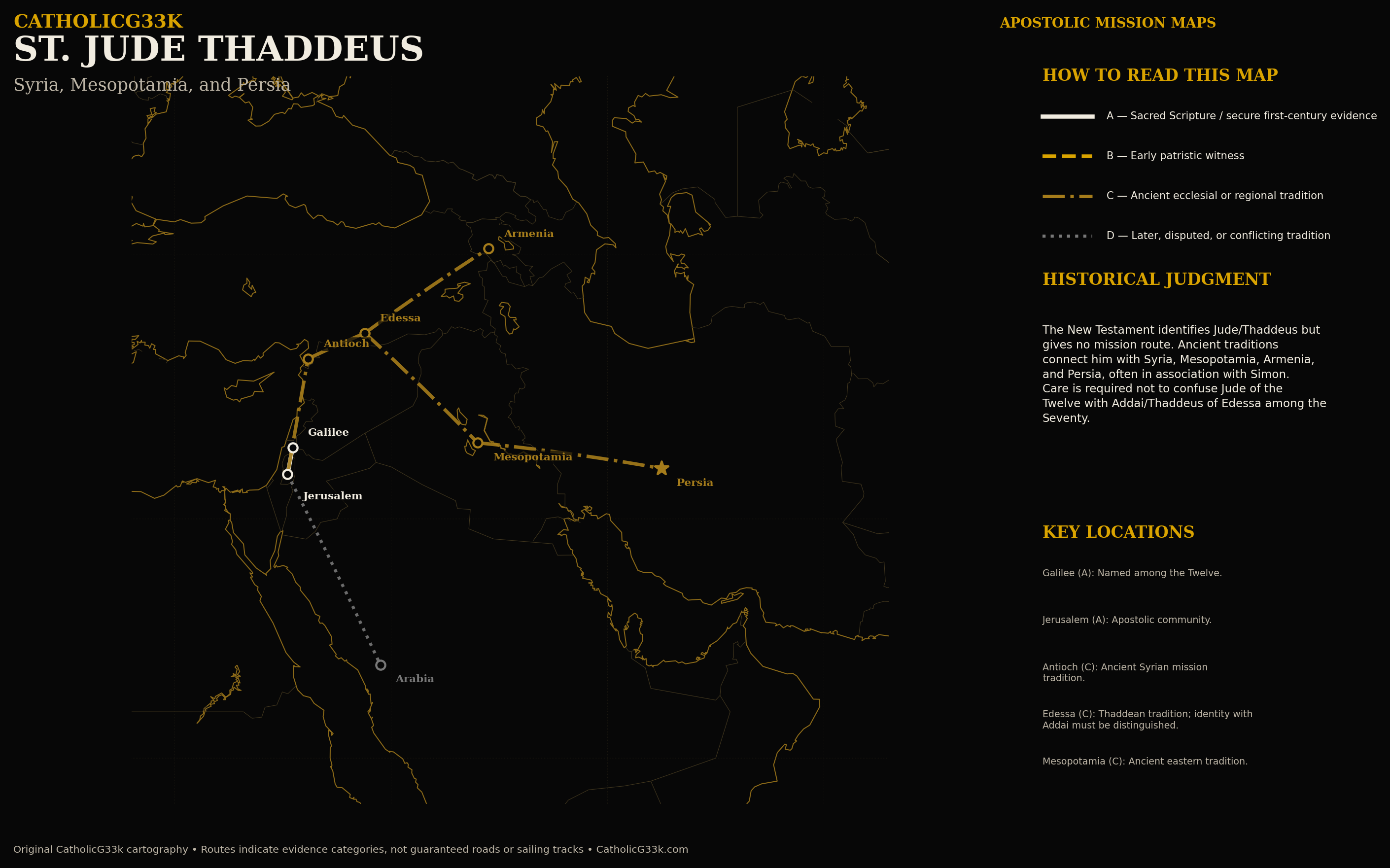
The New Testament identifies Jude/Thaddeus but gives no mission route. Ancient traditions connect him with Syria, Mesopotamia, Armenia, and Persia, often in association with Simon. Care is required not to confuse Jude of the Twelve with Addai/Thaddeus of Edessa among the Seventy.
Jude or Thaddeus is one of the Twelve and must be distinguished from Judas Iscariot. Ancient traditions associate him with Syria, Mesopotamia, Armenia, and Persia, often alongside Simon. Another difficulty is the relationship between Jude of the Twelve and Addai or Thaddeus of Edessa, a missionary commonly counted among the Seventy.
The map treats the Syrian and eastern traditions as ancient ecclesial memory while warning against collapsing separate persons automatically. This distinction protects both the Apostle and the particular heritage of the Syriac and Armenian churches.
Grade A: Galilee: Named among the Twelve. Jerusalem: Apostolic community.
Grade C: Antioch: Ancient Syrian mission tradition. Edessa: Thaddean tradition; identity with Addai must be distinguished. Mesopotamia: Ancient eastern tradition. Armenia: Armenian apostolic tradition. Persia: Ancient martyrdom tradition, often paired with Simon.
Grade D: Arabia: Later regional extension.
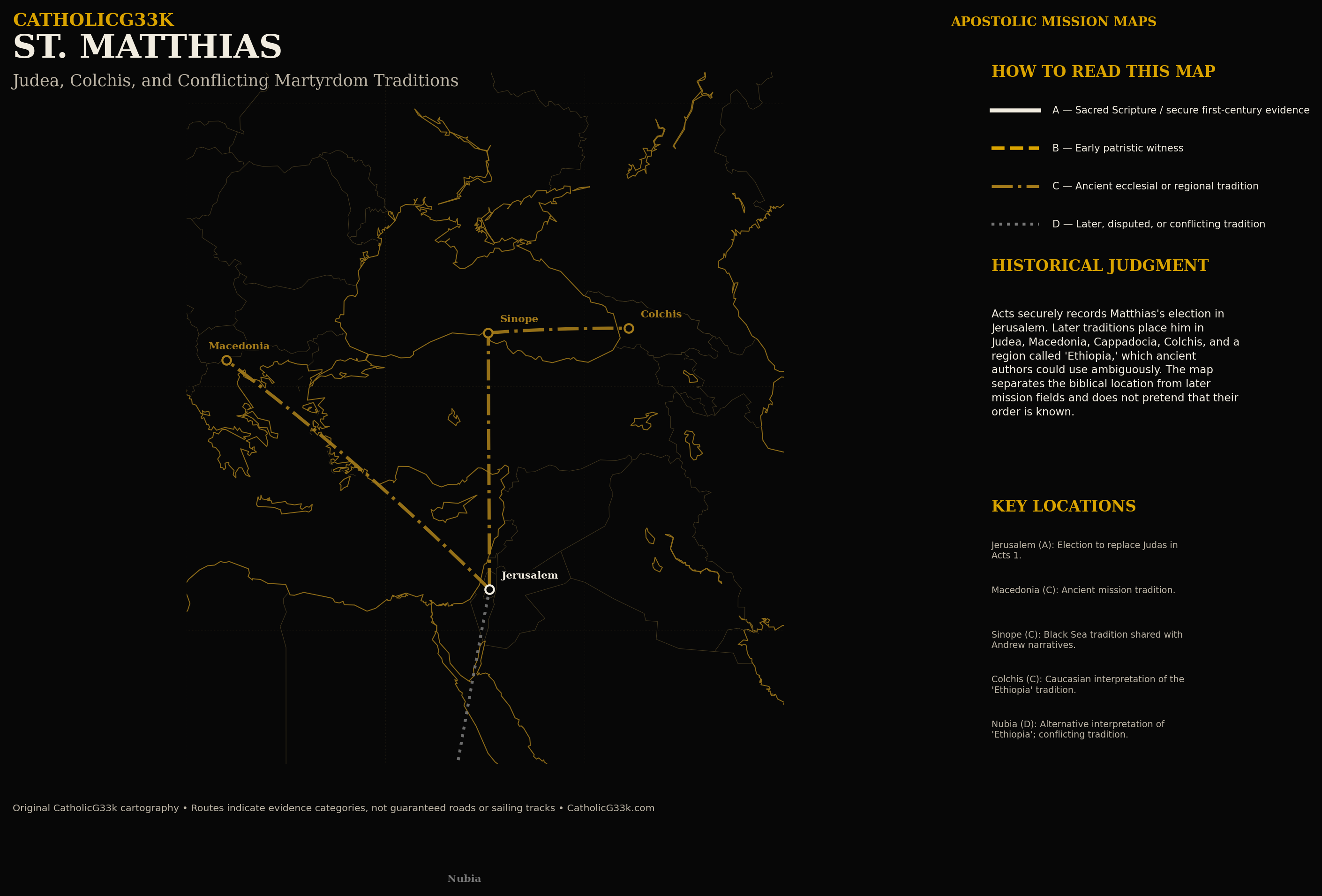
St. Matthias and the Black Sea Traditions
Acts securely records Matthias’s election in Jerusalem. Later traditions place him in Judea, Macedonia, Cappadocia, Colchis, and a region called ‘Ethiopia,’ which ancient authors could use ambiguously. The map separates the biblical location from later mission fields and does not pretend that their order is known.
Acts records the election of Matthias to restore the Twelve after Judas’s death. That Jerusalem event is secure; his subsequent mission is not. Traditions place him in Judea, Macedonia, Cappadocia, Colchis, or a region called Ethiopia, and accounts of his death also differ.
The ambiguity of “Ethiopia” matters here as it does for Matthew. Some traditions point toward Nubia or lands south of Egypt; others understand a Caucasian region. The map separates those possibilities rather than presenting a single confident path.
Grade A: Jerusalem: Election to replace Judas in Acts 1.
Grade C: Macedonia: Ancient mission tradition. Sinope: Black Sea tradition shared with Andrew narratives. Colchis: Caucasian interpretation of the ‘Ethiopia’ tradition.
Grade D: Nubia: Alternative interpretation of ‘Ethiopia’; conflicting tradition.
St. Paul: The Journeys Recorded in Acts
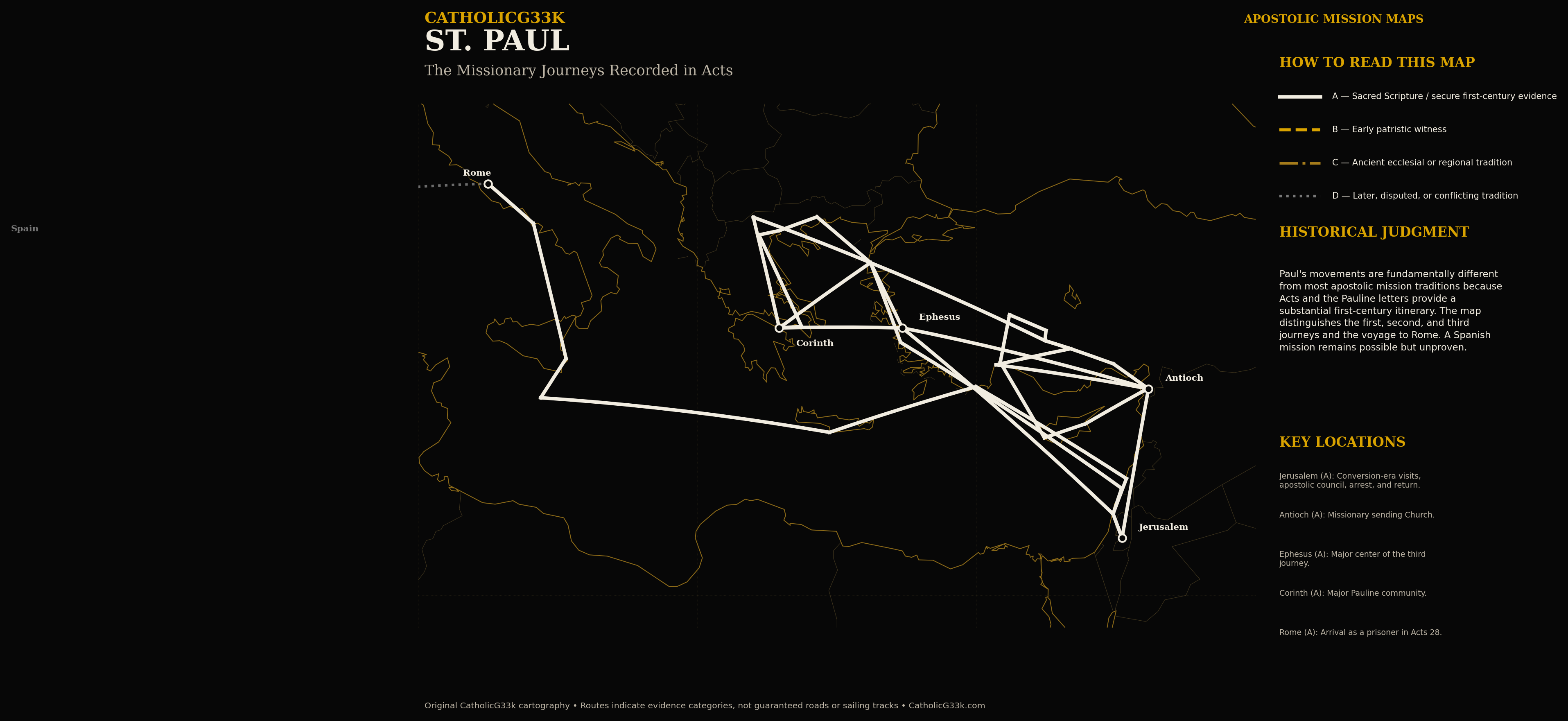
Paul’s movements are fundamentally different from most apostolic mission traditions because Acts and the Pauline letters provide a substantial first-century itinerary. The map distinguishes the first, second, and third journeys and the voyage to Rome. A Spanish mission remains possible but unproven.
Paul belongs on this page even though he was not one of the Twelve because his mission dominates the documentary record of Acts and the Pauline letters. His routes through Cyprus, Asia Minor, Macedonia, Greece, Jerusalem, Caesarea, Malta, and Rome can be reconstructed with far greater confidence than most apostolic journeys.
Romans records Paul’s intention to preach in Spain, but the New Testament does not confirm that he arrived there. Later testimony makes a western mission possible. The map therefore renders the Acts journeys as secure and Spain as intended or possible rather than established.
Grade A: Jerusalem: Conversion-era visits, apostolic council, arrest, and return. Antioch: Missionary sending Church. Ephesus: Major center of the third journey. Corinth: Major Pauline community. Rome: Arrival as a prisoner in Acts 28.
Grade D: Spain: Paul intended to go to Spain (Romans 15), but completion is not certain.
Coworkers, Not Isolated Travelers
Maps centered on the Apostles can unintentionally imply that twelve heroic individuals evangelized the world alone. Acts and the letters show something richer. Barnabas, Silas, Timothy, Titus, Luke, Mark, Apollos, Philip the Evangelist, Priscilla and Aquila, Phoebe, Lydia, Junia, Epaphras, deacons, prophets, household leaders, widows, patrons, and unnamed believers formed the missionary network of the early Church.
Local Churches were not temporary audience stops. They became enduring Eucharistic communities with ministers, discipline, charity, teaching, and responsibility for neighboring regions. Apostles revisited communities, wrote letters, sent delegates, received reports, corrected disorders, and appointed successors. Mission therefore created communion rather than a collection of disconnected spiritual experiences.
Women were indispensable to this expansion. They hosted churches in their homes, supported missionary labor, instructed converts, carried letters, served the poor, and risked persecution. A complete Catholic account honors apostolic authority while also recovering the wider body through which the Spirit spread the Gospel.
What the Maps Can and Cannot Prove
The maps can show the scale of Christian memory, the concentration of stronger evidence, the relationship between apostolic mission and later historic Churches, and the difference between a documented location and a later claim. They can help readers see why Antioch, Rome, Ephesus, Edessa, Armenia, India, and the Black Sea world became important in apostolic tradition.
They cannot prove that an Apostle followed the exact line drawn, visited every location in the displayed order, founded every later institution that claimed him, or preached within modern national borders bearing modern names. Ancient geographical terms often covered broad and shifting regions. Travel occurred by roads, coastwise sailing, household networks, and routes that are no longer recoverable.
A map also cannot determine doctrine. Catholic faith in the apostolicity of the Church rests upon Christ’s commission, the witness of Scripture and Tradition, the sacramental life, and the succession of apostolic ministry. An uncertain route for Simon or Matthew does not make the Church less apostolic, and a cherished local tradition does not become doctrine simply because it is old.
Apostolic Succession and the Church's Mission
The Apostles did more than travel. They preached a definite Gospel, baptized, celebrated the breaking of bread, laid hands upon ministers, judged disputes, guarded communion, and handed on authority. The Church remains apostolic because she is founded upon the Apostles, preserves their teaching, and continues their mission through the bishops in communion with the successor of Peter.
Apostolic succession is not a claim that every later bishop possesses the personal holiness or extraordinary founding role of an Apostle. It is the ordered transmission of ecclesial office within the one Church, serving fidelity to Christ’s deposit of faith and the sacramental communion He established.
The maps therefore end in the present. Every parish, mission, family, monastery, school, digital apostolate, and work of mercy participates in the same outward movement when it remains faithful to the Gospel received from the Apostles.
Primary Evidence and Historical Judgment
The evidence for Apostolic Missions & Maps must be read by genre. Narrative histories, letters, laws, inscriptions, archaeology, liturgical texts, theological arguments, and later hagiography answer different questions. A late summary can preserve earlier memory, but it cannot automatically outweigh contemporary evidence.
Chronology controls interpretation. The strongest reconstruction of Apostolic Missions & Maps begins with securely dated events and then places later testimony around them. This prevents later institutions, vocabulary, or controversies from being projected backward unchanged.
Interpretive boundaries are essential. A responsible account of Apostolic Missions & Maps distinguishes the event or institution itself from later retellings, doctrinal reception, devotional memory, and modern controversy. Conclusions are graded rather than forced into certainty.
Catholic significance follows from truthful history. The study of Apostolic Missions & Maps should illuminate apostolic continuity, worship, doctrine, mission, holiness, and human responsibility without allowing later concerns to erase the original chronology and evidence.
Common Misconceptions
“Every Apostle’s itinerary is known.”
No. Acts documents some ministries extensively, but most apostolic routes are preserved through traditions of varying date and reliability.
“Anything not written in Acts is automatically false.”
No. Early Christian writers and ancient local Churches can preserve real historical memory. Their testimony must be dated, compared, and evaluated rather than dismissed automatically.
“An ancient tradition proves every detail attached to it.”
No. A tradition may preserve a genuine association while later storytelling expands the route, miracles, chronology, or manner of death.
“A line on a map represents the exact road traveled.”
No. These lines visualize relationships between mission fields. They do not claim knowledge of every road, port, stop, or date.
“The Apostles founded isolated denominations.”
No. Their mission formed one Church in communion, expressed in local Churches gathered around the apostolic faith, Sacraments, and ordained ministry.
“Uncertainty weakens Catholic faith.”
No. Distinguishing revelation, early testimony, ancient tradition, and later legend strengthens credibility and prevents apologetics from depending upon exaggerated claims.
Catechism Highlights
- CCC 75-79: the Apostles transmitted what they received from Christ, orally and in writing.
- CCC 80-83: Sacred Scripture and Sacred Tradition communicate the one deposit of the Word of God.
- CCC 849-856: the Church is missionary by her nature.
- CCC 857-865: the Church is apostolic in foundation, teaching, succession, and mission.
- CCC 880-896: the college of bishops and the successor of Peter serve ecclesial communion.
- CCC 1267-1270: Baptism incorporates believers into Christ and His Church and calls them to witness.
Reflection Questions
- Why is it important to distinguish Scripture, early patristic witness, ancient tradition, and later legend?
- Which apostolic mission tradition appears strongest after examining the evidence grades?
- How can local ecclesial memory remain valuable even when an exact itinerary cannot be proven?
- What does Paul’s documented mission teach us about the practical work of evangelization?
- How did coworkers, households, and local Churches share in the apostolic mission?
- Where is Christ sending me to witness faithfully today?
Prayer for Apostolic Courage
Lord Jesus Christ, You called the Apostles by name and sent them to proclaim Your death and Resurrection to every nation.
We thank You for their courage, their suffering, their teaching, and the Churches formed through their witness. Preserve us from careless claims and from unbelieving dismissal. Give us love for truth, reverence for the memory of the saints, and humility wherever the evidence remains uncertain.
Send the Holy Spirit upon Your Church today. Strengthen bishops, priests, deacons, religious, missionaries, catechists, families, scholars, and all the baptized. Make CatholicG33k a faithful instrument of the same Gospel entrusted to the Apostles.
May we carry Your Name wherever You send us and remain in the communion, doctrine, Sacraments, and charity of Your one Church.
Through Christ our Lord.
Final Reflection
The map of the apostolic mission is not ultimately a map of lines. It is a map of obedience. Fishermen, tax collectors, scholars, women of means, tentmakers, households, martyrs, bishops, and unnamed disciples carried the confession that Jesus Christ is Lord from Jerusalem into the nations.
Some routes are illuminated by Scripture. Others survive through the testimony of early writers or the ancient memory of Churches that still worship where the Apostles are believed to have preached. Still others remain uncertain. Truthful Catholic history receives each according to its proper weight.
The essential fact is not uncertain: the Apostles went because Christ sent them. The Church exists today because the Gospel was handed on. The same Lord now entrusts that mission to us.
Selected Catholic Sources and Further Reading
- Sacred Scripture passages directly relevant to Apostolic Missions & Maps, read in literary and historical context.
- Catechism of the Catholic Church, especially the paragraphs identified in this article.
- First Clement, especially the witness to Peter and Paul.
- Ignatius of Antioch, Letters.
- Irenaeus of Lyons, Against Heresies III.3.
- Eusebius of Caesarea, Ecclesiastical History, read critically alongside earlier sources.
- Polycrates of Ephesus and other early Asian witnesses preserved by Eusebius.
- Ancient Syriac, Armenian, Indian, Greek, Latin, and other regional ecclesial traditions.
- Pope Benedict XVI, catecheses on the Apostles and the origins of the Church.
- The evidence matrix and source-method notes included with the CatholicG33k map package.
Historical method: Evidence for Apostolic Missions & Maps must be weighed according to date, genre, authorship, purpose, geography, and independence. The Catechism supplies doctrinal synthesis; it does not replace ancient historical evidence. Later memory should be identified as secure, probable, traditional, disputed, or unknown.