

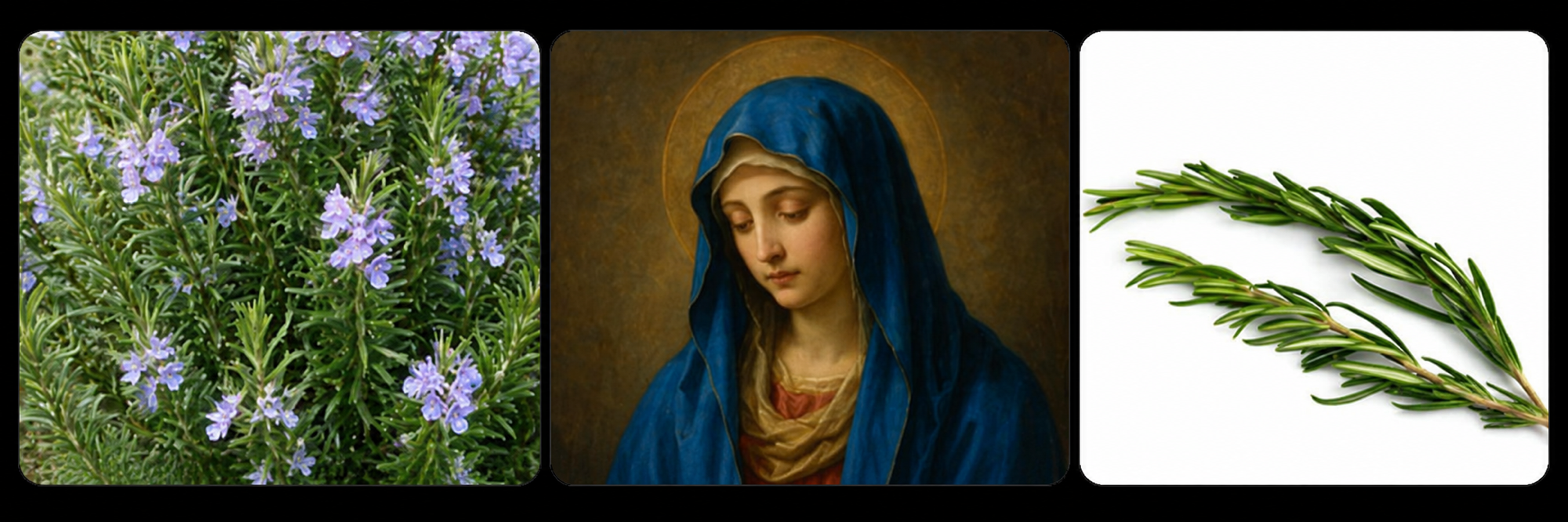
Among the many plants that have become associated with the Blessed Virgin Mary throughout Christian history, few are as beloved as rosemary. Its fragrant evergreen leaves, delicate blue flowers, and enduring symbolism have made it a cherished plant in Catholic homes, monasteries, and Marian gardens for centuries. Although Sacred Scripture never mentions rosemary by name, Christian tradition has woven the herb into beautiful stories that remind the faithful of Our Lady’s purity, humility, and maternal care.
It is important to distinguish between history, language, and pious tradition. The Church does not teach that rosemary possesses any supernatural connection with the Blessed Virgin Mary. Nevertheless, the rich devotional traditions surrounding the herb have inspired generations of Christians to meditate more deeply upon the life of the Mother of God.
The Meaning of the Name “Rosemary”
Many Christians have heard that the word rosemary means “Rose of Mary.” While this interpretation has become popular in devotional writings, it is not the true linguistic origin of the plant’s name.
The English word rosemary comes from the Latin ros marinus, which literally means “dew of the sea.” Ancient Romans gave the plant this name because it commonly grew along the Mediterranean coastline where sea mist covered the plants each morning. The Greek physician Dioscorides and the Roman naturalist Pliny the Elder both referred to the herb long before Christianity associated it with the Virgin Mary.
Yet Christians often found deeper spiritual meaning in existing names. Over time, many believers affectionately interpreted ros marinus as Rose of Mary, not as a statement of etymology but as a devotional title expressing love for the Mother of God. Just as medieval Christians saw spiritual symbolism throughout creation, rosemary naturally became one of the flowers dedicated to Our Lady.
The Medieval Legend of Mary’s Blue Mantle
One of the best-known Christian legends about rosemary takes place during the Flight into Egypt.
According to the Gospel of St. Matthew:
“And after they were departed, behold an angel of the Lord appeared in sleep to Joseph, saying: Arise, and take the child and his mother, and fly into Egypt…” (Matthew 2:13, Douay-Rheims)
Medieval tradition imagines that during this difficult journey the Holy Family paused to rest. Mary is said to have placed her blue mantle over a rosemary bush while caring for the Christ Child.
Before this event, the legend says, the rosemary blossoms were white. After the Virgin removed her cloak, the flowers had miraculously turned blue and retained that color forever in honor of the Mother of God.
This beautiful story is not found in Scripture, the writings of the Church Fathers, or any official teaching of the Catholic Church. Rather, it belongs to the treasury of Christian folklore and devotional legend. Its purpose is not to record history but to encourage meditation upon Mary’s loving care for Jesus and God’s blessing upon His creation.
The blue blossoms naturally reminded Christians of Mary’s traditional blue garments in sacred art, symbolizing heaven, purity, and fidelity.
Rosemary as a Symbol of Remembrance
Long before Christianity, rosemary symbolized remembrance and faithful memory.
The Greeks and Romans wore rosemary during ceremonies and believed it aided memory. Students often braided rosemary into wreaths while studying.
Christians transformed this ancient symbolism into something much deeper.
Rosemary came to represent:
- remembering Christ’s Passion,
- remembering the Blessed Virgin,
- remembering the saints,
- remembering the faithful departed.
Because rosemary remains green throughout the year, it also became a symbol of eternal life and the hope of the Resurrection.
Many Catholics placed rosemary upon graves, carried sprigs during funerals, or planted it in cemetery gardens as a sign that those who die in Christ await the resurrection of the body.
This symbolism harmonizes beautifully with Our Lady, who “kept all these words, pondering them in her heart” (Luke 2:19; cf. Luke 2:51). Mary herself becomes the model of holy remembrance, faithfully contemplating the mysteries of Christ throughout her life.
Rosemary in Marian Gardens
During the Middle Ages, monasteries and convents cultivated gardens filled with plants that reminded the faithful of the Blessed Virgin Mary.
These became known as Marian gardens.
Every flower, herb, tree, and vine carried symbolic meaning.
Rosemary was often planted alongside:
- lilies, symbolizing Mary’s purity,
- roses, recalling her title “Mystical Rose,”
- violets, representing humility,
- lavender, associated with cleanliness and devotion,
- columbines, symbolizing the gifts of the Holy Ghost,
- irises, recalling the sorrow that would pierce Mary’s heart (cf. Luke 2:35).
The fragrance of rosemary reminded Christians that the virtues of Our Lady should spread throughout the world like sweet perfume.
Its evergreen leaves symbolized Mary’s unfailing faith.
Its resilience represented her steadfastness beneath the Cross.
Rosemary in Catholic Homes
For centuries Catholic families cultivated rosemary near their homes.
While practical reasons certainly existed—the herb flavors food, preserves meats, and possesses medicinal qualities—many families also regarded it as a visible reminder of Mary’s presence and protection.
Some households planted rosemary near entrances, believing that seeing the plant each day encouraged prayer.
Others placed fresh sprigs near Marian statues or household shrines.
In certain European countries, rosemary was woven into Christmas decorations, recalling both the Nativity and the Holy Family.
These customs belong to popular Catholic devotion rather than official liturgical practice, yet they demonstrate how deeply Marian spirituality shaped ordinary Christian life.
Rosemary in Weddings
Another ancient custom connected rosemary with marriage.
Brides often carried rosemary to symbolize fidelity, purity, and lasting love.
Christians readily saw Marian significance in this tradition because Mary herself perfectly exemplified faithfulness to God’s will.
When the Angel Gabriel announced God’s plan, she answered:
“Behold the handmaid of the Lord; be it done to me according to thy word.” (Luke 1:38, Douay-Rheims)
Thus rosemary became not only a symbol of remembrance but also of faithful love and lifelong commitment.
Rosemary and the Virtues of Mary
Catholic tradition has often associated rosemary with several virtues displayed perfectly in the Blessed Virgin.
Purity
Its delicate blossoms recall Mary’s Immaculate Purity.
Fidelity
Its evergreen leaves symbolize unwavering faithfulness.
Humility
The plant grows quietly without demanding attention, reflecting Mary’s humble words:
“Because he hath regarded the humility of his handmaid…” (Luke 1:48, Douay-Rheims)
Perseverance
Rosemary survives harsh climates and difficult conditions, reminding Christians of Mary’s steadfast endurance throughout the sufferings of Christ.
Remembrance
Like Mary, who treasured every mystery concerning her Son, rosemary calls believers to keep God’s works alive within their hearts.
Is Rosemary Officially Dedicated to Mary?
The Catholic Church has never issued an official declaration dedicating rosemary to the Blessed Virgin Mary.
Neither the Catechism of the Catholic Church nor the Roman Missal assigns rosemary any formal devotional status.
Instead, its Marian association belongs to the rich heritage of Catholic popular piety.
The Directory on Popular Piety and the Liturgy (Congregation for Divine Worship and the Discipline of the Sacraments, 2001) encourages popular devotions when they remain rooted in authentic Christian faith and lead believers toward Christ and the liturgy rather than replacing it.
In this spirit, rosemary serves as a gentle reminder—not an object of devotion in itself, but a created sign pointing toward the beauty of God’s grace in His Mother.
A Living Reminder of Our Lady
Whenever Catholics encounter rosemary, they may remember more than an aromatic herb.
Its evergreen branches speak of hope.
Its fragrance recalls the sweetness of holiness.
Its blue blossoms bring to mind the Virgin’s heavenly purity.
Its long history of remembrance encourages Christians to imitate Mary by keeping Christ at the center of their hearts.
Whether growing in a monastery garden, beside a family home, or in a simple flowerpot on a windowsill, rosemary has quietly become one of Christianity’s most beloved Marian plants.
While history reminds us that its name originally meant “dew of the sea,” devotion has long allowed believers to affectionately think of it as the “Rose of Mary”—a humble evergreen that points beyond itself to the woman who always leads souls to her Son, Jesus Christ.
Sources
- Sacred Scripture (Douay-Rheims): Matthew 2:13–15; Luke 1:38, 1:48; Luke 2:19, 2:35, 2:51.
- Directory on Popular Piety and the Liturgy: Principles and Guidelines (Congregation for Divine Worship and the Discipline of the Sacraments, 2001).
- Pliny the Elder, Natural History, Book 24.
- Dioscorides, De Materia Medica, Book III.
- Various medieval European Marian legends and devotional traditions concerning the Flight into Egypt and Marian gardens.
Leave a Reply