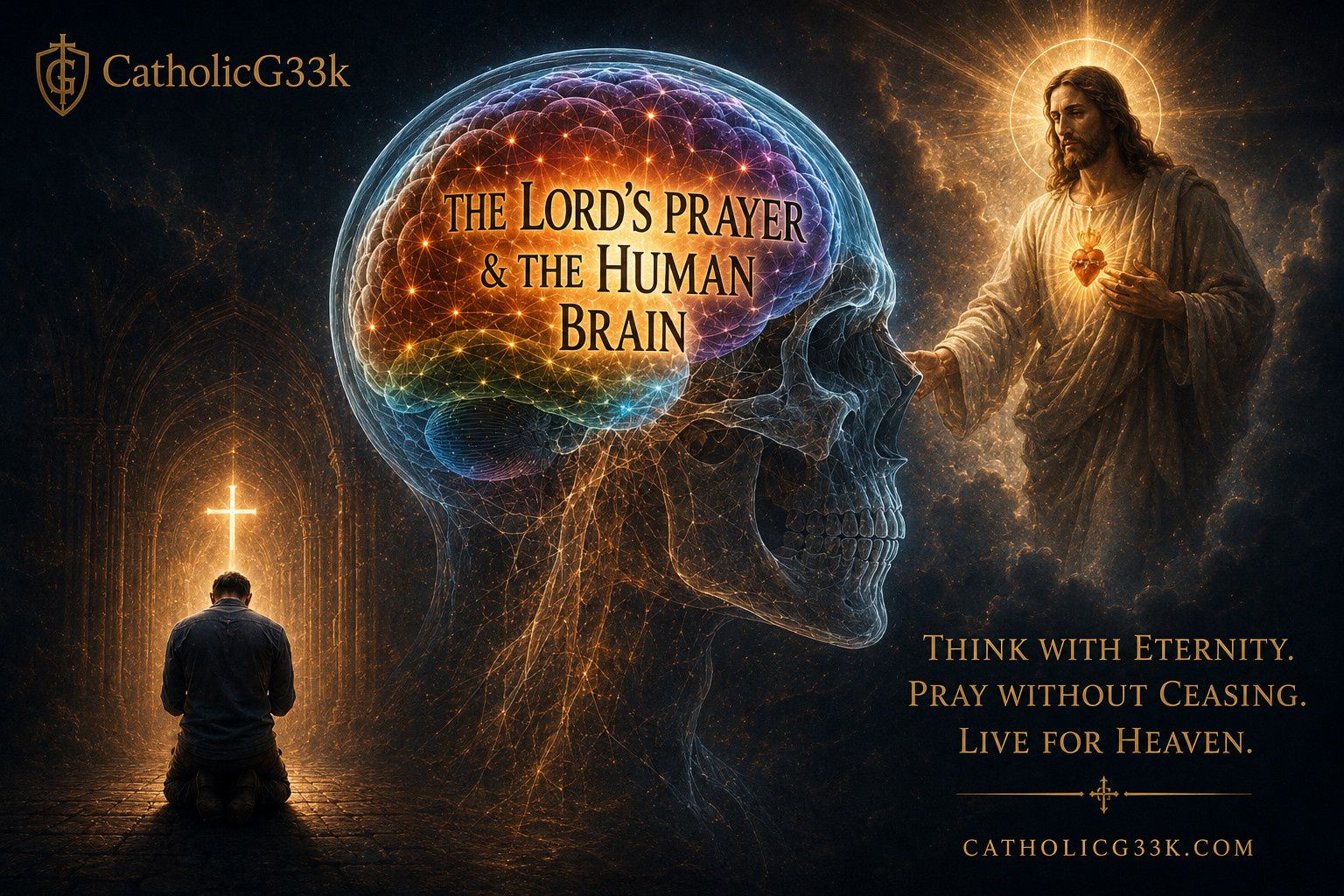
The Lord’s Prayer, Neuroscience, and Grace
A Catholic reflection on how the prayer taught by Christ forms the soul, renews the mind, and cultivates holy patterns of trust, hope, surrender, forgiveness, and perseverance.
I’ve been meditating on the Lord’s Prayer and have come to appreciate how deeply it speaks to both the soul and the human person as a whole.
As Catholics, we believe this prayer was given to us by Jesus Christ Himself — not as a psychological technique, but as a path into communion with the Father.
Yet because grace builds upon nature, it is not surprising that the spiritual dispositions cultivated by the Lord’s Prayer may also correspond to healthy patterns of thought, emotion, and behavior that neuroscience can observe.
Our Father, Who Art in Heaven
By addressing God as Father, we enter into a relationship of trust, belonging, and dependence. This can foster a sense of security rather than fear.
Neuroscientists have observed that experiences of trust, attachment, and loving connection often involve regions such as the medial prefrontal cortex and anterior cingulate cortex, areas associated with emotional regulation and social bonding.
Hallowed Be Thy Name
This petition turns our attention away from ourselves and toward the holiness and majesty of God.
Such God-centered focus may help quiet excessive self-referential thinking and rumination. Studies of contemplative prayer and meditation suggest that practices directing attention beyond oneself can reduce activity in aspects of the brain’s default mode network associated with repetitive self-focused thought.
Thy Kingdom Come
Here we place our hope not in temporary things but in God’s eternal reign.
Hope is a theological virtue, yet even on a natural level, hope encourages perseverance, purpose, and resilience. Hope and positive anticipation are associated with neural systems involved in motivation, reward, and goal-directed behavior.
Thy Will Be Done on Earth as It Is in Heaven
Surrendering to God’s will does not mean passivity; it means trusting Divine Providence.
Letting go of the illusion of total control can reduce anxiety and stress. Research suggests that acceptance, trust, and surrender may be associated with healthier emotional regulation and decreased activation of threat-related systems.
Trusting God is not abandoning responsibility. It is placing responsibility under Providence.
Give Us This Day Our Daily Bread
This petition teaches dependence on God for today’s needs rather than anxious preoccupation with tomorrow.
By grounding attention in the present moment and trusting God’s providence, we may reduce catastrophic thinking and unnecessary worry. Present-focused attention is linked to healthier emotional regulation and reduced stress responses.
Forgive Us Our Trespasses as We Forgive Those Who Trespass Against Us
Forgiveness lies at the heart of the Gospel.
Christ calls us not merely to receive mercy but to extend it to others. Psychological research has found that forgiveness is associated with reduced stress, lower levels of resentment, and greater emotional well-being.
Brain regions involved in empathy, perspective-taking, and social understanding are often engaged when people practice forgiveness and compassion.
Lead Us Not into Temptation
This petition acknowledges our weakness and dependence upon God’s grace.
It calls us to vigilance, self-discipline, and moral responsibility. Neuroscience associates self-control and resistance to unhealthy impulses with executive functions of the prefrontal cortex, which help us pause, evaluate choices, and act according to our higher goals.
But Deliver Us from Evil
The final petition reminds us that we do not face suffering, temptation, or evil alone.
God is our protector and strength. Trusting in His presence can foster courage, perseverance, and hope — qualities associated with greater emotional resilience and psychological well-being.
More Than Brain Science
The Lord’s Prayer is far more than a tool for mental health.
It is a prayer taught by Jesus Christ that forms the soul in faith, hope, charity, humility, forgiveness, trust, and perseverance.
While neuroscience may observe some of the natural effects that accompany these dispositions, the deepest transformation of the Lord’s Prayer is spiritual: it draws us into communion with God and conforms us to Christ.
The Lord’s Prayer does not merely change how we think — it helps transform who we become through the grace of God, one petition at a time.
“Be not solicitous therefore, saying: What shall we eat, or what shall we drink, or wherewith shall we be clothed? … For your Father knoweth that you have need of all these things.” — Matthew 6:31–32
“Be transformed by the renewing of your mind.” — Romans 12:2
The peace of Christ be upon you.
Grace Perfects Nature
These findings do not prove the supernatural effects of prayer or grace. Rather, they suggest that the dispositions cultivated by the Lord’s Prayer — trust, hope, surrender, forgiveness, self-control, and perseverance — correspond to patterns of human flourishing that neuroscience can observe at the natural level.
That distinction preserves both good science and good theology: grace is not reducible to brain activity, but grace ordinarily works through the human nature God created.
Gratia non tollit naturam, sed perficit — grace does not destroy nature, but perfects it.
As St. Thomas Aquinas taught, grace does not destroy nature, but perfects it.
Sources: Matthew 6:31–32; Romans 12:2; St. Thomas Aquinas, Summa Theologiae I, q. 1, a. 8 ad 2; Long et al., Progress in Neurobiology (2020); Feldman, Trends in Cognitive Sciences (2017); Garrison et al. (2015); Brewer et al., PNAS (2011); Taylor et al. (2012); Etkin, Büchel, and Gross, Nature Reviews Neuroscience (2015).