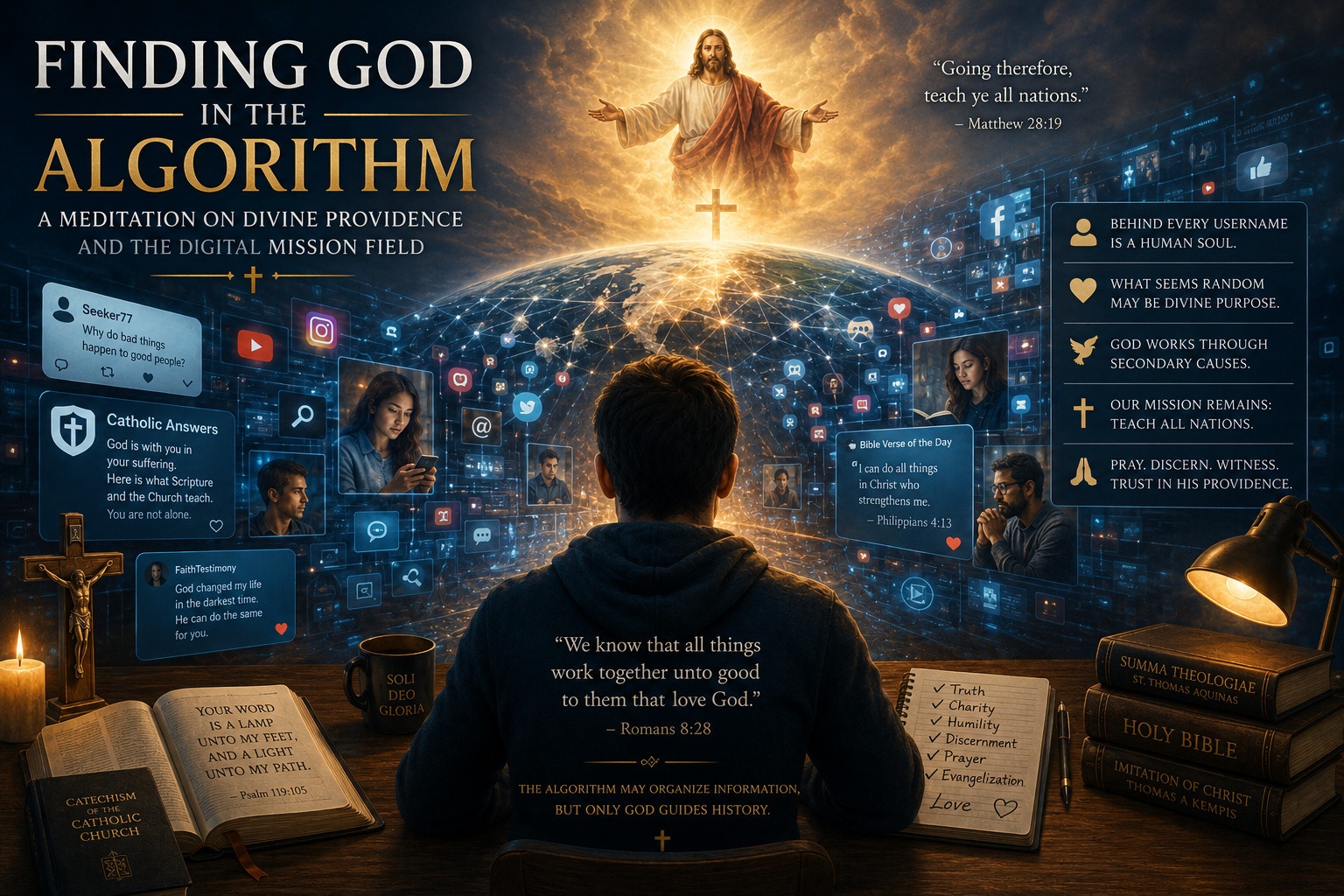
Finding God in the Algorithm
A meditation on divine providence and the digital mission field.
At first glance, the internet can seem like the very opposite of order. Endless scrolling, conflicting opinions, viral trends, distractions, misinformation, and noise fill our screens every day.
Algorithms appear to govern what we see, what we read, and even what captures our attention. It can feel chaotic, impersonal, and at times spiritually exhausting.
Yet faith teaches us something remarkable:
Nothing exists outside the providence of God.
The Catechism of the Catholic Church teaches that God guides all creation with wisdom and love toward its ultimate end. This does not mean that everything on the internet is good.
Sin, error, and vice certainly exist there, just as they exist in every corner of human society. But it does mean that God remains sovereign even amid human confusion.
The Lord who used Roman roads to spread the Gospel in the first centuries can also use fiber-optic cables and wireless networks today.
Behind Every Screen Is a Soul
When we think of an algorithm, we often imagine a cold mathematical process sorting information.
Yet behind every search, every post, every shared article, and every message stands a human soul made in the image of God.
Every username represents a person for whom Christ died.
Every comment thread contains immortal beings destined for eternal communion with God or eternal separation from Him.
This changes how we view the digital world.
Chance Clicks and Hidden Grace
What appears to be random may, in God’s providence, become an opportunity for grace.
A person searching for answers about suffering discovers a testimony of faith. Someone battling loneliness encounters a prayer group online. A skeptic stumbles upon an explanation of the Eucharist.
A fallen-away Catholic finds a video that awakens memories of childhood faith.
What seems like a chance click may become the first step in a journey back to God.
God Works Through Unexpected Means
Throughout Scripture, God repeatedly works through unexpected means.
Moses encountered God through a burning bush. Philip was sent to meet an Ethiopian traveler on a deserted road. St. Paul was guided by circumstances, opportunities, and encounters that appeared ordinary at the time but were instruments of divine direction.
God delights in using secondary causes to accomplish His purposes.
The internet is filled with secondary causes.
This should inspire both humility and hope.
Humility, because we may never know how God uses our witness. A simple message of encouragement, a shared Scripture verse, a thoughtful defense of the faith, or a charitable response to criticism may bear fruit years later in a soul we never meet.
Hope, because evangelization does not depend solely upon our skill. The Holy Spirit remains the principal agent of every conversion.
The Digital Mission Field
Christ’s command remains unchanged: “Going therefore, teach ye all nations.”
The nations today gather not only in cities and marketplaces but also in digital spaces.
Mission territory now includes comment sections, podcasts, social media feeds, discussion forums, and video platforms.
The Church’s mission has not changed; only some of the roads have.
An Examination of Conscience Online
This realization invites an examination of conscience.
Do we enter digital spaces as disciples of Jesus Christ?
Do our words reflect charity?
Do our posts reveal truth?
Do our interactions lead others closer to God or further away?
The internet often rewards outrage, pride, and self-promotion, but the Christian is called to witness through patience, kindness, and integrity.
Providence in Our Own Feeds
We should also remember that God’s providence extends to our own digital lives.
Perhaps the article we encountered today, the sermon that appeared in our feed, or the prayer that surfaced at the right moment was not merely coincidence.
Divine providence often works quietly, weaving together countless ordinary events to draw us toward holiness.
The Lord Remains Present
The next time you open a browser or scroll through a feed, pause for a moment.
Beneath the code, beyond the algorithms, and behind every screen is a world loved by God.
The internet may seem chaotic, but the Lord remains present.
He is still calling souls, still planting seeds of truth, and still transforming hearts.
The algorithm may organize information, but only God guides history.
And by His grace, even the vast digital wilderness can become a place of encounter, conversion, and evangelization.
Sources: Catechism of the Catholic Church §§302–314; Matthew 28:19–20; Acts 8:26–40; the Church’s teaching on divine providence and secondary causes.