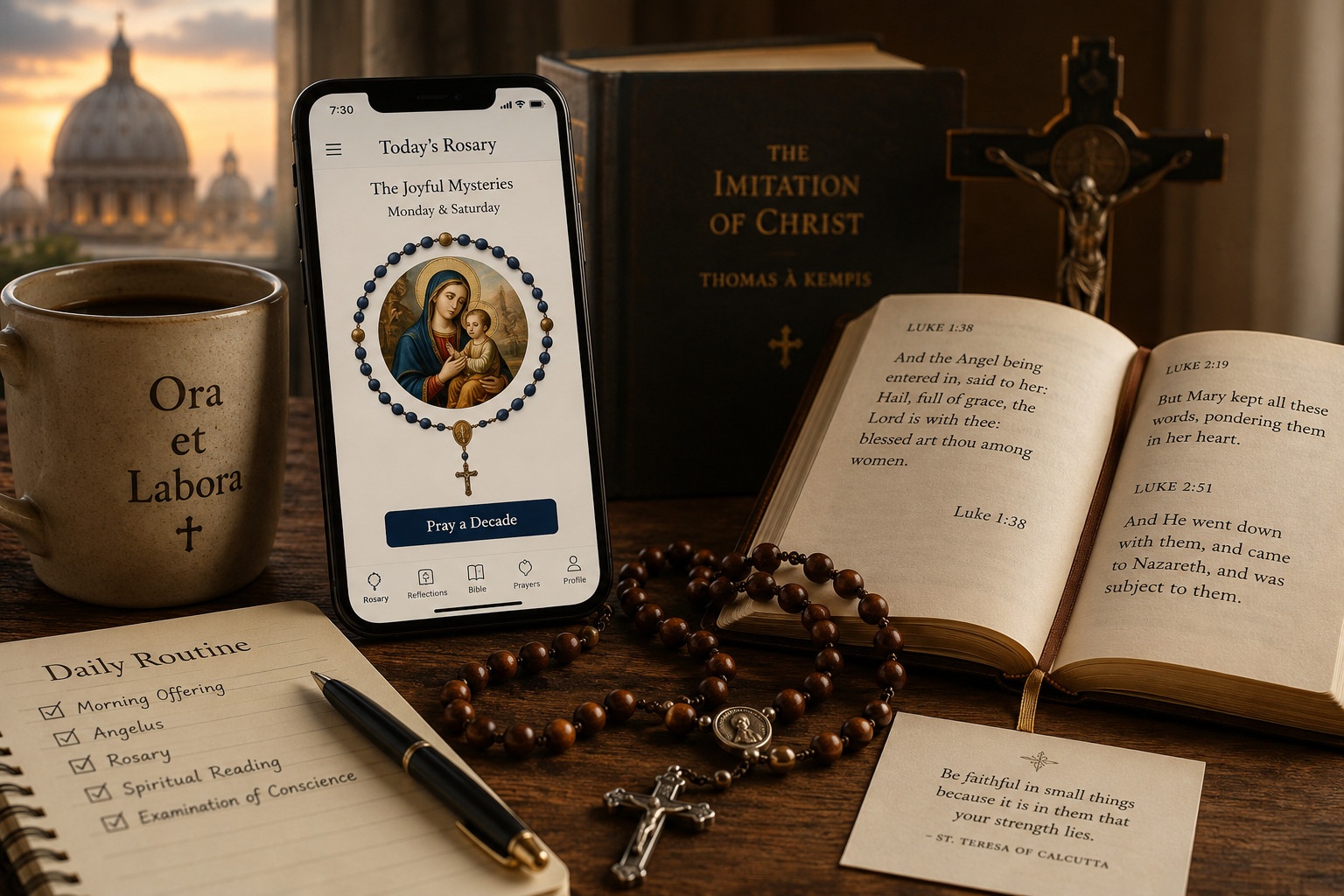
The Rosary & Routine: Building a Digital Prayer Life
How to integrate ancient prayer practices into your modern daily routine using technology.
For many Catholics, the challenge isn’t wanting to pray.
It’s remembering to pray.
Life moves quickly. Notifications arrive constantly. Emails pile up. Calendars fill. Before we know it, the day has slipped away, and prayer has been pushed to tomorrow.
Yet what if the very technology competing for our attention could become a tool that helps us return our attention to God?
The digital age presents a unique challenge, but it also presents a unique opportunity.
Sanctifying Time
For centuries, Catholics have developed rhythms of prayer that sanctify time. The Angelus marked the morning, noon, and evening. Church bells reminded entire communities to lift their hearts to God. Monasteries structured their days around prayer. Families gathered for the Rosary after dinner.
These practices were never merely about scheduling.
They were about remembering.
Remembering God’s presence. Remembering eternity. Remembering that every moment belongs to Him.
Today’s world may not be filled with church bells, but nearly everyone carries something else in their pocket: a smartphone.
And while phones often distract us, they can also become modern bells calling us back to prayer.
The key is intentionality.
Technology is a tool. It can either pull us away from God or help direct us toward Him. The difference lies in how we use it.
The Rosary as a Digital Discipline
Consider the Rosary.
For generations, Catholics have turned to this beautiful devotion to meditate on the mysteries of Christ through the eyes of His Blessed Mother. The Rosary requires no special equipment, no perfect environment, and no advanced theological training.
It only requires faith and perseverance.
Yet many people struggle to pray it consistently.
This is where technology can help.
A recurring reminder on your phone can become an invitation to pray a decade during lunch. An audio Rosary can accompany a morning commute. A digital calendar can reserve sacred time just as it reserves meetings and appointments. A prayer app can provide daily reflections on the mysteries.
The goal is not to replace prayer with technology.
The goal is to use technology to support prayer.
Think of it this way: a Rosary app is not the prayer. The prayer is your conversation with God. The app simply helps create the space for that encounter.
Content Is Not Communion
This distinction matters.
The danger of the digital age is not merely distraction. It is the illusion that consuming spiritual content is the same as spiritual growth.
Watching videos about prayer is not prayer.
Listening to discussions about holiness is not holiness.
Reading spiritual quotes is not the same as speaking with God.
These resources can be valuable, but they are meant to lead us into prayer, not replace it.
The Rosary teaches this lesson beautifully.
Its repetitive prayers slow us down. The rhythm of the Hail Marys creates space for contemplation. The mysteries invite us to step away from the endless stream of digital information and enter into the life of Christ.
In a culture obsessed with speed, the Rosary teaches patience.
In a culture obsessed with novelty, the Rosary teaches faithfulness.
In a culture obsessed with constant stimulation, the Rosary teaches silence.
Use Technology as a Servant
Perhaps that is one reason it remains so powerful.
Technology changes every year. The Gospel does not.
Apps come and go. The mysteries of Christ remain.
Devices become obsolete. Prayer endures.
This is why building a digital prayer life requires balance.
Use technology as a servant, not a master.
Allow reminders to prompt prayer, but do not become dependent upon them. Listen to spiritual content, but spend even more time speaking directly to God. Use digital tools to build habits, but remember that grace—not technology—is what transforms the soul.
Connect Prayer to Routine
One practical approach is to connect prayer with existing routines.
Pray a decade of the Rosary while making coffee.
Pray the Angelus when your lunch reminder appears.
Listen to Scripture during your commute.
End the day with an examination of conscience before setting your phone aside for the night.
Small habits become lasting habits.
Lasting habits become spiritual disciplines.
Spiritual disciplines become pathways to holiness.
Prayer Is Relationship
Most importantly, remember that prayer is not another task to complete on a checklist.
Prayer is a relationship.
The Rosary is not about finishing fifty-three Hail Marys.
It is about drawing closer to Jesus through Mary.
The purpose of every reminder, every calendar notification, every prayer app, and every digital tool should be to foster that relationship.
The saints sanctified time with the tools available to them.
We are called to do the same.
Closer to Christ
The digital world does not have to be a barrier to prayer. With wisdom and discipline, it can become a bridge.
So the next time your phone vibrates, consider pausing before opening another notification.
Instead of immediately scrolling, offer a prayer.
Instead of reaching for more noise, enter a moment of silence.
Instead of letting technology consume your attention, use it to direct your attention toward God.
The Rosary has guided Catholics for centuries.
And even in the digital age, its beads still lead where every Christian heart longs to go:
Closer to Christ.
Sources: St. Louis de Montfort, The Secret of the Rosary; Catechism of the Catholic Church §§2558–2565, 2700–2724; St. John Paul II, Rosarium Virginis Mariae (2002); Luke 2:19, 51; Luke 1:28–42.