

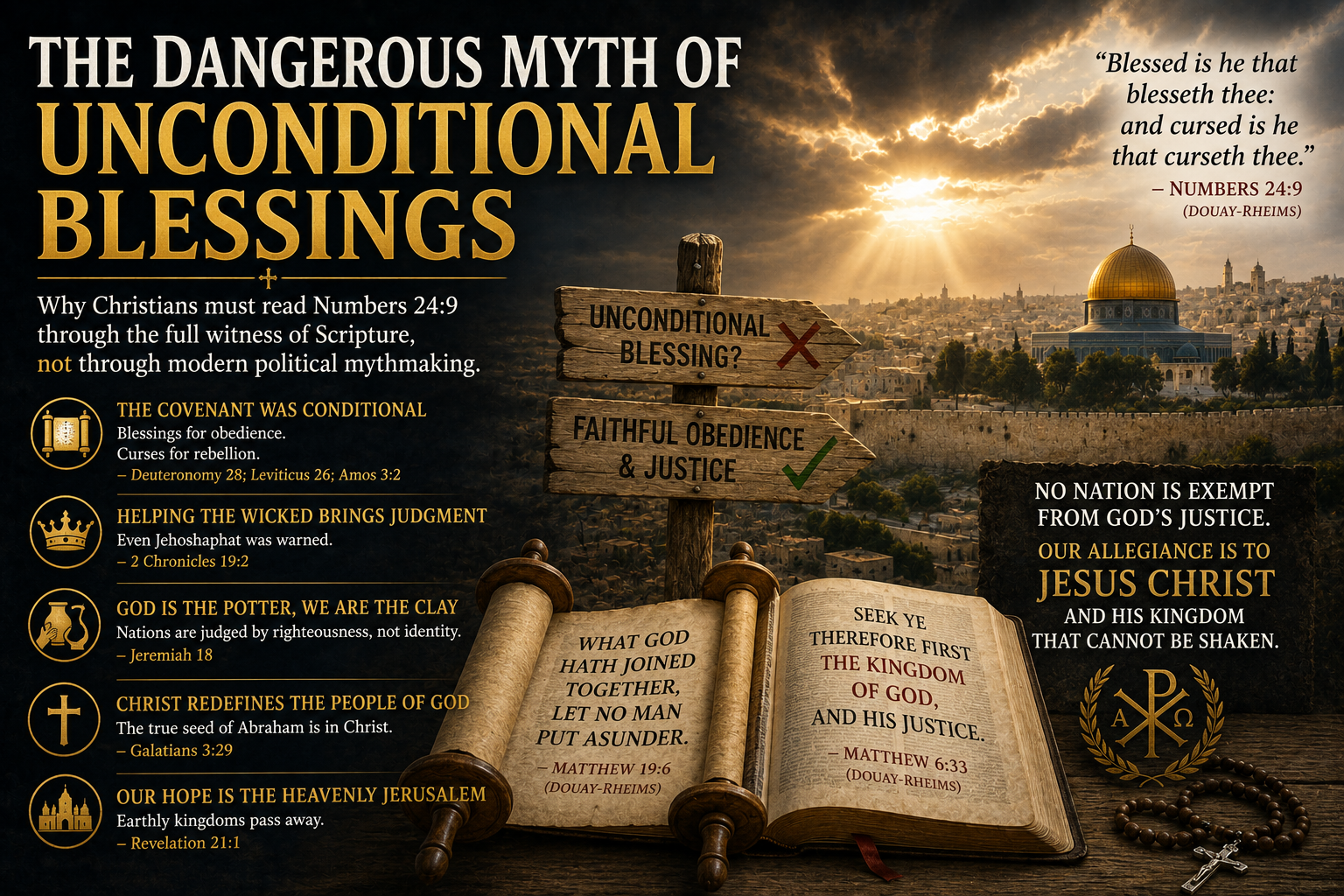
Why Christians must read Numbers 24:9 through the full witness of Scripture, not through modern political mythmaking.
“Blessed is he that blesseth thee: and cursed is he that curseth thee.”
A Verse That Shapes Modern Theology
A single line from the Oracle of Balaam has become one of the most frequently cited verses in modern geopolitical theology.
Many Christians use Numbers 24:9 as though it were an unconditional guarantee that support for the modern State of Israel always brings divine blessing, while criticism automatically brings divine judgment.
But Scripture is not that simplistic.
To isolate this verse from the rest of the biblical narrative is to ignore the deeply conditional nature of God’s covenant dealings with Israel.
The Covenant Was Not a Blank Check
The covenant at Sinai was never presented as automatic immunity.
It came with blessings for obedience and curses for rebellion.
In Leviticus 26 and Deuteronomy 28, God makes clear that covenant privilege brings covenant responsibility.
Israel’s election did not exempt her from judgment.
It intensified accountability.
“You only have I known of all the families of the earth: therefore will I visit upon you all your iniquities.”
To claim the blessings while ignoring the warnings is not biblical faithfulness.
It is selective reading.
The Danger of Helping the Wicked
The story of Jehoshaphat and Ahab reveals this danger clearly.
Jehoshaphat allied himself with Ahab, a wicked king of Israel. After barely escaping disaster, he was rebuked by the prophet Jehu:
“Thou helpest the ungodly, and thou art joined in friendship with them that hate the Lord, and therefore thou didst deserve indeed the wrath of the Lord.”
This matters.
If even an ancient king of Israel could be so wicked that helping him brought judgment, then no modern nation can claim unconditional moral immunity.
The Potter and the Clay
Jeremiah 18 dismantles the idea of unchangeable national destiny.
God compares nations to clay in the hands of a potter.
If a nation repents, God may show mercy.
If a nation turns to evil, God may withdraw blessings previously promised.
The point is clear:
God deals with nations morally, not mechanically.
No nation controls divine favor by identity, bloodline, borders, or political status.
Christ Redefines the People of God
Jesus radically reorients the meaning of covenant identity.
In Matthew 8, He praises the faith of a Roman centurion and warns that many from east and west will sit with Abraham, Isaac, and Jacob, while some “children of the kingdom” will be cast out.
Saint Paul makes this even clearer:
“And if you be Christ’s, then are you the seed of Abraham, heirs according to the promise.”
The true inheritance is fulfilled in Christ.
The blessing of Abraham comes through union with Him, not through political nationalism.
The Earthly City and the Heavenly Jerusalem
Saint Paul contrasts the earthly Jerusalem with the Jerusalem above:
“But that Jerusalem, which is above, is free: which is our mother.”
This does not give Christians permission to hate or despise Jewish people. The Church rejects all hatred and antisemitism.
But it does mean Christians must not confuse the Kingdom of God with any earthly nation-state.
The Church’s hope is not founded on borders, military power, or geopolitical alliances.
Our hope is in Christ.
Christian Nationalism and Selective Scripture
Christian nationalism often wants the blessings of the Old Covenant without the moral demands of the Old Covenant.
It wants divine favor without repentance.
Identity without holiness.
Political power without the Cross.
But Scripture does not allow this.
Every nation is judged according to justice, mercy, truth, and fidelity to God.
No nation is above moral judgment.
The Kingdom That Cannot Fall
The Book of Revelation does not end with the triumph of an earthly empire.
It ends with the New Jerusalem coming down from heaven:
“And I saw a new heaven and a new earth. For the first heaven and the first earth was gone.”
The final hope of Christians is not any earthly political order.
It is the Kingdom of God.
All earthly kingdoms pass away.
Christ’s Kingdom alone endures forever.
Final Thoughts
Numbers 24:9 must be read within the full witness of Sacred Scripture.
God’s blessing is never detached from justice.
God’s covenant is never a license for impunity.
God’s people must never confuse earthly power with heavenly promise.
Our allegiance belongs first and finally to Jesus Christ.
May we resist every false gospel of national exceptionalism and place our hope in the Kingdom that cannot be shaken.
“Seek ye therefore first the kingdom of God, and his justice.”
Sources
Sacred Scripture (Douay-Rheims):
- Numbers 24:9
- Leviticus 26
- Deuteronomy 28
- Amos 3:2
- 2 Chronicles 18–19
- Jeremiah 18
- Matthew 6:33
- Matthew 8:5–13
- Matthew 21:33–46
- Galatians 3:29
- Galatians 4:21–31
- Revelation 21
Catechism of the Catholic Church:
- §§781–786 — The People of God
- §§839–840 — The Church and the Jewish People
- §§2104–2109 — Social duty toward true religion
- §§2302–2306 — Peace and justice