

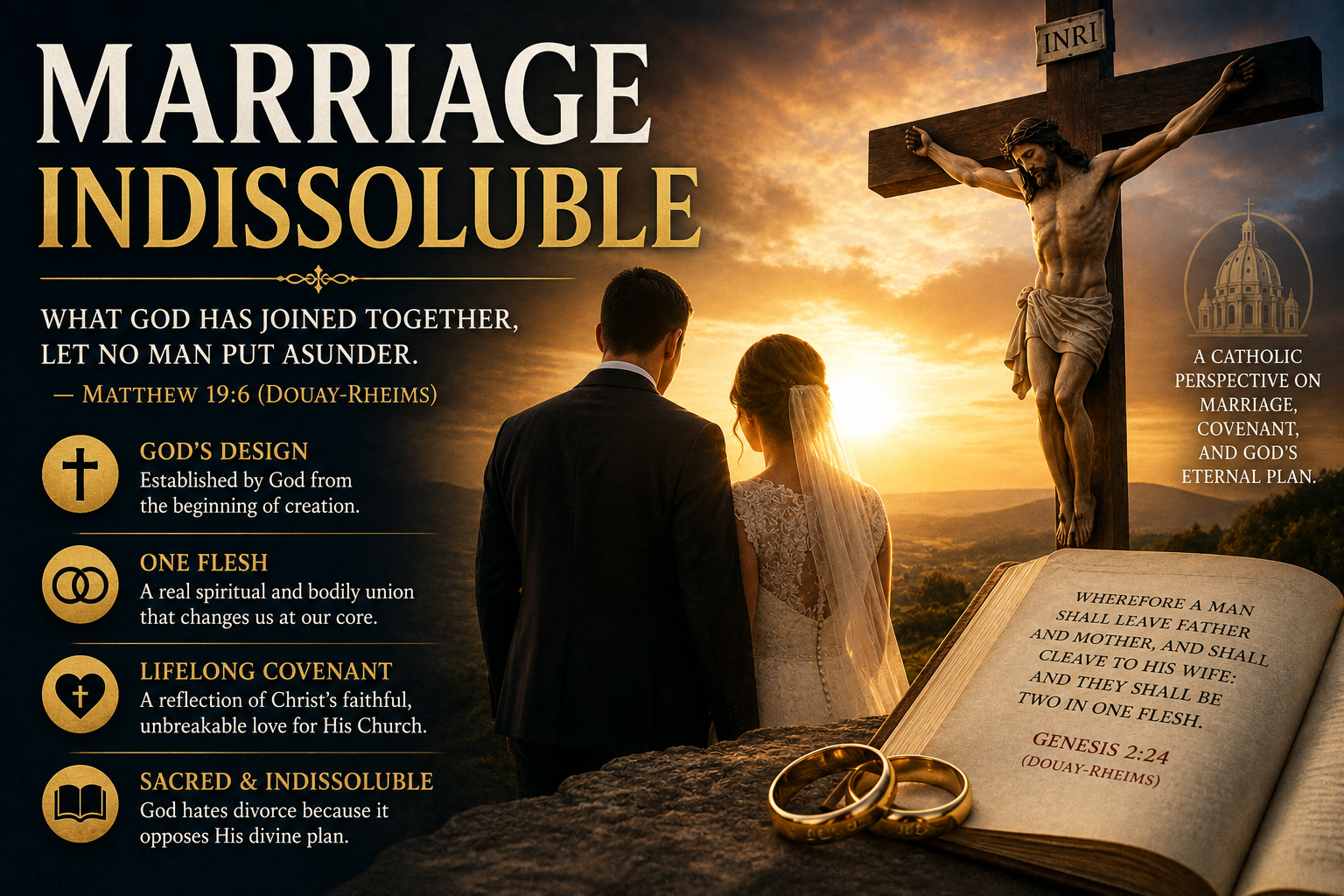
Marriage is not merely a contract—it is a sacred covenant established by God. Discover why Sacred Scripture and the Catholic Church teach that a valid sacramental marriage cannot be dissolved by any human authority.
“What therefore God hath joined together, let no man put asunder.”
Marriage Is God’s Design
What if divorce isn’t simply a painful legal process, but an act fundamentally opposed to God’s design for creation?
This is not about condemning those who have experienced the pain of divorce. Rather, it is about understanding the profound reality of Christian marriage.
Modern society often views marriage as a legal contract, a social arrangement, or even a lifestyle choice. But Sacred Scripture and the Catholic Church teach something far greater.
Marriage is a divine institution, established by God from the beginning of creation.
It is ordered toward:
- Unity
- Fidelity
- Permanence
These are not merely ideals—they are essential properties of marriage itself.
The One Flesh Union
The Book of Genesis tells us:
“Wherefore a man shall leave father and mother, and shall cleave to his wife: and they shall be two in one flesh.”
This is more than poetic language.
Marriage creates a real spiritual and bodily union.
Husband and wife become one flesh—a profound reality established by God Himself.
Jesus reaffirmed this truth when He declared:
“What therefore God hath joined together, let no man put asunder.”
Notice who joins the spouses together.
Not the priest.
Not the government.
Not society.
God Himself.
Because God is the author of marriage, no merely human authority possesses the power to dissolve a valid sacramental marriage.
Christ Restores God’s Original Plan
When questioned about divorce, Jesus did not relax God’s teaching.
Instead, He restored marriage to its original dignity.
“Whosoever shall put away his wife, and marry another, committeth adultery against her.”
The disciples knew that Moses had permitted divorce under the Old Law.
Christ explained why.
“Because of the hardness of your heart Moses permitted you to put away your wives: but from the beginning it was not so.”
Divorce was never part of God’s original design.
It was a concession made because of human sinfulness—not an expression of God’s perfect will.
Jesus restores marriage to what it was always meant to be: a lifelong covenant.
The Church Has Always Taught Marriage Is Indissoluble
For over two thousand years, the Catholic Church has faithfully preserved Christ’s teaching.
The Catechism states:
“The matrimonial union of man and woman is indissoluble: God himself has determined it.”
— Catechism of the Catholic Church, §1614
Likewise:
“Divorce is a grave offense against the natural law.”
— Catechism of the Catholic Church, §2384
Marriage is not simply a legal contract.
It is a covenant.
A contract can be dissolved.
A covenant reflects God’s own faithful and everlasting love.
Why Does God Hate Divorce?
The prophet Malachi records these sobering words:
“The Lord… hateth putting away.”
Why such strong language?
Because marriage reflects God’s covenant with His people.
Saint Paul writes:
“Husbands, love your wives, as Christ also loved the church, and delivered himself up for it.”
Christ never abandons His Church.
His love remains faithful even when His people fail.
Christian marriage is meant to mirror that same unwavering fidelity.
Divorce therefore wounds not only a family—it obscures the image of God’s faithful love.
Marriage Vows Are Sacred
Marriage vows are not casual promises.
They are sacred vows made before Almighty God.
Scripture warns:
“If thou hast vowed any thing to God, defer not to pay it.”
When spouses exchange vows, they promise:
- Lifelong fidelity
- Permanent union
- Total self-giving
These promises are not temporary commitments based upon feelings.
They are sacred covenants intended to endure until death.
Separation Is Not the Same as Divorce
The Church recognizes that in situations involving abuse, grave danger, or serious harm, spouses may need to separate.
The Catechism teaches:
Civil divorce may be tolerated when it is the only possible way to secure legal rights, protect children, or safeguard necessary interests.
— Catechism of the Catholic Church, §2383
However, separation does not dissolve the sacramental bond.
A valid marriage remains valid until the death of one spouse unless the Church determines through a decree of nullity that no valid marriage existed from the beginning.
This distinction is essential.
The Church seeks both justice and compassion while remaining faithful to Christ’s teaching.
Grace Makes Marriage Possible
Marriage is difficult because authentic love requires sacrifice.
No husband or wife can live this vocation by human strength alone.
God provides grace.
Saint Paul records Christ’s promise:
“My grace is sufficient for thee.”
The Sacrament of Matrimony gives spouses supernatural grace to remain faithful, forgive generously, and persevere through trials.
Marriage is not sustained merely by emotion.
It is sustained by God’s grace.
Marriage Is a Covenant, Not a Contract
Marriage is not:
- Disposable
- Conditional
- Temporary
It is a lifelong covenant established by God.
In a culture that often treats relationships as temporary, Christian marriage stands as a witness to God’s faithful and enduring love.
Its permanence is not oppression.
It is freedom rooted in unconditional love.
Final Thoughts
Divorce attempts to separate what God has joined together.
Marriage reflects the faithful, permanent covenant between Christ and His Church.
This is why the Church continues to proclaim the indissolubility of marriage—not as an arbitrary rule, but as a beautiful truth rooted in God’s own love.
May every Christian marriage become a living witness to the faithful, sacrificial, and everlasting love of Jesus Christ.
“What therefore God hath joined together, let no man put asunder.”
Sources
Sacred Scripture (Douay-Rheims):
- Genesis 2:24
- Ecclesiastes 5:4
- Malachi 2:16
- Matthew 19:3–9
- Mark 10:2–12
- Ephesians 5:25–32
- 2 Corinthians 12:9
Catechism of the Catholic Church:
- §§1601–1666 (The Sacrament of Matrimony)
- §1614
- §§1644–1651
- §2383
- §2384
Leave a Reply