

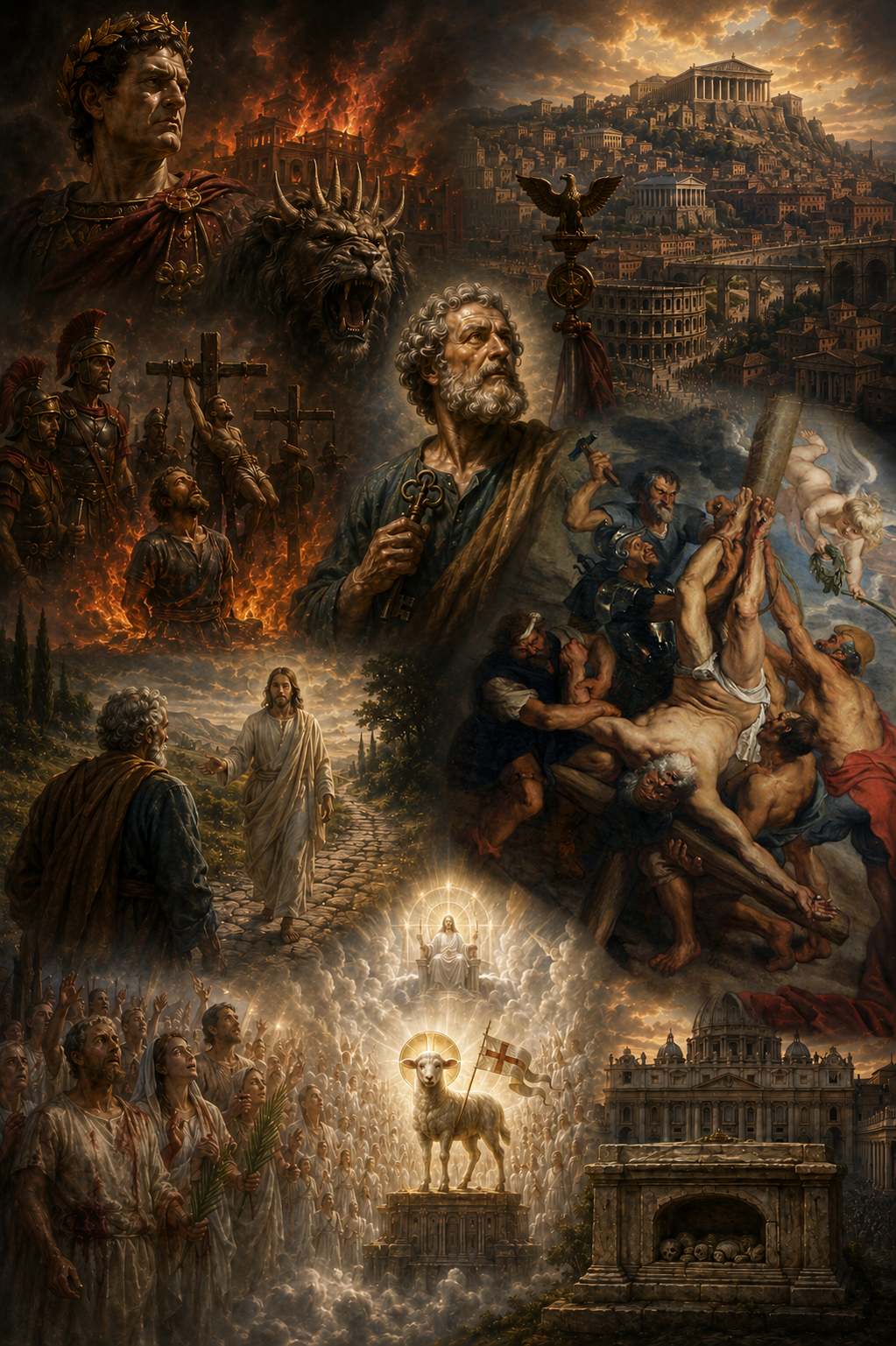
A Meditation on Empire, Martyrdom, and the Victory of the Lamb
When the Book of Revelation is read carefully—not as a codebook for modern anxieties, but as a first-century Christian text written for suffering believers—its world comes sharply into focus.
This is not a book written in abstraction.
It is written in blood and fire, beneath the shadow of imperial power.
From the beginning, the Church has understood Revelation as apocalyptic prophecy: a form of writing that unveils spiritual realities through symbols. Its purpose is not to confuse but to reveal; not to obscure truth, but to communicate it in a way that could endure persecution.
St. John is writing to Christians living under the crushing weight of Rome. And Rome, at that moment in history, had a face.
Nero and the Beast
Revelation speaks of a Beast who wages war against the saints, demands loyalty and worship, rules through terror, and persecutes the faithful.
The Beast bears a number:
“Let him that hath understanding count the number of the beast. For it is the number of a man: and the number of him is six hundred sixty-six.”
—Revelation 13:18
To John’s original audience, this would not have seemed mysterious.
In the ancient world, Hebrew and Aramaic letters carried numerical values—a practice known as gematria. When the name Nero Caesar is written in Hebrew letters, the numerical value totals six hundred and sixty-six. This is not a modern invention but an ancient observation recognized by many scholars.
Nero was the first Roman emperor to unleash a systematic persecution of Christians. Following the Great Fire of Rome in AD 64, he blamed the Christian community and unleashed a campaign of brutality intended not merely to punish, but to terrify. Christians were crucified, burned alive, and used as human torches to illuminate imperial gardens.
John’s readers needed little explanation. They knew exactly whom the imagery evoked.
Yet Revelation is not merely about one man. Nero is a type—a visible manifestation of something deeper: political power that exalts itself against God and demands what belongs to God alone. The Beast is Nero, but it is also more than Nero. It is every empire, ruler, or system that seeks divine honors while opposing the Kingdom of God.
Babylon: The Name Rome Earned
This brings us to Babylon.
In the Old Testament, Babylon is never merely a city. It becomes the symbol of pride raised against God, empire built upon domination, and power intoxicated by violence.
By the first century, Jews and Christians had already begun using “Babylon” as a symbolic name for Rome. This is why St. Peter can write:
“The church that is in Babylon, elected together with you, saluteth you.”
—1 Peter 5:13
Peter is not writing from ancient Mesopotamia. The historic city of Babylon had long since lost its former glory.
He is writing from Rome—the new Babylon—the center of imperial power, idolatry, and persecution.
This was not secrecy for its own sake. It was wisdom. To name Rome directly could be dangerous; to identify it symbolically was both prudent and faithful.
St. John does the same.
In Revelation, Babylon is described as a great city ruling over the kings of the earth, seated upon seven hills, and drunk with the blood of the saints. The ancient world knew only one city universally associated with seven hills.
Rome.
Babylon is not the Church.
Babylon is the power that persecutes the Church.
Peter Goes to Rome
After the descent of the Holy Ghost at Pentecost, Peter emerged as the leading figure among the Apostles. Filled with divine courage, he preached Christ crucified and risen, healed the sick, confronted authorities, and endured imprisonment for the sake of the Gospel.
As Christianity spread beyond Judea, ancient tradition records that Peter eventually journeyed westward to Rome, the capital of the empire.
This was no ordinary city. Rome was hostile to the Gospel, yet strategically positioned at the center of the known world. From Rome, the message of Christ could radiate outward to the nations.
The testimony of the early Church is remarkably consistent. St. Clement of Rome speaks of Peter’s martyrdom. St. Ignatius of Antioch describes the Roman Church as presiding in charity. St. Irenaeus teaches that the Church of Rome was founded and organized by Peter and Paul and possesses a unique apostolic authority recognized throughout the Christian world.
Peter came to Rome not as a conqueror, but as a shepherd prepared to lay down his life for the flock entrusted to him.
The Shepherd and the Beast
Here Peter’s story becomes inseparable from the message of Revelation.
Peter does not keep a safe distance from empire.
He walks directly into its heart.
He shepherds the Church in Rome during Nero’s reign—during the reign of the Beast. He writes from Babylon. He warns from Babylon. And ultimately, he dies in Babylon.
Long before this, Christ had foretold Peter’s end:
“Amen, amen I say to thee, when thou wast younger, thou didst gird thyself, and didst walk where thou wouldst. But when thou shalt be old, thou shalt stretch forth thy hands, and another shall gird thee, and lead thee whither thou wouldst not.”
—John 21:18
The early Church never doubted the meaning of these words. Peter would die by crucifixion.
Ancient tradition further records that Peter requested to be crucified upside down. Not from theatrical piety, but from humility. The Apostle who had once denied Christ did not consider himself worthy to die in precisely the same manner as his Lord.
Peter did not conquer Rome.
He sanctified it with his blood.
Domine, Quo Vadis?
During Nero’s persecution, Peter was urged to leave Rome for his own safety and for the good of the Church.
According to ancient Christian tradition, as he departed along the Appian Way, he encountered the risen Christ.
Peter asked:
Domine, quo vadis?
“Lord, where are You going?”
Christ replied:
“I am going to Rome to be crucified again.”
Peter immediately understood.
Christ continues to suffer in His Mystical Body, the Church. To abandon the flock would be to abandon Christ.
So Peter turned around.
The shepherd returned to Babylon.
The Victory of the Lamb
This is why Revelation matters.
Babylon kills Peter.
Babylon kills Paul.
Babylon kills countless saints.
And Revelation proclaims that Babylon will fall.
The book is not primarily one of accusation but of assurance. It tells believers that the Beast is real, persecution will come, empire will demand worship, and martyrdom may be costly.
But it also declares that the Beast is temporary.
Babylon is judged.
The martyrs are victorious.
The Lamb reigns.
The Church is not the harlot of Revelation.
She is the Bride.
Clothed in white.
Purified by the blood of Christ.
Rome called itself eternal.
Revelation says it is not.
Rome called itself savior.
Revelation says the Lamb is Savior.
Rome demanded worship.
Revelation commands:
“Adore ye God.”
—Revelation 19:10
And in the end, the empire that crucified Peter fell, while the Church he shepherded continues to proclaim Jesus Christ to the nations.
Final Witness
Peter was buried on Vatican Hill.
Above his tomb now stands St. Peter’s Basilica.
Babylon always falls.
The Lamb always reigns.
And Peter’s bones beneath Rome remain a silent testimony:
The shepherd did not flee.
The Beast did not win.
And the Kingdom of God outlasted the empire that sought to destroy it.
Leave a Reply