

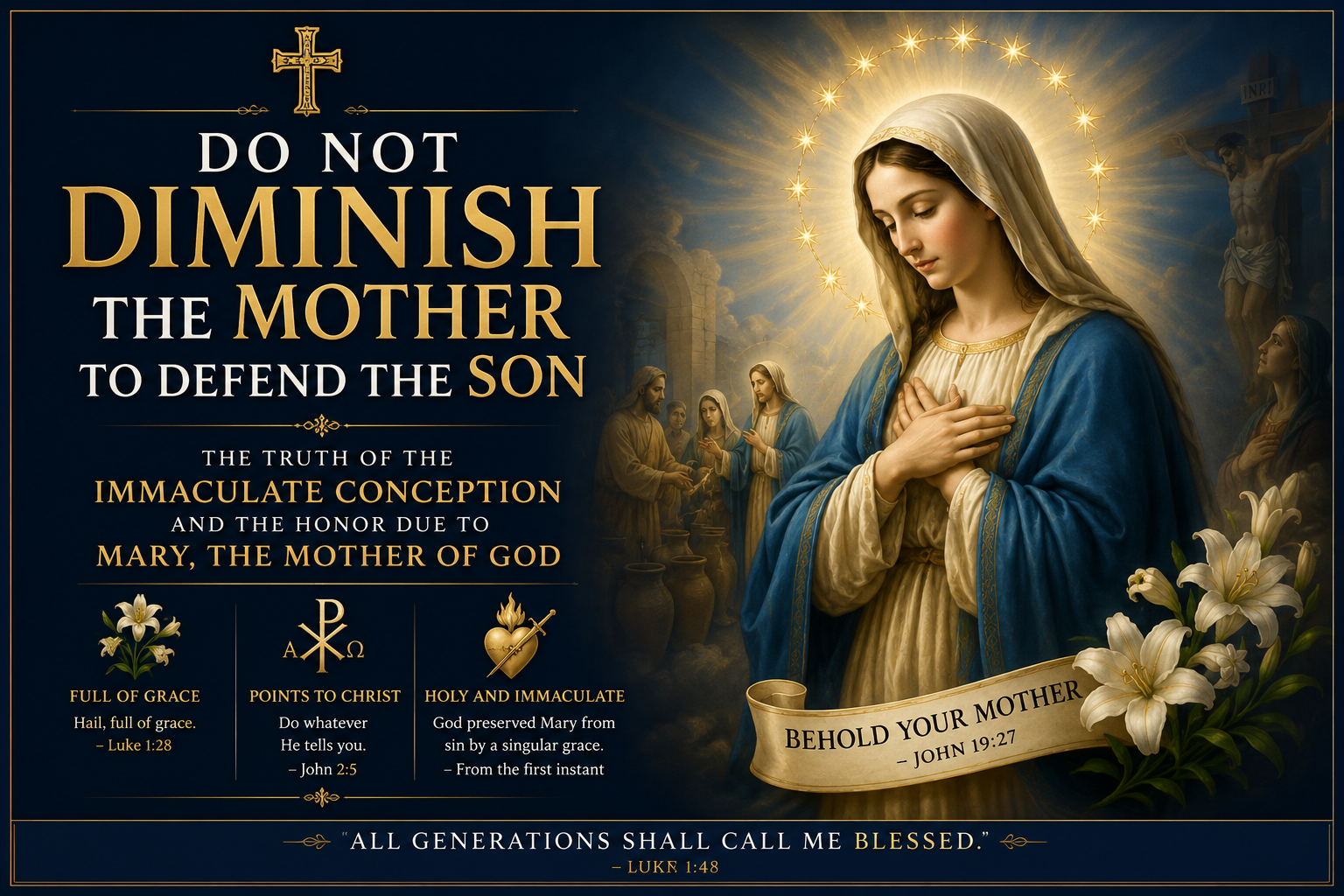
—The Truth of the Immaculate Conception and the Honor Due to Mary, the Mother of God
Friends in Christ,
There is a certain error a tragic, recurring one that echoes through the centuries. It claims to exalt Christ by diminishing His Mother. It says, “Mary was a godly woman, yes, but not without sin. She was ordinary, like the rest of us. To call her immaculate is to rob Christ of His glory.”
My friend, this is not fidelity to Scripture; this is a failure to understand the Incarnation.
When you tear down the Mother, you do not raise up the Son. You tear down the mystery of grace itself.
The Root of the Error: Misreading the Word of God
We often hear Romans 3:23“All have sinned and fall short of the glory of God.”
Yes, all who can sin, have sinned. But is this an absolute statement without exception?
If so, then Jesus Christ Himself would be included. Clearly, He is not. Nor are infants, nor those incapable of moral choice.
Saint Paul is teaching about the universality of original sin, not denying that God may, in His providence, preserve someone from it by a singular grace. And that is exactly what He did for Mary.
From the first instant of her conception, the grace of Christ — yes, the grace of her Savior — flowed backward through time and preserved her from the stain that infects us all.
God can save in two ways: by pulling us from the pit, or by keeping us from falling into it.
Mary was saved by prevention, not by cure — and that makes her the first and most perfect fruit of redemption.
“My Spirit Rejoices in God My Savior” — Luke 1:47
Some claim this verse disproves her sinlessness. They say, “If she needed a Savior, then she must have sinned.”
But that logic is shallow.
Is a doctor’s skill any less marvelous if he prevents disease rather than cures it?
Christ’s saving power is even more magnificent in Mary, because He saved her before sin ever touched her soul.
When the Archangel Gabriel greets her, he doesn’t say, “Hail, Mary, you are a decent woman.”
He says, “Hail, full of grace.” (Luke 1:28)
In Greek, κεχαριτωμένη — a perfect participle meaning “you who have been and remain completely graced.”
Full of grace. Not partly. Not temporarily. But full.
And where grace abounds fully, sin has no dwelling place.
The Misunderstood “Rebuke” at Cana
“Woman, what is that to me and to thee?” (John 2:4) — some claim this proves Jesus was correcting His mother.
Far from it.
This is not a rebuke — it is revelation.
“Woman” is the same title Christ uses from the Cross: “Woman, behold thy son.” (John 19:26)
In that title, He reveals her as the New Eve, the mother of all who live in grace.
And notice this: after her request, Jesus performs His first miracle.
Her intercession does not fail; it unlocks His public ministry.
If that’s a rebuke, it’s the strangest one in history — one that ends in water turned to wine and the glory of God revealed.
The Fittingness of Her Purity
It was fitting — supremely fitting — that the vessel chosen to bear God Himself be pure, spotless, and wholly dedicated to His purpose.
If the Old Ark of the Covenant was made of the finest acacia wood, overlaid with pure gold, and set apart for the presence of God’s Word written on stone, how much more fitting that the New Ark — who would carry the Word made flesh — be —wholly holy?
Would the Lord of heaven dwell nine months in a vessel still stained by sin?
No, friends — the holiness of Christ does not need Mary’s sinlessness, but His holiness demands it.
It is not that she purified Him; rather, He sanctified her from the very beginning.
The Church’s Consistent Witness
Long before 1854, when the dogma of the Immaculate Conception was solemnly defined, the Church Fathers proclaimed this truth.
Saint Ephrem called her “all holy.”
Saint Ambrose wrote, “Mary, a virgin not only undefiled but a virgin whom grace has made inviolate, free from every stain of sin.”
And even Saint Augustine, fierce against Pelagian pride, said:
“When sin is treated, I wish no question to be raised concerning the Holy Virgin Mary. Out of respect for the Lord, I wish that issue to be excluded entirely.”
(De Natura et Gratia, 36)
This is not a medieval invention. This is the ancient faith of the Church — the faith of the saints, the faith of heaven.
The True Christocentric Meaning
To honor Mary is not to rival Christ.
Every glory she possesses is derivative, every grace she has is received.
She magnifies the Lord — she does not eclipse Him.
When you look at the moon on a clear night, you do not accuse it of stealing the light of the sun. You marvel at the reflection.
So it is with Mary.
Her light is Christ’s light, refracted through the prism of her perfect love.
“Do Whatever He Tells You”
At Cana, Mary says the last recorded words of hers in Scripture:
“Do whatever He tells you.” (John 2:5)
That is her mission in every age — to lead us unfailingly to her Son.
To belittle her, then, is not piety. It is blindness.
To honor her is not idolatry. It is obedience to Scripture itself, which calls her blessed among women and promises that all generations shall call her blessed (Luke 1:42, 48).
So let us not fear to love the Mother whom our Lord loved so perfectly.
Let us not imagine that the Infinite God is jealous of the creature He Himself adorned with grace.
And let us pray, with confidence and tenderness:
O Mary, conceived without sin, pray for us who have recourse to thee.
Leave a Reply